Zero-sum social identity, not zero-sum economic beliefs, explain voting preference in 2024 U.S. presidential election
Authors
Affiliation
Aashia Khan
Binghamton University
Zihan Hei
Binghamton University
Jeff John
Binghamton University
Shane McCarty
Binghamton University
Abstract
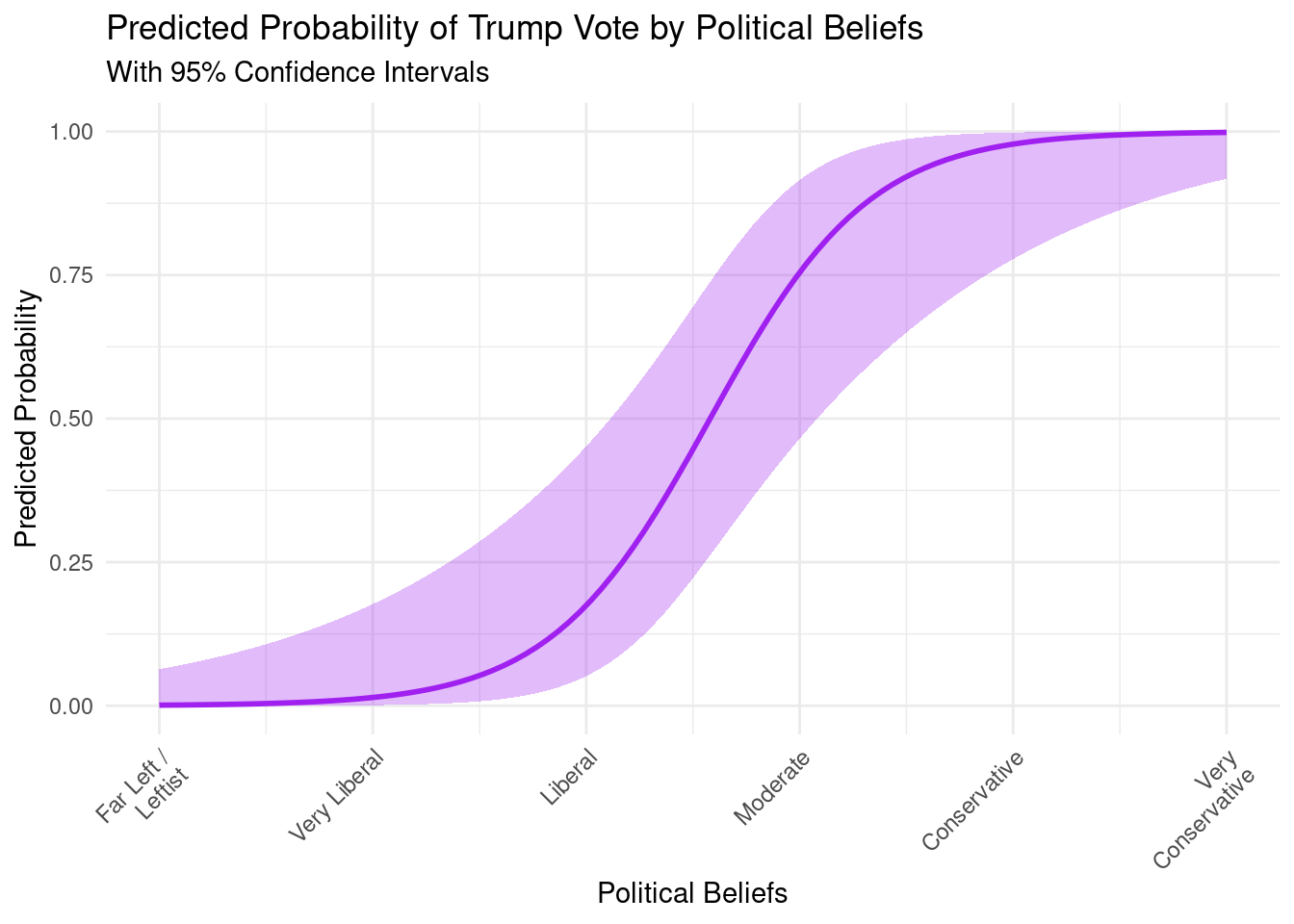
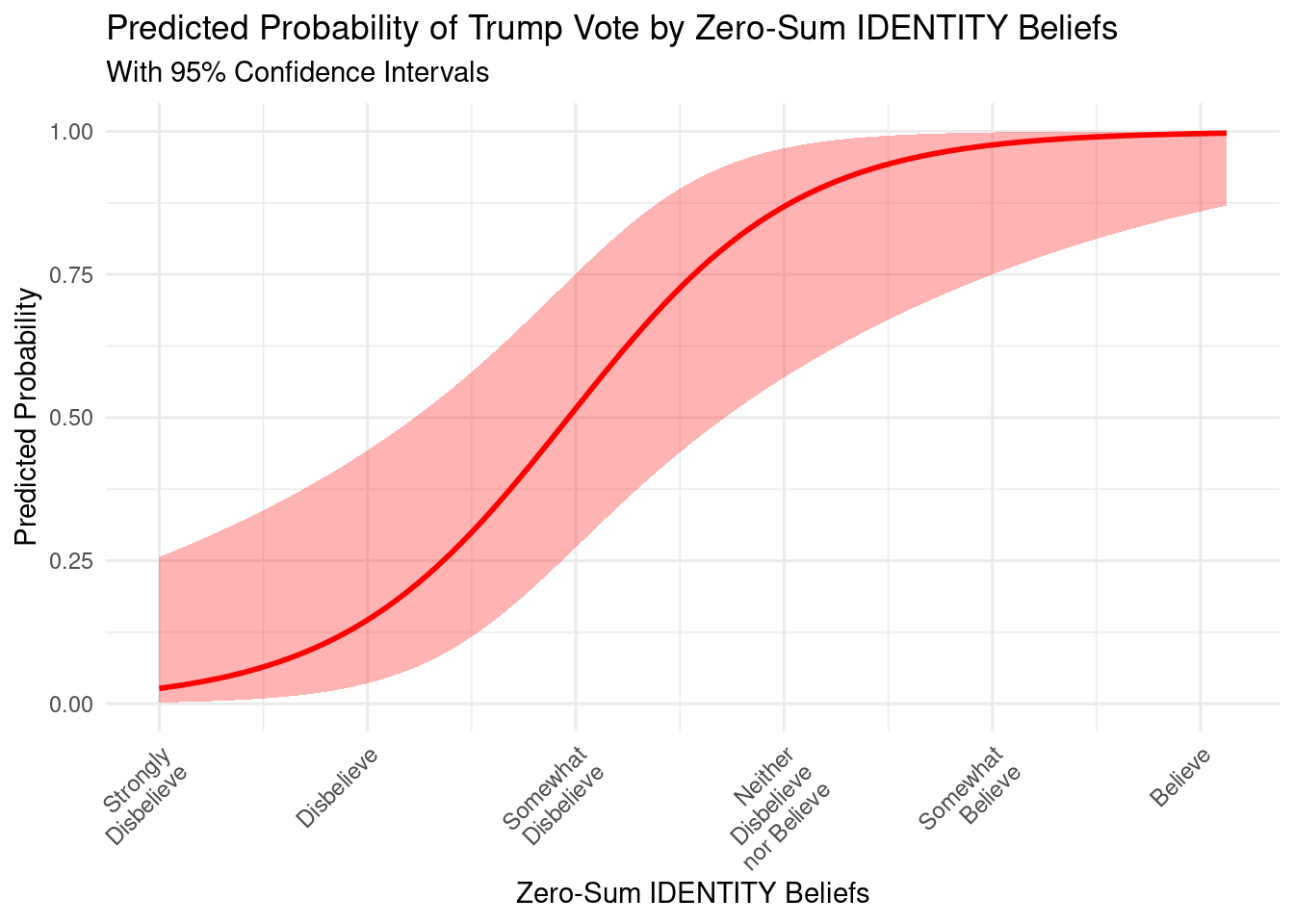
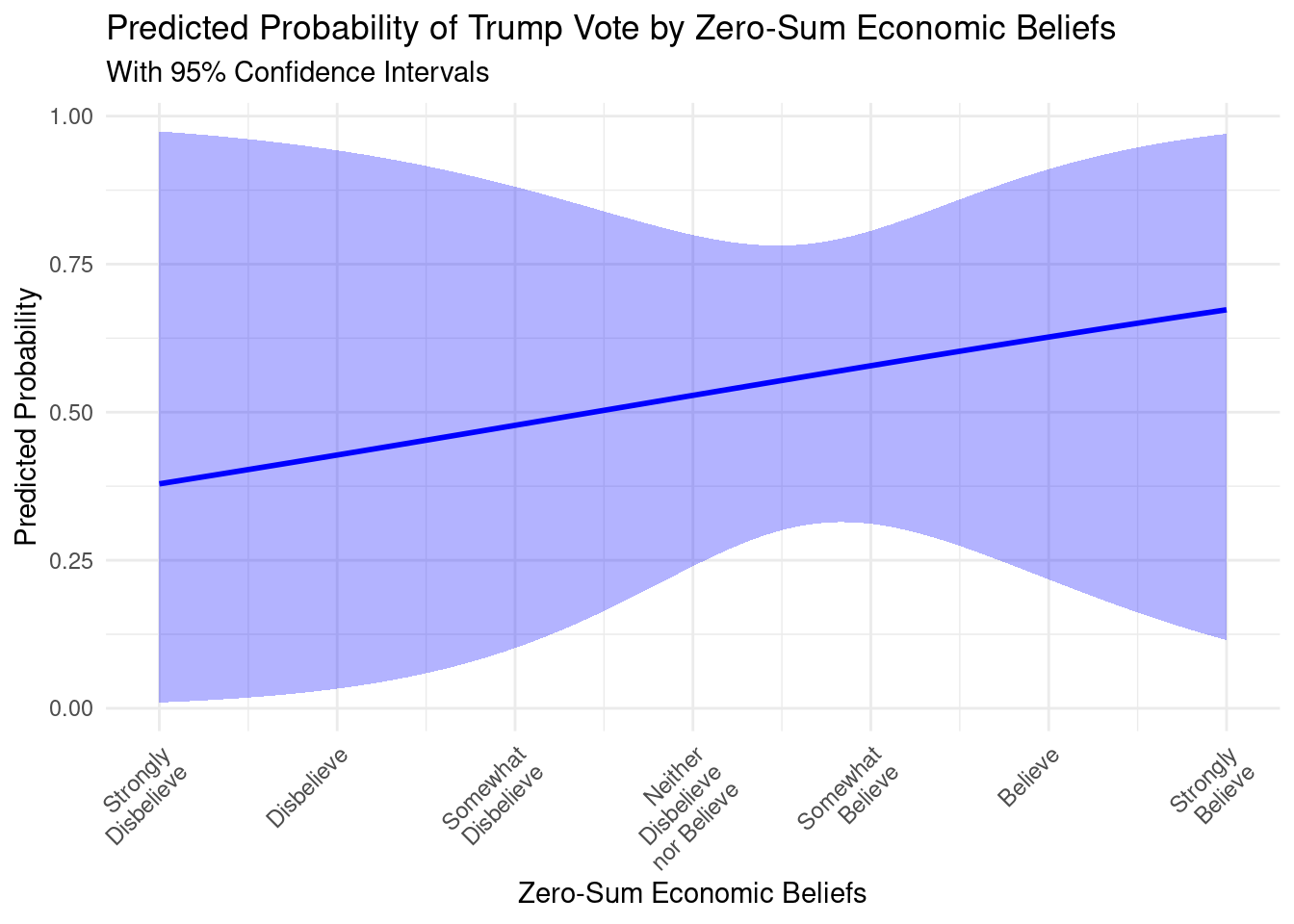
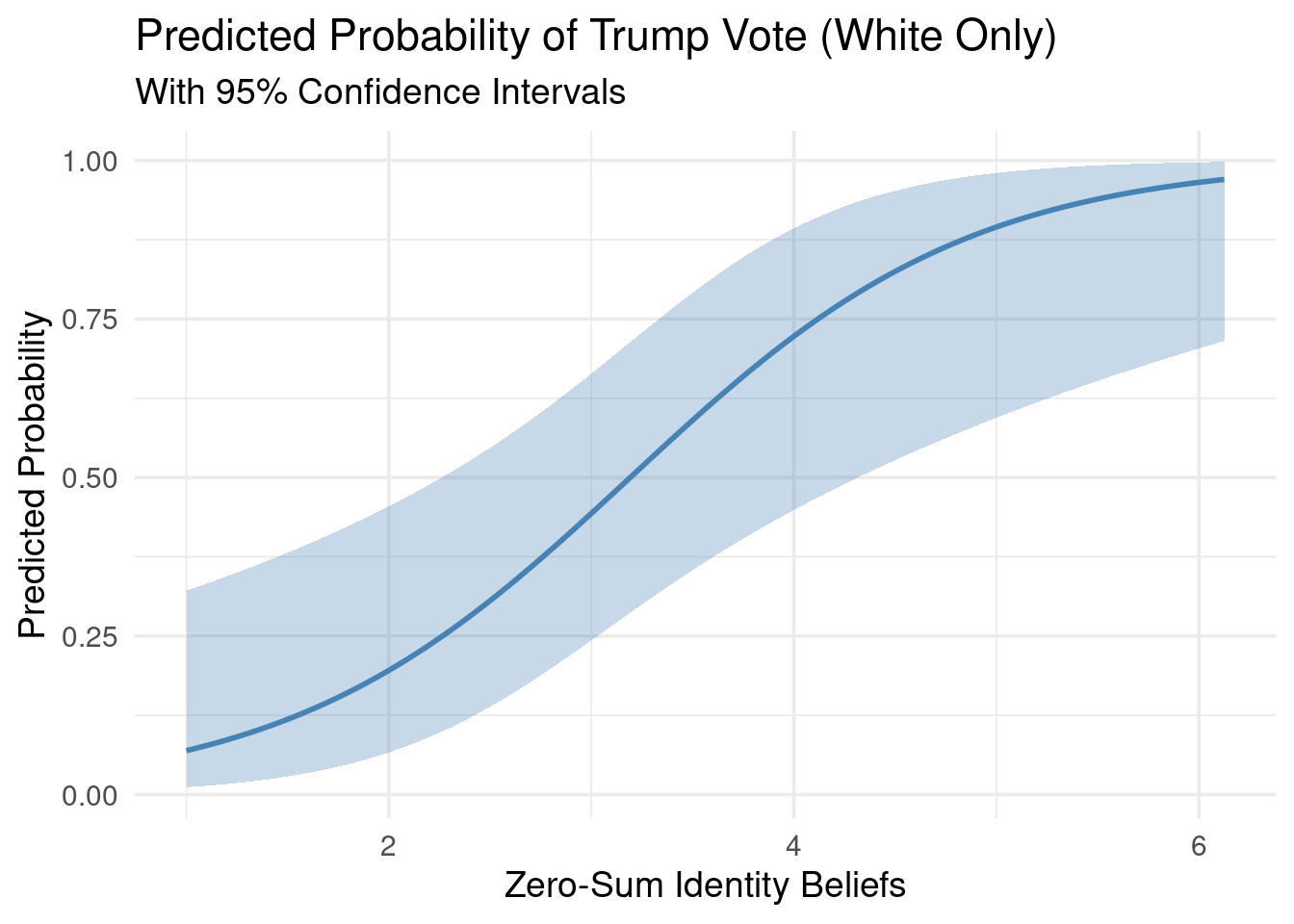
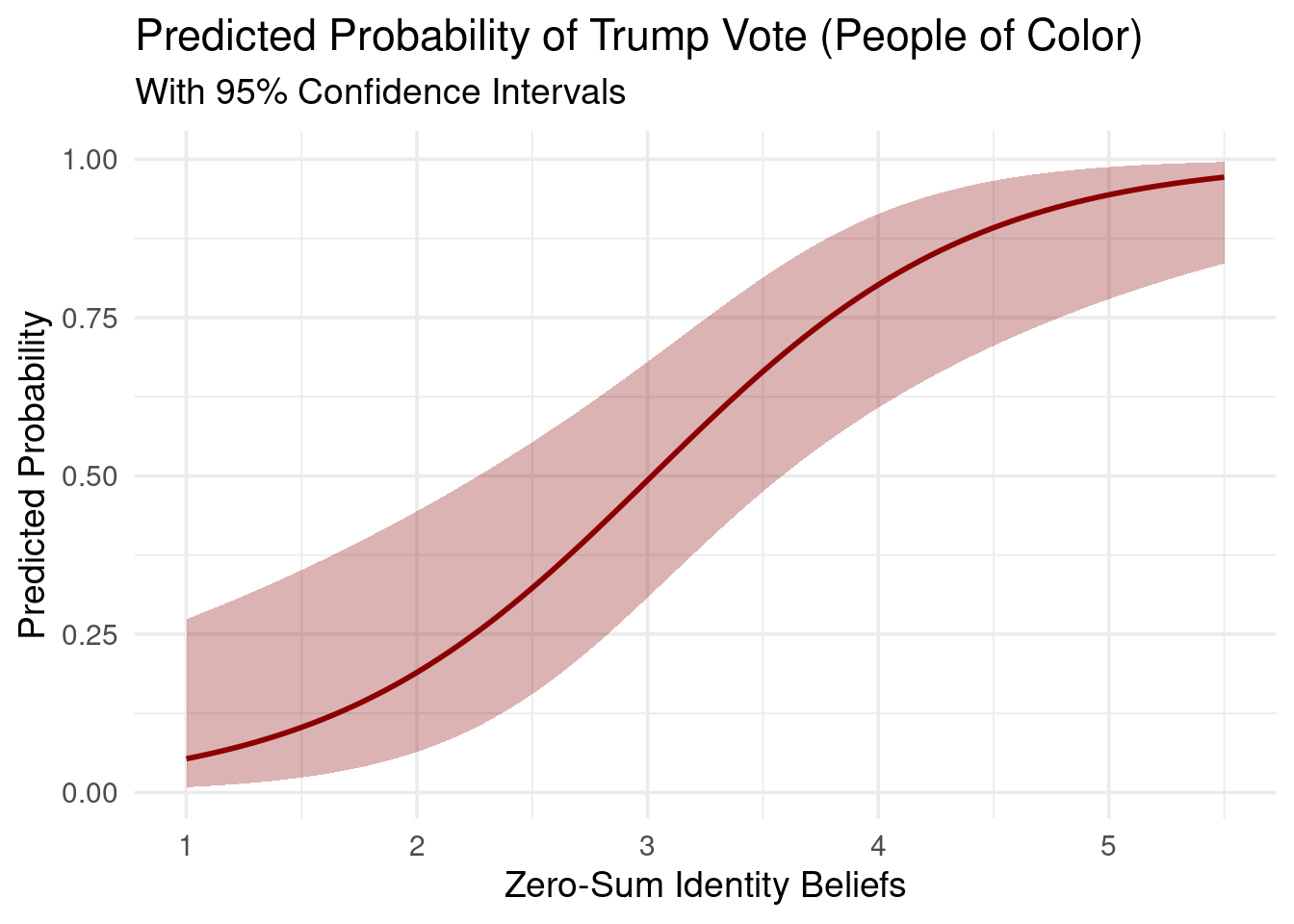
Background: Zero-sum beliefs—the perception that one group’s gains necessarily result in another group’s losses—are important predictors of political attitudes. However, the referents for zero-sum beliefs as economic or social identity remain underexplored in relation to political ideology, party affiliation, and voting behavior in contemporary elections. Method: We conducted a comprehensive analysis examining three dimensions of zero-sum beliefs (general, economic, and social identity). We conducted eleven Kruskal-Wallis tests on each of the zero-sum belief statements to investigate whether endorsement of zero-sum beliefs across multiple domains beliefs could be partially explained by political party affiliation and racial/ethnic identity. Subsequently, we examined whether zero-sum belief patterns – compared with politicial beliefs, gender, racial identity, and competition beliefs – are most associated with self-reported voting for Donald Trump versus Kamala Harris in the 2024 presidential election. Results: All eight zero-sum social identity belief items differed by political party affiliation. However, there was no effect for economic or general beliefs. Republican voters provided significantly higher endorsement of zero-sum social identity beliefs compared to Independents and Democrats. A logistic regression shows that political beliefs and zero-sum social identity beliefs are independently and significant explanatory variables for voting behavior in the 2024 presidential election. Specifically, more conservative political beliefs and higher endorsement of zero-sum social identity are associated with Trump support and more liberal political beliefs and lower zero-sum social identity beliefs are associated with Harris support. Discussion: Zero-sum social identity beliefs may represent a competitive core belief underlying contemporary political party affiliation and candidate preference. These findings affirm prior work that zero-sum thinking about economics differ from social identities, with similar levels of agreement on zero-sum economic beliefs across political parties but significantly different levels of agreement on zero-sum social identity beliefs by party affiliation. To the best of our knowledge, this study is the first to show that zero-sum thinking about social identities predicts voter preference in the 2024 election. Ultimately, future work needs to examine how to reduce zero-sum social identity thinking.
Keywords
zero sum beliefs, social identities, political affiliation, racial identity
Introduction
Zero-sum beliefs – the subjective view that as one person gains, others inevitably lose – have been linked to numerous beneficial and harmful social, political, and psychological outcomes (Andrews-Fearon & Davidai (2023)). A zero-sum mindset can be conceptualized as a specific type of competitive belief regarding the relative distribution of limited resources (e.g., physical resources and social status) between two (or more) groups (e.g., racial groups). Although the origin of this mindset can be traced to inter-generational scarcity and high-competition environments for resources, other important factors may partially explain the adoption and centrality of zero-sum beliefs in the current U.S. political discourse.
In a seminal article, Norton & Sommers (2011) demonstrates that White respondents’ perceptions of anti-Black bias has decreased markedly since the 1950s while their perception of anti-White bias has increased significantly during that same period. A decade later, Rasmussen et al. (2022) provide a conceptual replication of these findings and find that “Whites now believe that anti-White bias is more prevalent than anti-Black bias” (p. 1806). The line of research and related studies have led to the modern-day conception of zero-sum racial beliefs, which has been measured frequently using this item: “Less discrimination against minorities means more discrimination against Whites” (Davidai & Ongis (2019)). Chinoy et al. (2023) argue that zero-sum thinking is the root of political differences, demonstrating zero-sum beliefs partially explain a range of social and political views: pro-redistribution policy support, racial attitudes, gender attitudes, and anti-immigration attitudes beyond traditional sociodemographic measures of age, gender, race, income, and state of residence.
Zero-sum racial beliefs are a domain-specific belief about social groups, which differ from zero-sum economic beliefs. For example, people may hold beliefs that policies aimed at reducing income inequality unfairly disadvantage the wealthy, or that initiatives promoting equity give disadvantaged communities an ‘unearned’ advantage over advantaged individuals (Brown et al. (2022)). A plethora of research lines show zero-sum domain-specific beliefs about economic groups and social groups, such as ethnic, citizenship, trade, and income (Chinoy et al. (2023)), as well as perceived competition between immigrants and native-born individuals (Esses et al. (2001)). Though domain-specific beliefs can emerge across many areas, they are often most potent when tied to social identities, when political and interpersonal behavior is strongly influenced by perceived group competition.
Zero-Sum Social Identity Beliefs
Many domain-specific zero-sum beliefs focus on social identity. For example, Wong et al. (2017) found that men with zero-sum gender beliefs have poorer mental health outcomes, worse romantic relationships, and a more polarized view of domestic chores. On the other hand, according to Boland & Davidai (2024), zero-sum political beliefs can lead to a disinterest in political discussion because they lead individuals to antagonize other political ideologies and reduce openness to different ideas, leading to less cross-grup discussion and more polarization. In addition to examining one’s actual standing as a member of a social group, understanding beliefs about one’s own and other social groups may be key for addressing bias and assumptions about resource distribution.
Zero-Sum Economic Beliefs
Zero-sum thinking takes on a unique form when viewed through a more hierarchical lens such as economics. Andrews-Fearon & Davidai (2023) posits that individuals who view the United States as more economically unequal were more likely to hold economic zero-sum beliefs. These individuals were therefore more likely to view the world as unjust. This falls in line with the aforementioned argument that zero-sum ideology often leads to prioritizing dominance and competition. On a more global scale, Hornborg (2003) explains dependency theory, a zero-sum economic framework that acknowledges how certain nations benefit at others expense. This theory claims that some nations exploit the resources of others, leading to the prosperity of the former while the latter suffers. Although economic zero-sum beliefs are much like other types of zero-sum thinking, they differ in that individuals belonging to one’s own group are also thought of as competition. Both on a global and individual scale, the less wealthy are left competing with one another, rather than with the wealthy individuals or groups that oppress them.
Political Party Affiliation
Political party affiliation is a key determinant of voter preference in elections. Several models aim to expain party affiliation and voting based on sociodemographics. For example, Nadeem (2024) found that young people, women, and Black and Hispanic voters tend to be more Democratic leaning. Alternatively, White voters without 4 year degrees tend to lean Republican. However, this methodology struggles in that the social dynamics that determine the relationship between sociodemographics and political affiliation are subject to change. For example, a report by Pew Research Center (2025) examines voting pattern shifts across the 2016, 2020, and 2024 Presidential elections by sociodemographic groups. While some groups tend to be more reliably associated with certain political parties at certain times, these relationships can change meaningfully in a few election cycles. In fact, such drastic shifts have led journalists and academics to speculate on whether a political realignment has taken shape in U.S. politics based on race, class, gender, education and their intersections (Barber & Pope, 2024; Meyer, 2025). However, many prior models have failed to capture the complex arrangements of sociodemographic variables and beliefs influencing voter preference. A (2021) Pew Research Center report provided evidence of 9 different typology groups making up the Republican and Democrat coalitions in 2020. The 6 typology groups within the Republican coalition and 5 typology groups within the Democrat coalition hold very different views on racial bias and social groups, economics, climate change, and health, among others. Prior research demonstrates that zero-sum belief scores differ by political party affiliation, but there is significant variation within political parties (Davis & Sequeira (2024)), suggesting zero-sum beliefs might explain overall differences between parties and identification with specific factions within the Republican and Democrat coalition.
Study Aims
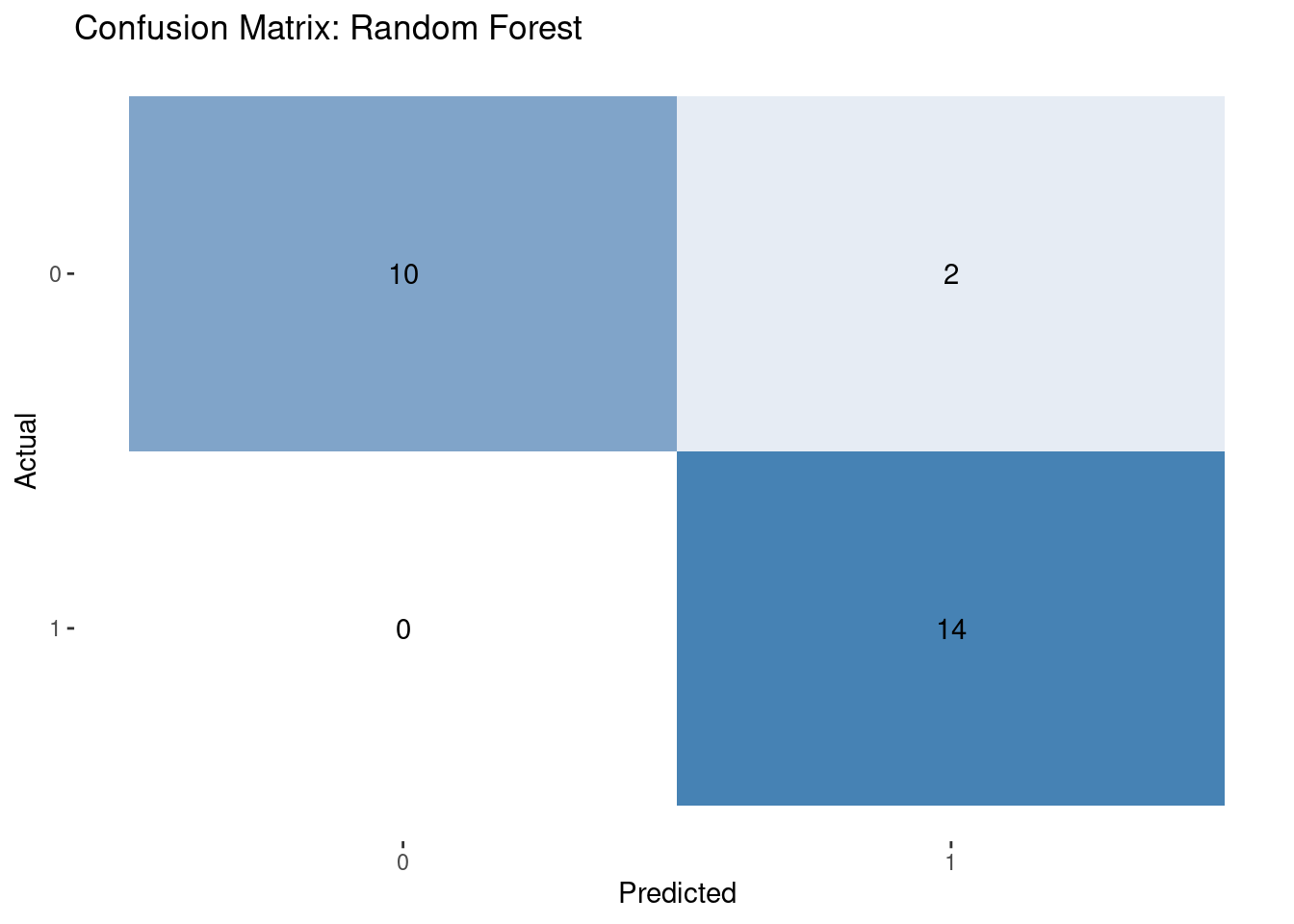
The objective of the study is to: 1) examine domain-specific zero-sum beliefs: zero-sum economic beliefs and zero-sum social identity beliefs, 2) test whether zero-sum beliefs differ based on political party and/or racial identity, 3) test the association between sociodemographic variables and zero-sum beliefs in a logistic regression to explain voter preference for Donald Trump vs. Kamala Harris, and 4) use machine learning models to validate explanatory predict voter preference models.
Methods
Participants and Sampling
More than fifty-five thousand people who are active on the Prolific platform were eligible to complete a 45-minute health beliefs survey with measures on various beliefs associated with politics and health. Using a quota sample by gender (50% Man/ 50% Woman), political affiliation (33% Republican, 33% Democrat, and 34% Independent), and race/RACIALIDENTITY.4 (White 40%, Black 20%, Asian 20%, Mixed 10%, and Other 10%), Prolific recruited one hundred and twenty-five people to complete the survey.
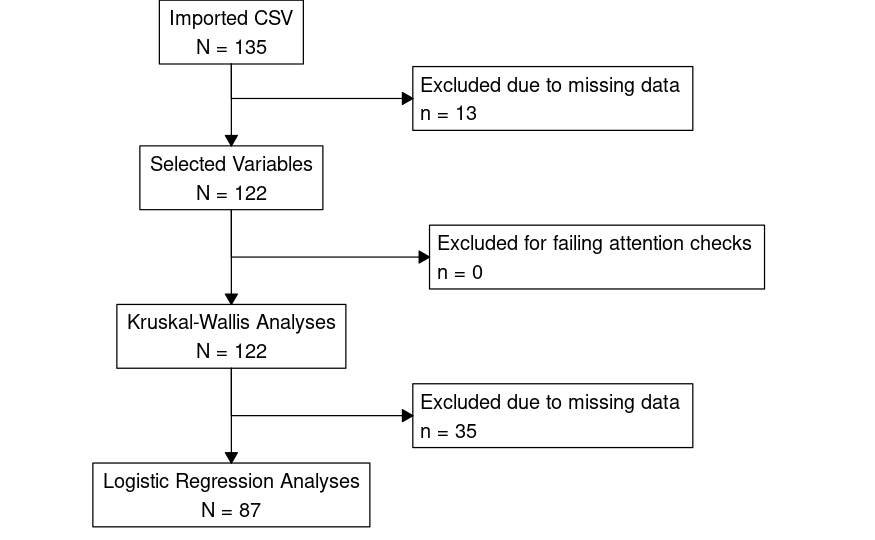
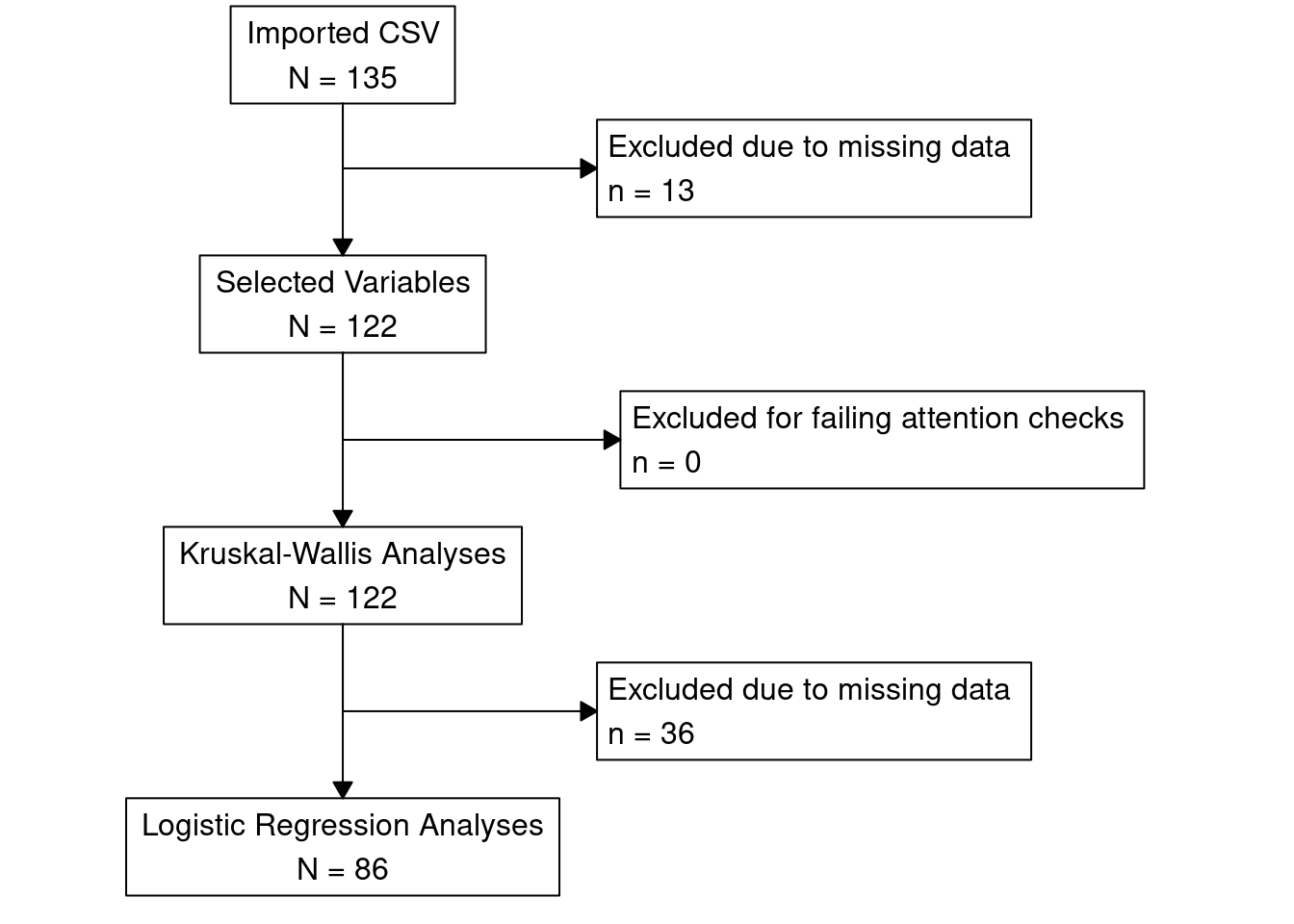
A total of 135 individuals were recruited through Prolific, and 10 were excluded due to incomplete responses, yielding a final analytic sample of 125 participants. The final sample was roughly balanced in terms of gender (50.4% male), racial identity (White: 39.2%, Black: 22.4%, Asian: 18.4%, Mixed/Other: 17.6%), and political affiliation (Democrats: 34.4%, Independents: 32.0%, Republicans: 31.2%).
Figure 1. Participant Flowchart showing exclusions for missing data and final analytic samples used in Kruskal_Wallis and Logistic Regression analyses
Measures
Gender
Respondents reported their gender using the following options: Girl or woman, boy or man, nonbinary/genderfluid/genderqueer, I am not sure/questioning).
Racial Identity
Respondents reported their racial identity using the following options: American Indian or Alaska Native, Asian, Black or African American, Hispanic or Latine, Middle Eastern or North African, Native Hawaiian/Pacific Islander, White, Other).
Subjective Social Status
Respondents reported their subjective social status using MacArthur’s Ladder with the following options Lowest 1 to Highest 10).
Political Beliefs
Respondents reported their political beliefs using the following options: far left/leftist, very liberal, liberal, moderate, conservative, very conservative, alt-right/far-right.
Education
Respondents reported their highest educational attainment using the following options: Some high school or less, High school diploma or GED, Some college, but no degree, Associates or technical degree, Bachelor’s degree, Graduate or professional degree (MA, MS, MBA, PhD, JD, MD, DDS).
Political Party Affiliation
Respondents reported their political party affilaition using the following options: Conservative Party, Democratic Party, Libertarian Party, Republican Party, Socialist or Green Party.
Self-Reported Voting in 2024 U.S. Presidential Election
Respondents reported their voter preference in the 2024 voting behavior using the following selections: Donald Trump, Kamala Harris, Jill Stein, Robert Kennedy Jr., Chase Oliver, Claudia De La Cruz, Cornel West, and DID NOT VOTE IN 2024.
Zero-Sum Beliefs
Respondents were asked to report their level of agreement using a 7-point Likert scale (1: Strongly Disbelieve, 2: Disbelieve, 3: Somewhat Disbelieve, 4: Neither, 5: Somewhat Believe, 6: Believe, 7: Strongly Believe) with .
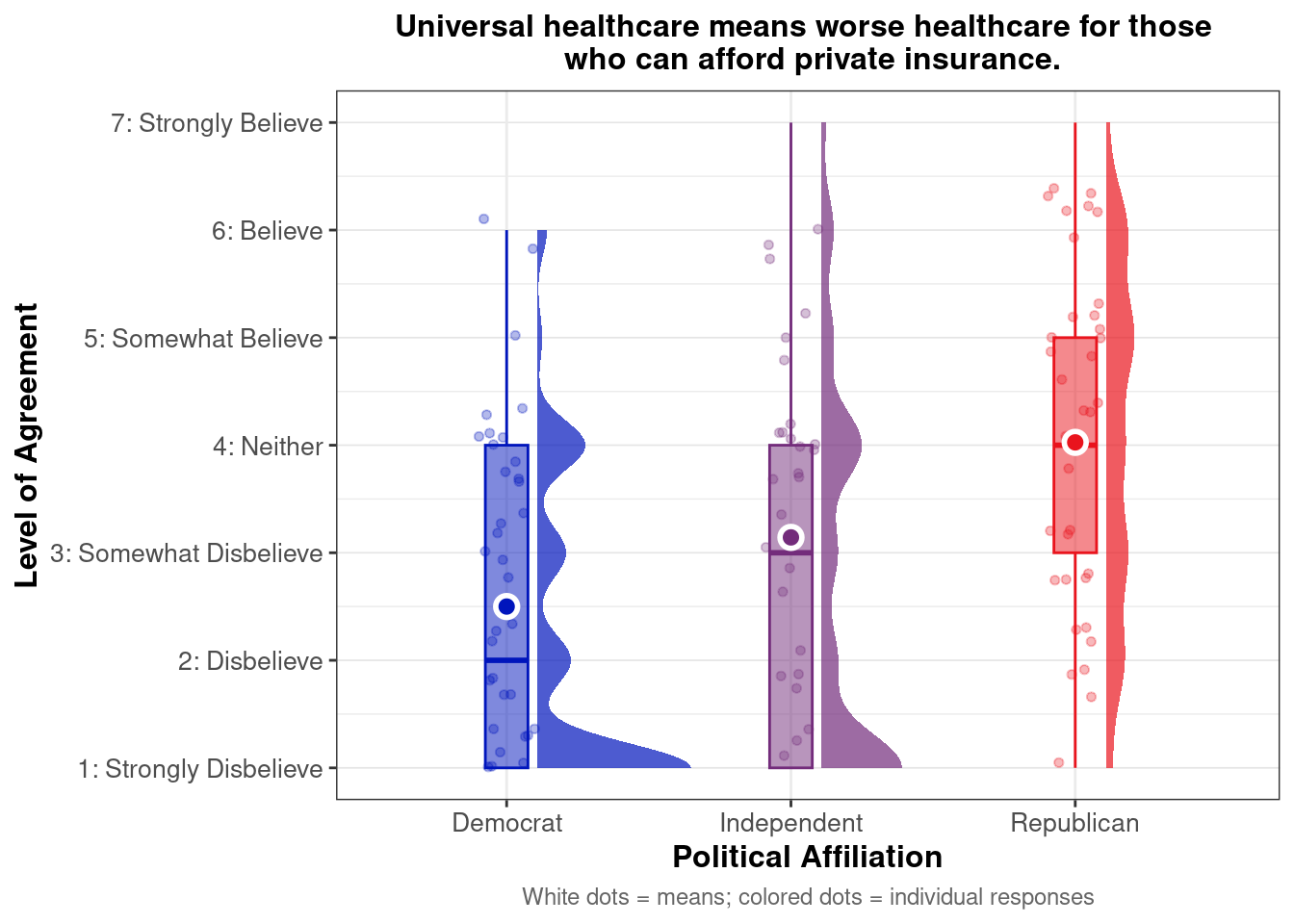
Respondents were asked to report their level of agreement to 11 zero-sum belief statements using items from two measures and unvalidated, self-generated statements on a 7-point Likert scale (1: Strongly Disbelieve, 2: Disbelieve, 3: Somewhat Disbelieve, 4: Neither Believe Nor Disbelieve, 5: Somewhat Believe, 6: Believe, 7: Strongly Believe). The first three items were selected from the Belief in a Zero Sum Game (BZSG) scale: 1) “Life is so devised that when somebody gains, others have to lose”; 2) “When some people are getting poorer, it means that other people are getting richer”; and 3) “The wealth of a few is acquired at the expense of many” ((Różycka-Tran et al., 2015; Wojciszke et al., 2009)). An additional item was selected from a validated measure capturing beliefs about social identities: 4) “As women face less sexism, men end up facing more sexism” (Wilkins et al. (2015)). Using this sentence construction to examine a gain and loss for two specific groups, seven additional statement were created by the lead author with input from co-authors.
Data Analysis Plan
Data was exported from the qualtrics platform in numerical format and imported into Posit Cloud. R code provided in the data science workflow (Wickham et al. (2016)) was modified to install R packages (see install.R), import data (alldata.csv) using readr, transform sociodemographic variables, such as gender identity (GENDER) to a binary variable (GENDER_MAN) using dplyr, visualize data in a raincloud plot using ggplot2, and model for inferential statistical tests from the stats package along with decision tree and random forest models from the tidymodels package. An exploratory factor analysis using promax rotation was used to examine the factor structure of the eleven items capturing zero sum beliefs.
We analyzed 11 zero-sum belief items (ZEROSUM_), covering both economic and social identity dimensions. Our primary goal was to assess differences across political affiliation (POLITICALPARTY) and racial/ethnic identity (RACIALIDENTITY.4).
First, we conducted a two-way Analysis of Variance (ANOVA) for each zero-sum belief item. To assess whether ANOVA assumptions were met, we used the Shapiro-Wilk test to evaluate the normality of residuals. All 11 items showed non-normality. However, given ANOVA’s robustness to moderate deviations from normality, we further examined residuals using Q-Q plots (qqnorm and qqline) to visualize distributional shape. These plots indicated that the violations were not severe, so we proceeded with ANOVA while noting the assumption limitations.
To address the non-normality more formally and ensure result accuracy, we complemented the ANOVA with a non-parametric Kruskal-Wallis test for each zero-sum belief. This approach allowed us to evaluate group differences without relying on normality assumptions.
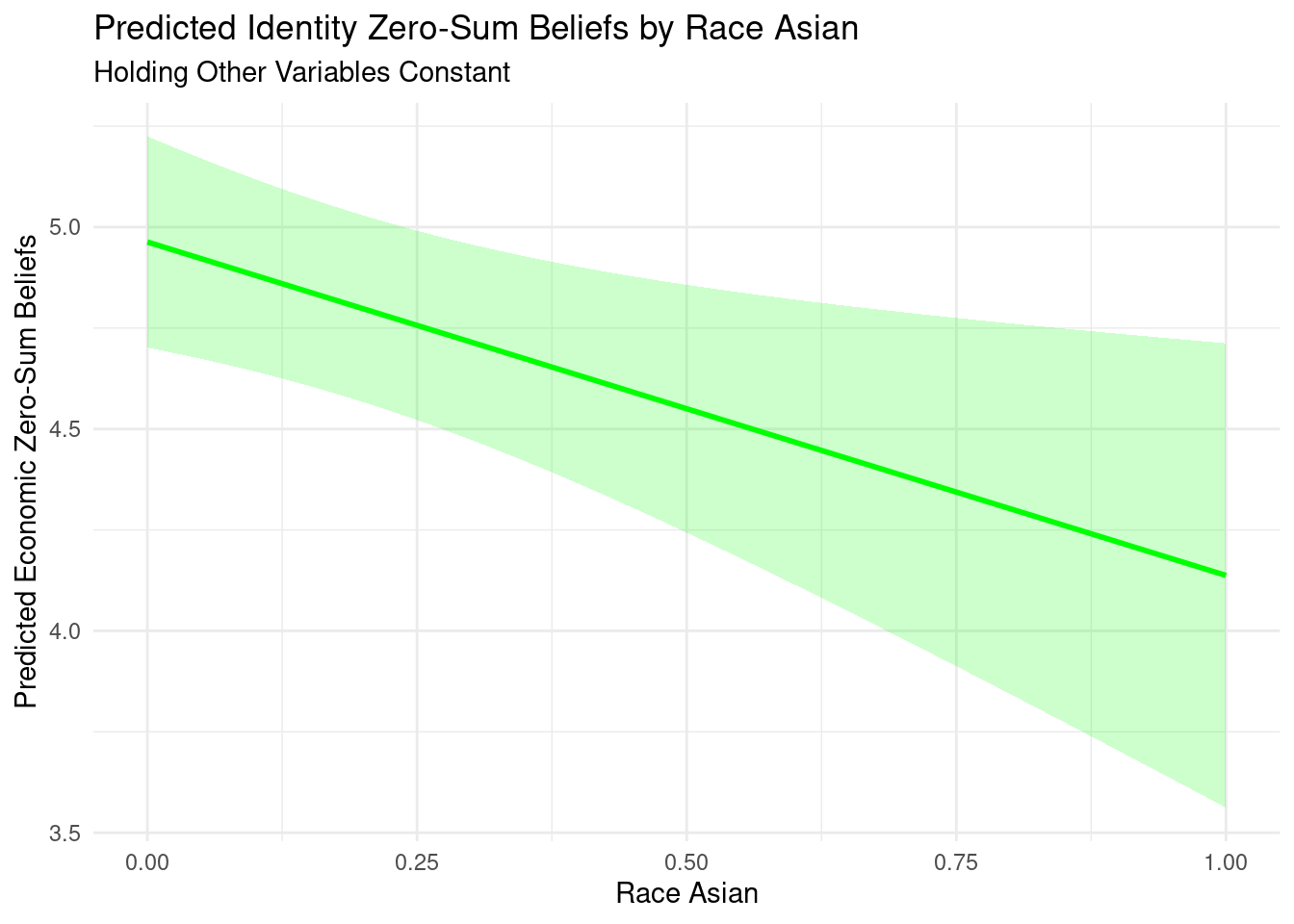
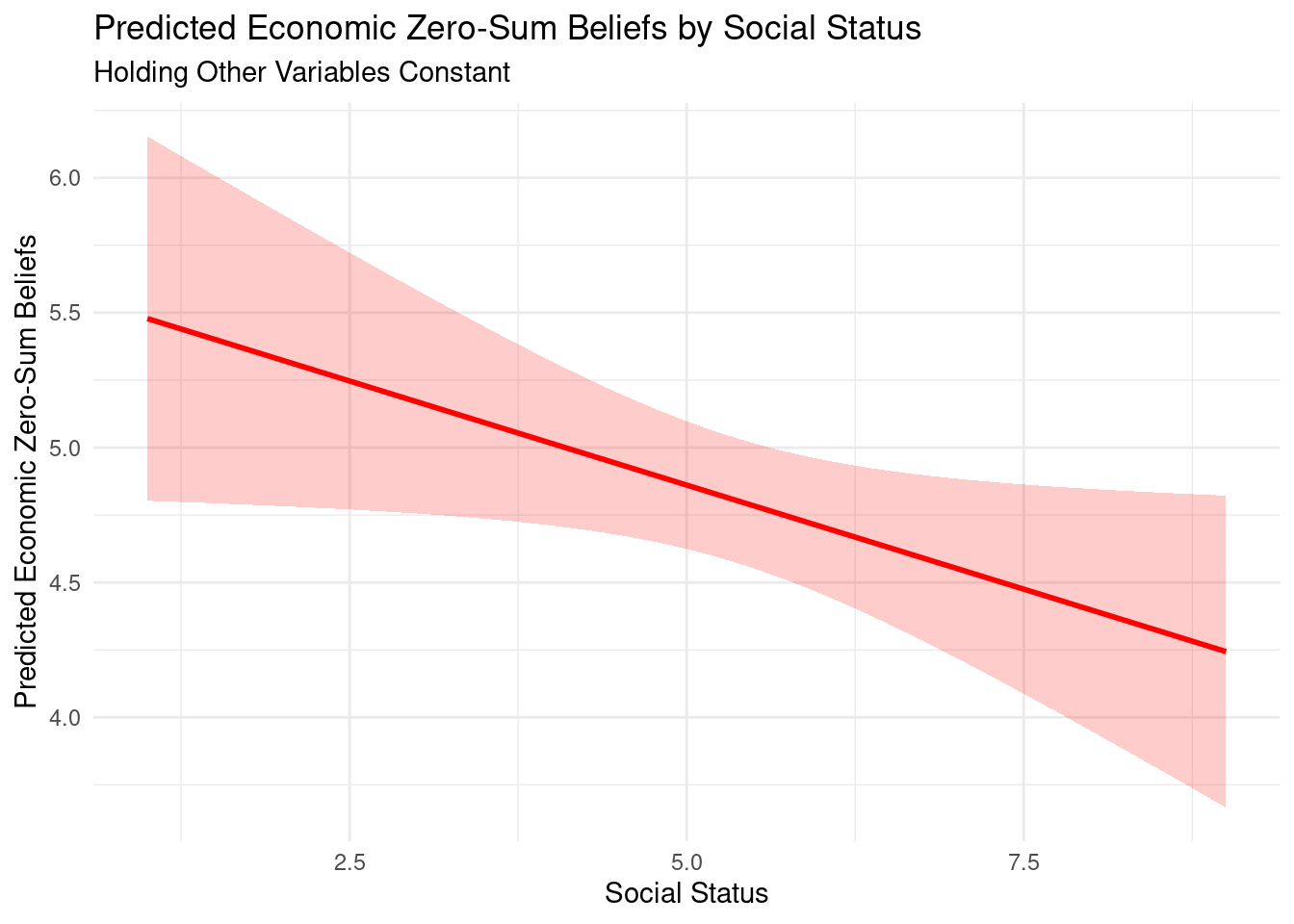
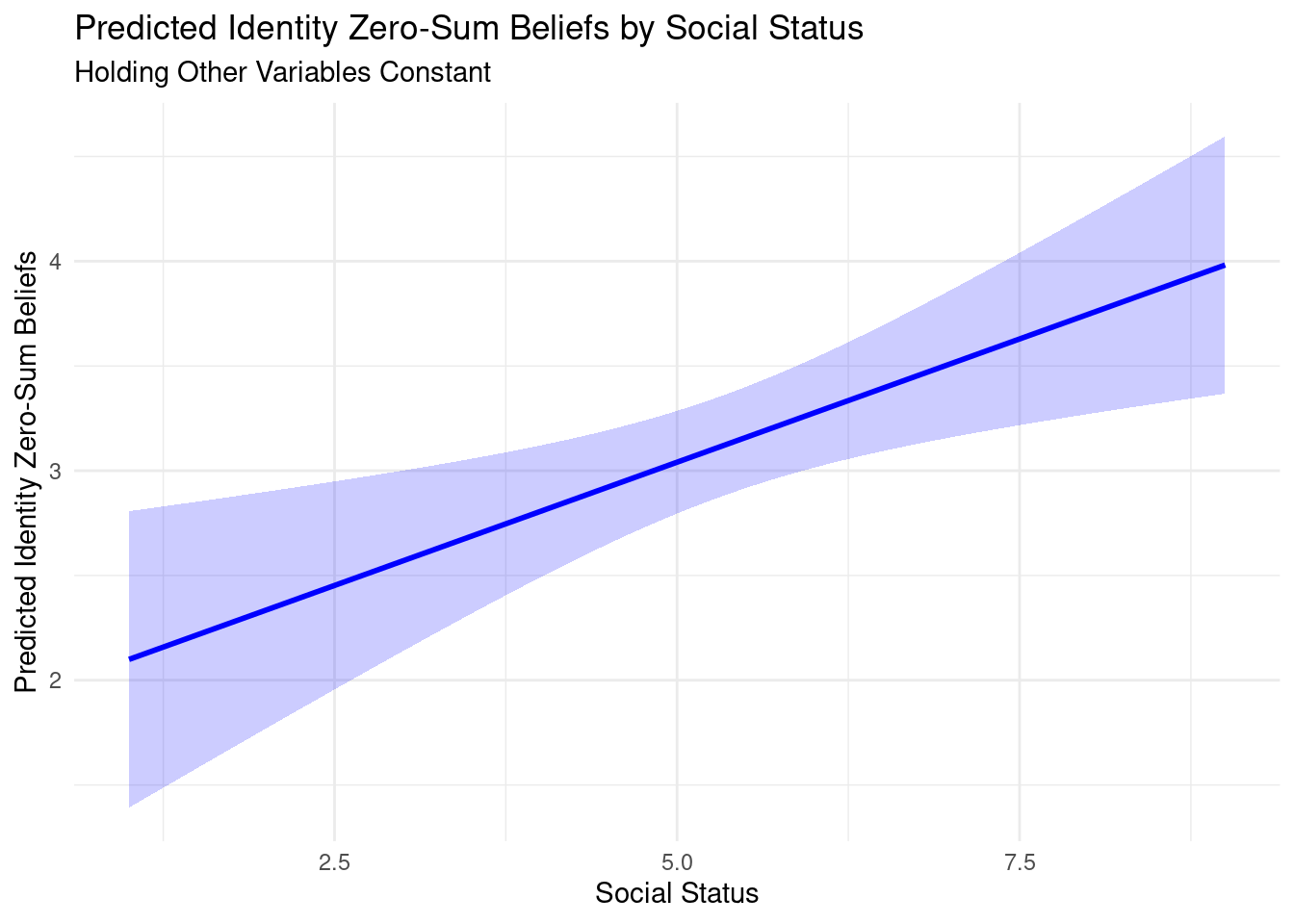
Next, an explanatory logistic regression was conducted to classy voter’s preference for Donald Trump (1) vs. Kamala Harris (0) ( TRUMPVOTE ) using POLITICALBELIEFS, ZEROSUM_ECONOMIC, ZEROSUM_IDENTITY, ZEROSUM_1, GENDER_MALE, RELIGIOUS_YES, RACE_BLACK, RACE_ASIAN, RACE_OTHER, EDUCATION_HIGH, and SOCIALSTATUS.
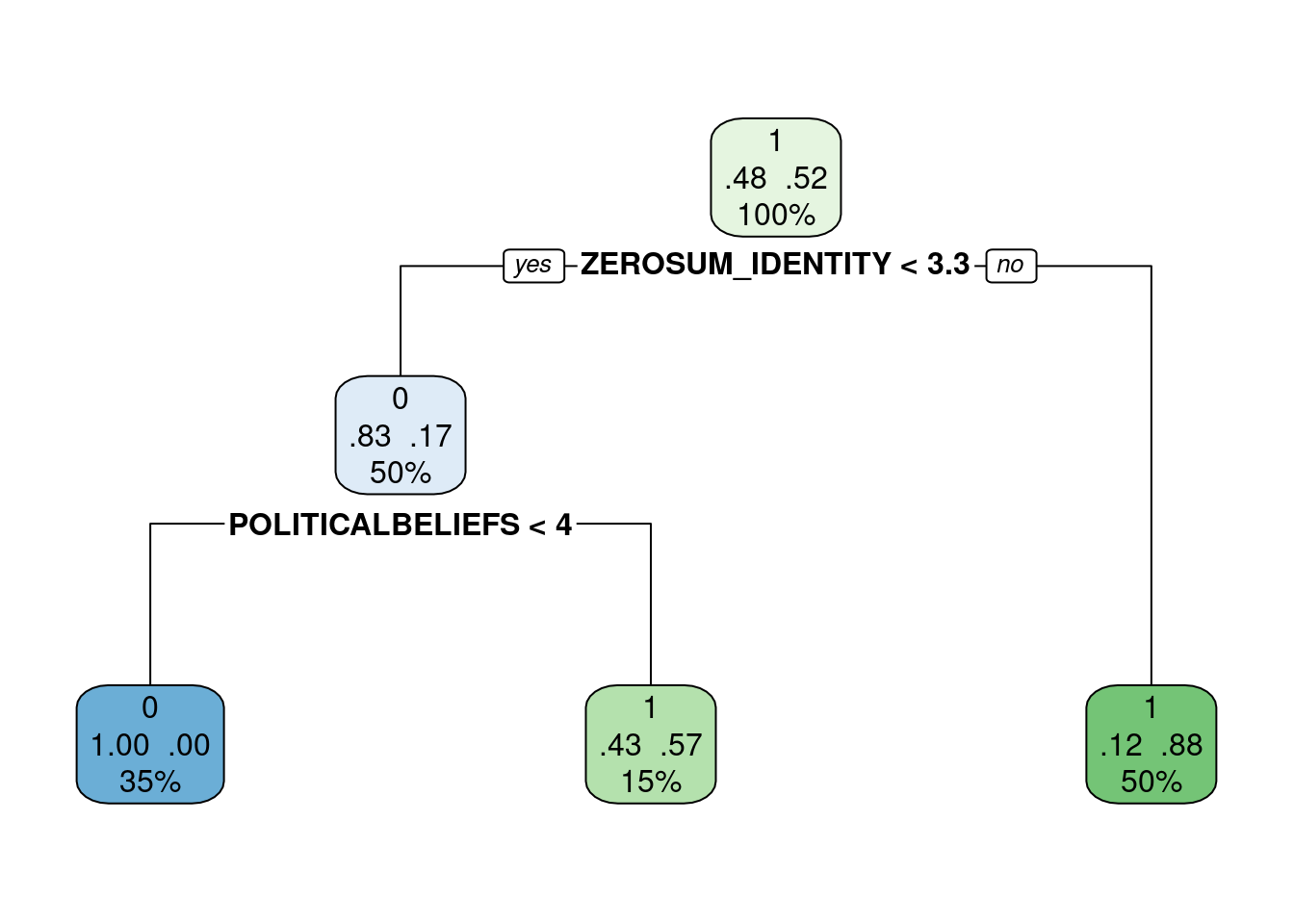
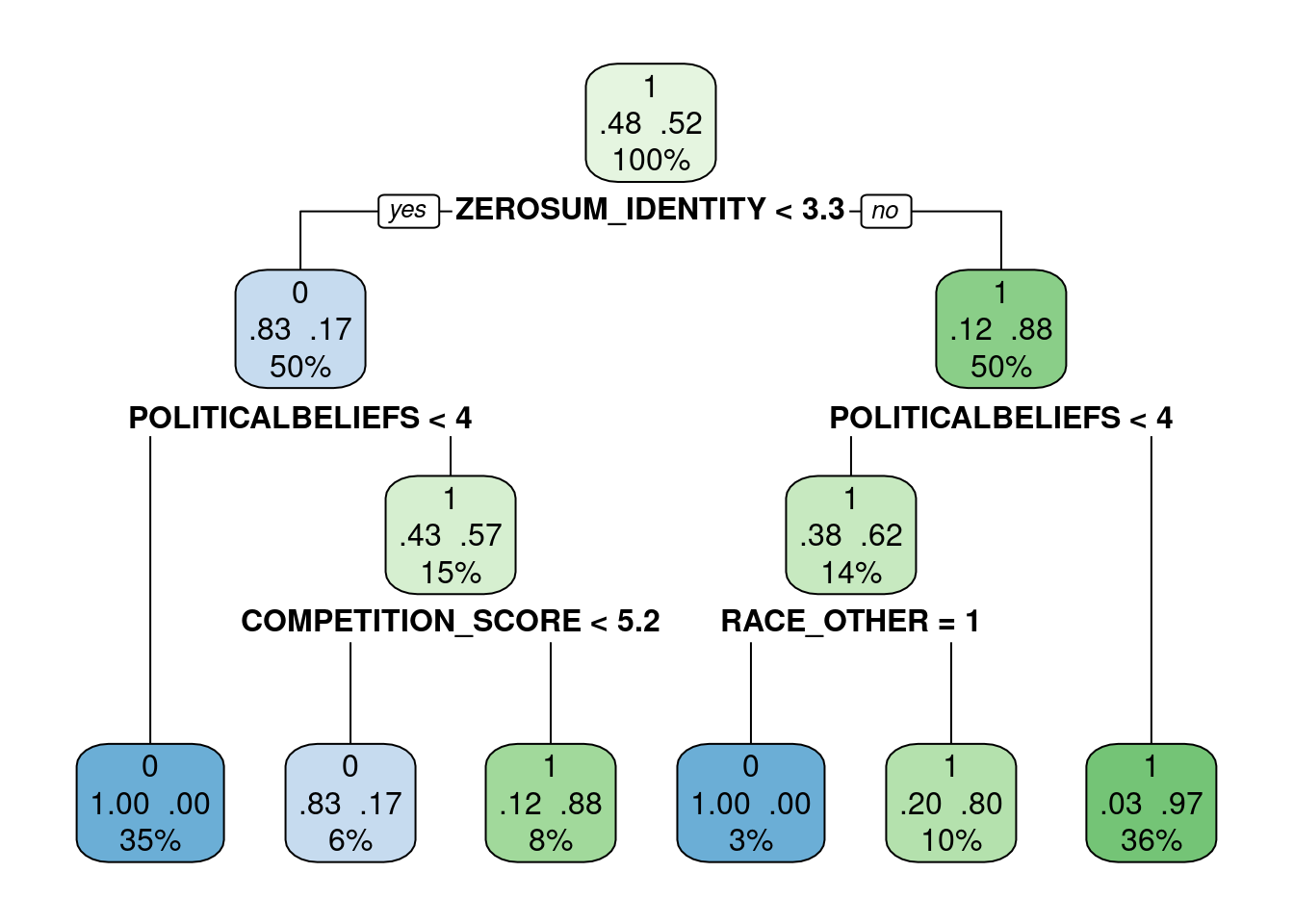
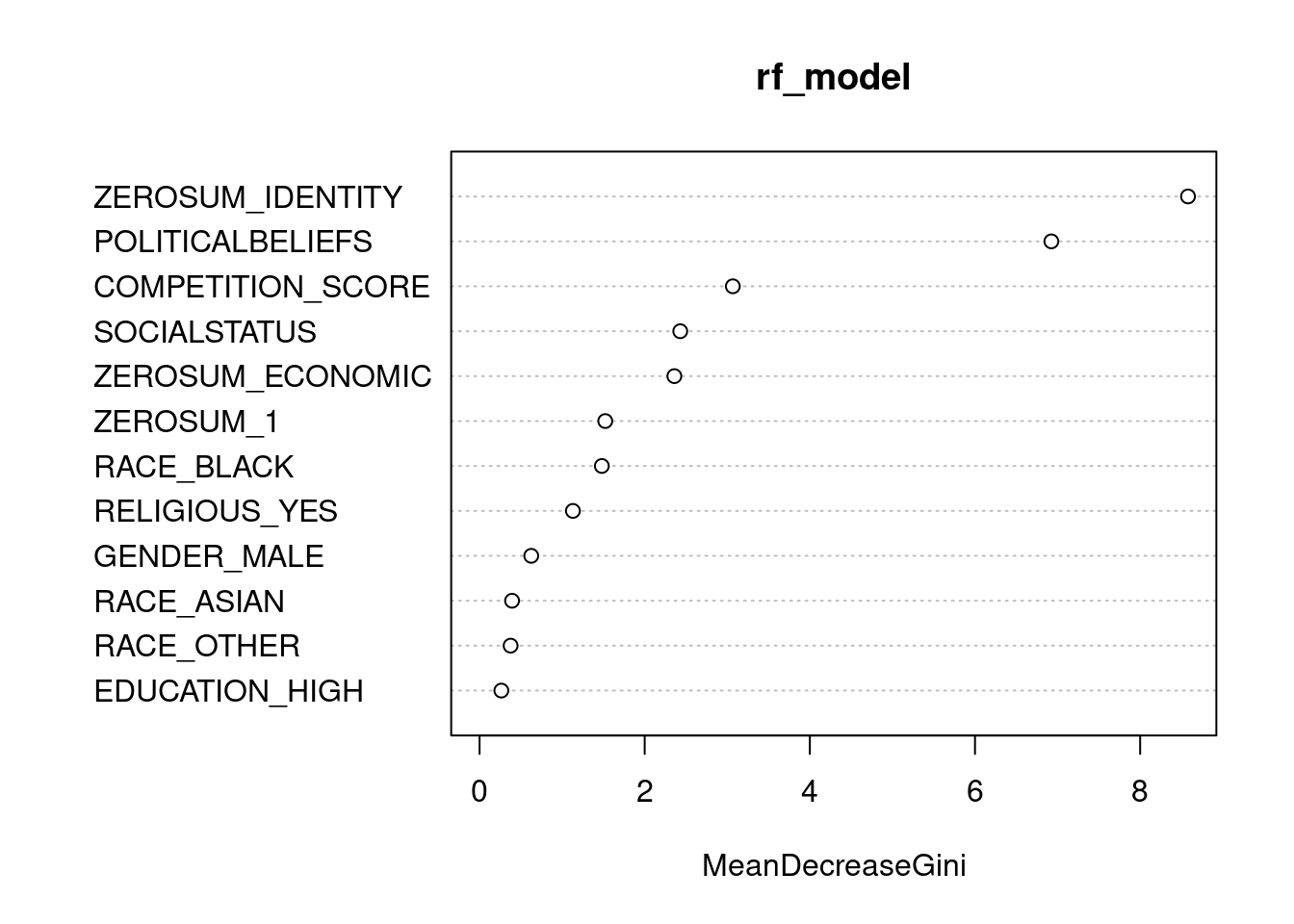
Additionally, we used the tidymodels package in R to classify using a predictive modeling approach. Specifically, both decision tree and random forest classifiers were implemented to predict voter preference.
Using this integrative modeling framework, we provide both explanatory and predictive models for classifying voter preferences.
Results
In [1]:
Show the code
# Run install.R to ensure packages are installedsource("install.R")
Attaching package: 'dplyr'
The following objects are masked from 'package:stats':

    filter, lag
The following objects are masked from 'package:base':

    intersect, setdiff, setequal, union
Registered S3 methods overwritten by 'ggpp':
  method                  from
  heightDetails.titleGrob ggplot2
  widthDetails.titleGrob  ggplot2
Attaching package: 'codebook'
The following object is masked from 'package:codebookr':

    codebook
Suggested APA citation: Thériault, R. (2023). rempsyc: Convenience functions for psychology.
Journal of Open Source Software, 8(87), 5466. https://doi.org/10.21105/joss.05466
Loading required package: carData
Attaching package: 'car'
The following object is masked from 'package:dplyr':

    recode
Attaching package: 'dataMaid'
The following object is masked from 'package:rmarkdown':

    render
The following object is masked from 'package:dplyr':

    summarize
Loading required package: usethis
Attaching package: 'devtools'
The following object is masked from 'package:dataMaid':

    check
Attaching package: 'psych'
The following object is masked from 'package:MBESS':

    cor2cov
The following object is masked from 'package:car':

    logit
The following object is masked from 'package:codebook':

    bfi
The following objects are masked from 'package:ggplot2':

    %+%, alpha
corrplot 0.95 loaded
Loading required package: rpart
randomForest 4.7-1.2
Type rfNews() to see new features/changes/bug fixes.
Attaching package: 'randomForest'
The following object is masked from 'package:psych':

    outlier
The following object is masked from 'package:dplyr':

    combine
The following object is masked from 'package:ggplot2':

    margin
The following object is masked from 'package:recipes':

    fixed
Show the code
levels_list <-list(EDUCATION_LEVEL =c("Some high school or less","High school diploma or GED","Some college, but no degree","Associates or technical degree","Bachelor’s degree","Graduate or professional degree" ),ETHNICITY =c("Asian","Black","White","Mixed/Other" ),Employment.status =c("Part-Time","Full-Time","Unemployed (and job seeking)","Not in paid work (e.g. homemaker', 'retired or disabled)","Due to start a new job within the next month","Other","DATA_EXPIRED" ),INCOME =c("Less than $25,000","$25,000-$49,999","$50,000-$74,999","$75,000-$99,999","$100,000-$149,999","$150,000 or more","Prefer not to say" ),Nationality =c("United States" ),POLITICALAFFIL =c("Conservative Party","Democratic Party","Libertarian Party","Republican Party","Socialist or Green Party","None of the above" ),POLITICALPARTY =c("Democrat","Republican","Independent" ),RACIALIDENTITY.4 =c("Asian","Black","White","Mixed/Other" ),RACIALIDENTITY.6 =c("Asian","Black","White","Latine","Mixed","Other" ),RELIGIOUS_Identity =c("Christian", "Muslim", "Hindu", "Buddhist", "Jewish", "Folk Religion", "Other", "Religiously Unaffiliated", "Decline to answer" ),SERIOUS =c("No", "Not Sure", "Yes"),SEX =c("Female", "Male"),SEXUAL_IDENTITY =c("Straight or heterosexual","Gay or lesbian","Bisexual, pansexual, or queer","Asexual","Not sure" ),STREETRACE =c("Asian American","Native American/American Indian","White","Latine","Black","Arab","Mexican","Some other race" ),Student.status =c("Yes","No","DATA_EXPIRED" ),VOTE_2024 =c("Donald Trump","Kamala Harris","Jill Stein","Robert Kennedy Jr.","Chase Oliver","Claudia De La Cruz","Cornel West","DID NOT VOTE IN 2024" ) )categorical_table <- select_data %>%select(all_of(categorical_vars)) %>%pivot_longer(cols =everything(),names_to ="Variable",values_to ="Value" ) %>%mutate(Value =if_else(is.na(Value), "Missing", Value)) %>%group_by(Variable, Value) %>%summarise(n =n(), .groups ="drop") %>%group_by(Variable) %>%mutate(percent =paste0(round(100* n /sum(n), 1), "%"),Value =factor( Value,levels =c(levels_list[[cur_group()$Variable]], "Missing") ) ) %>%arrange(Variable, Value) %>%ungroup()kable( categorical_table,col.names =c("Variable", "Category", "Count", "Percent"),caption ="Table 1. Frequencies and Percentages for Categorical Variables",booktabs =TRUE,row.names =FALSE,format =ifelse(knitr::is_latex_output(), "latex", "html")) %>%kable_styling(latex_options =c("hold_position", "scale_down"),bootstrap_options =c("striped", "condensed"),full_width =FALSE )
Table 1. Frequencies and Percentages for Categorical Variables
Variable
Category
Count
Percent
EDUCATION_LEVEL
High school diploma or GED
7
6%
EDUCATION_LEVEL
Some college, but no degree
19
16.4%
EDUCATION_LEVEL
Associates or technical degree
7
6%
EDUCATION_LEVEL
Bachelor’s degree
45
38.8%
EDUCATION_LEVEL
Graduate or professional degree
38
32.8%
ETHNICITY
Asian
23
19.8%
ETHNICITY
Black
25
21.6%
ETHNICITY
White
45
38.8%
ETHNICITY
Mixed/Other
23
19.8%
Employment.status
Part-Time
28
24.1%
Employment.status
Full-Time
48
41.4%
Employment.status
Unemployed (and job seeking)
10
8.6%
Employment.status
Not in paid work (e.g. homemaker', 'retired or disabled)
Table 2. Descriptive Statistics Table for Continuous Variables
Variable
n
mean
median
sd
min
max
AGE
115
36.21
33
12.88
19
73
SOCIALSTATUS
116
5.35
6
1.74
1
9
POLITICALBELIEFS
114
3.68
4
1.35
1
6
ATTENTION3
116
2.00
2
0.00
2
2
ZEROSUM_1
116
3.93
4
1.73
1
7
ZEROSUM_2
115
4.73
5
1.61
1
7
ZEROSUM_3
115
4.89
5
1.50
1
7
ZEROSUM_4
115
3.05
3
1.63
1
6
ZEROSUM_5
116
2.88
3
1.77
1
7
ZEROSUM_6
115
3.43
3
2.04
1
7
ZEROSUM_7
114
3.54
4
1.80
1
7
ZEROSUM_8
115
2.99
3
1.63
1
7
ZEROSUM_9
115
2.63
2
1.75
1
7
ZEROSUM_10
116
3.19
3
1.75
1
7
ZEROSUM_11
115
3.20
3
1.73
1
7
NEOLIB_1
113
4.85
5
1.05
2
6
NEOLIB_2
115
4.37
5
1.34
1
6
NEOLIB_3
110
4.15
4
1.42
1
6
Table 2 reports the descriptive statistics (count, mean, median, sd, min, max) for all study variables. The sample consisted of 116 participants, with a mean age of 36.21 years (SD = 12.88, range = 19–73). Participants reported a mean social status of 5.35 (SD = 1.74) on a 10-point scale.
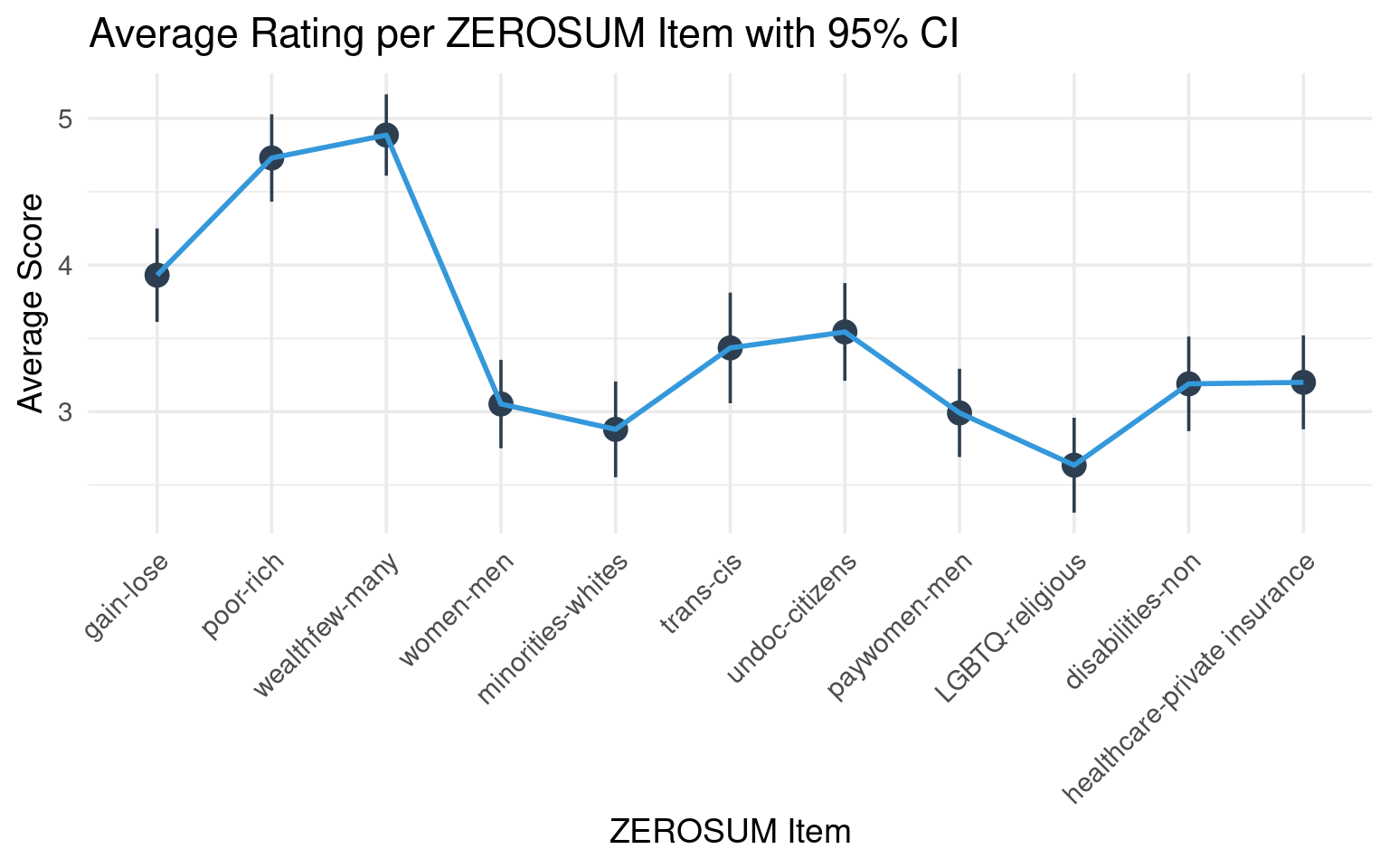
Zero-sum belief items were rated on a 7-point scale with neutral in the middle. For Item 1, the average score was close to neutral (M = 3.92). Items 2 and 3 had higher average scores (M = 4.75 and M = 4.92, respectively), indicating general agreement. Items 4 through 11 showed lower average scores (ranging from 2.59 to 3.52), reflecting more disagreement than agreement with those statements.
In [10]:
Show the code
# select and reshape the ZEROSUM itemszerosum_long <- select_data %>%select(starts_with("ZEROSUM_")) %>%pivot_longer(cols =everything(),names_to ="Item",values_to ="Score" )# mean score per itemzerosum_summary <- zerosum_long %>%group_by(Item) %>%summarise(MeanScore =mean(Score, na.rm =TRUE),n =sum(!is.na(Score)),sd =sd(Score, na.rm =TRUE),se = sd /sqrt(n), CI_lower = MeanScore -qt(0.975, n -1) * se, # Lower 95% CICI_upper = MeanScore +qt(0.975, n -1) * se, # Upper 95% CI.groups ="drop" ) %>%mutate(Item =factor(Item, levels =paste0("ZEROSUM_", 1:11)))item_labels <-c("gain-lose","poor-rich","wealthfew-many","women-men","minorities-whites","trans-cis","undoc-citizens","paywomen-men","LGBTQ-religious","disabilities-non","healthcare-private insurance")ggplot(zerosum_summary, aes(x = Item, y = MeanScore)) +geom_pointrange(aes(ymin = CI_lower, ymax = CI_upper),color ="#2c3e50", size =0.8) +geom_line(aes(group =1), color ="#3498db", linewidth =1) +theme_minimal(base_size =14) +scale_x_discrete(labels = item_labels) +labs(title ="Average Rating per ZEROSUM Item with 95% CI",x ="ZEROSUM Item",y ="Average Score" ) +theme(axis.text.x =element_text(angle =45, hjust =1))
Average ratings for each ZEROSUM item with 95% confidence intervals. Items 2 (“poor-rich”) and 3 (“wealthfew-many”) received the highest ratings. Item 1 (“gain-lose”) was rated moderately, while items 4 through 11 had the lowest average ratings.
Factor Analysis
Factor Analysis of Zero-Sum Beliefs
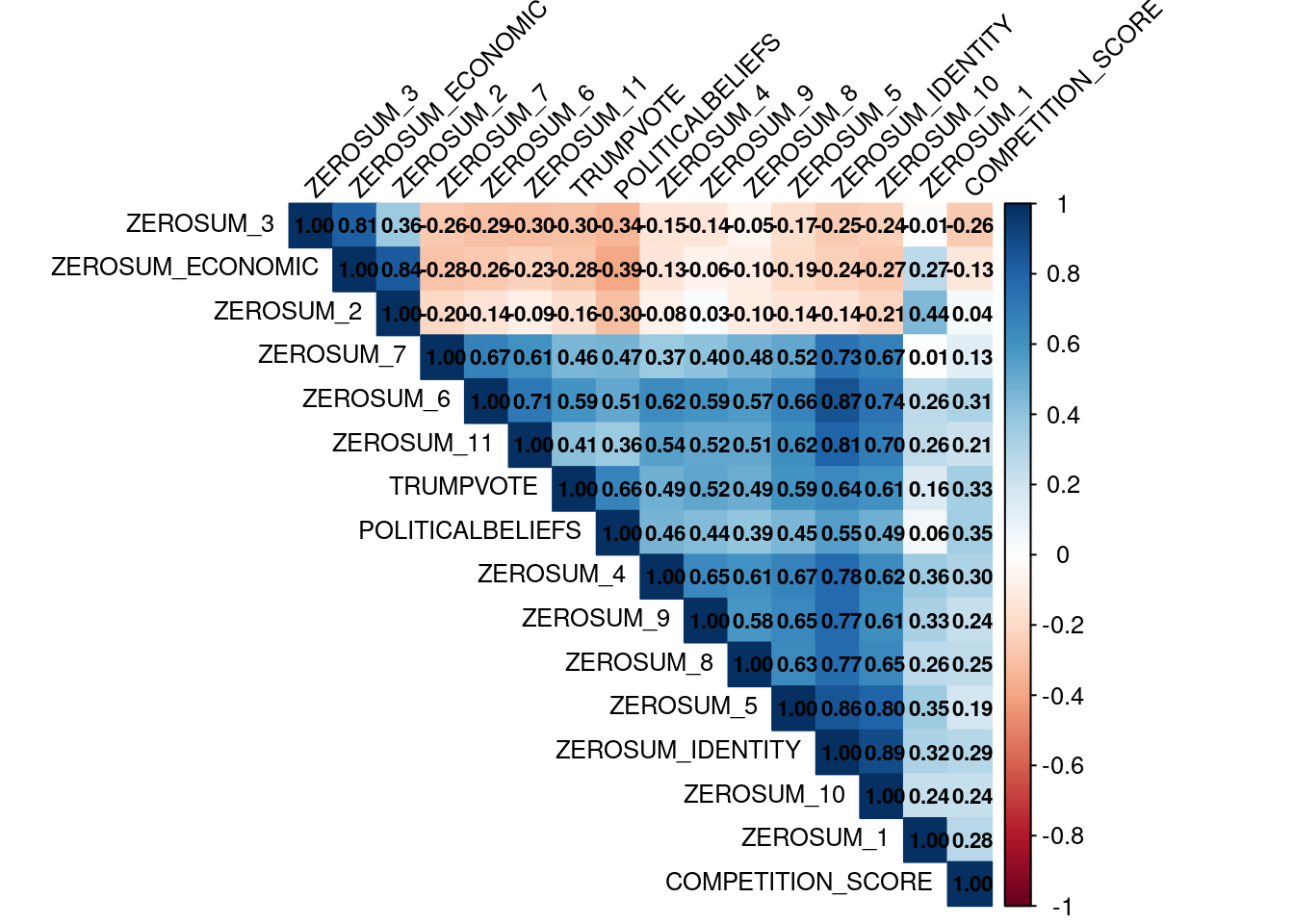
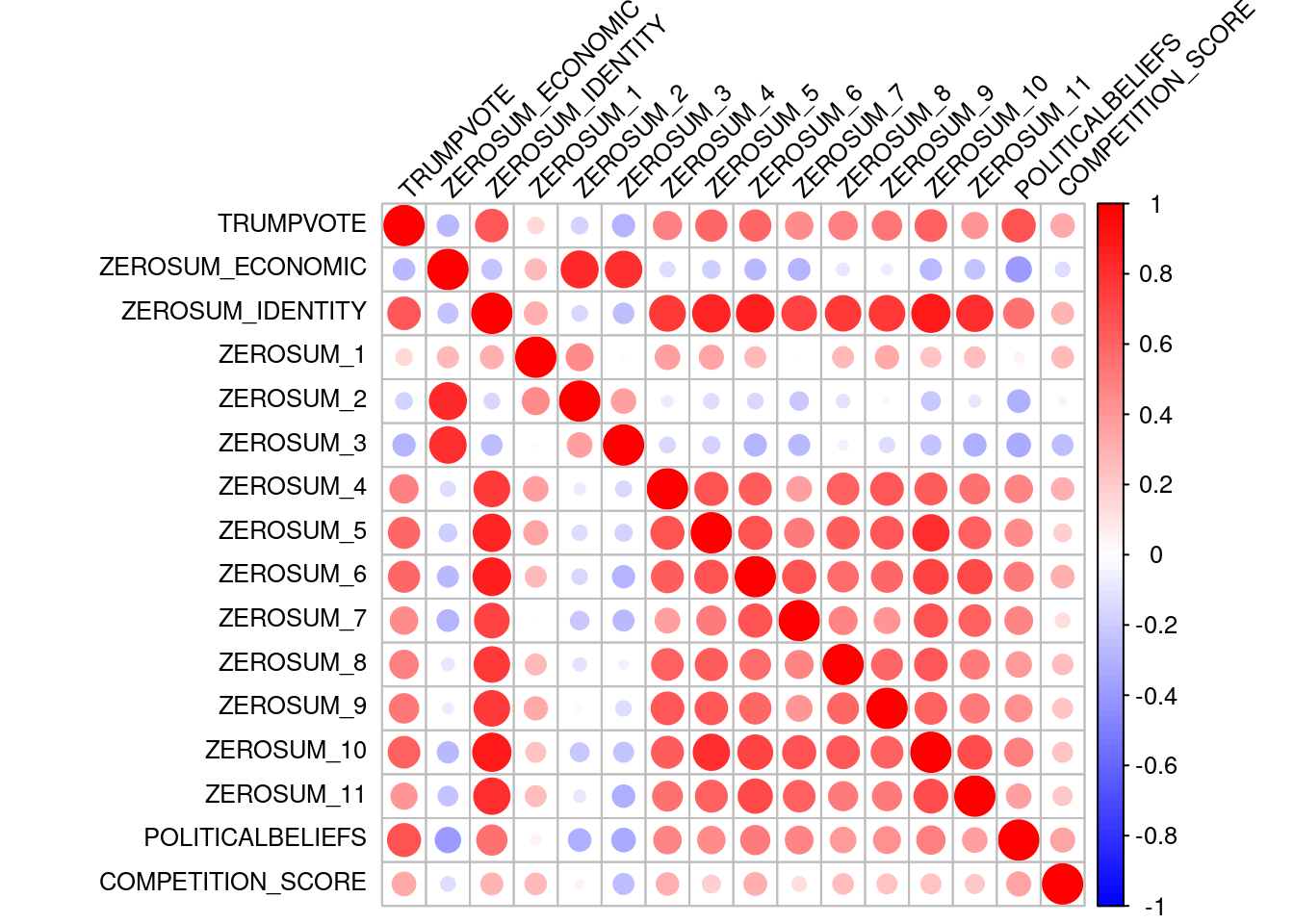
The output below displays the correlation matrix of the Zero-Sum Beliefs items. Each cell represents the Pearson correlation between pairs of items. ZEROSUM_1 is moderately positively correlated with most of the other zero-sum items (r = .092 - .462), suggesting a general zero-sum thinking. ZEROSUM_2 and ZEROSUM_3 also show a moderate positive correlation with each other (r = .479). Most notably, ZEROSUM_4 through ZEROSUM_11 are consistently and positively correlated, with moderately positive correlations (ranging from 0.46 to 0.68), indicating a strong internal consistency among these items. This pattern supports the idea that these items are likely capturing a common latent construct.
In [11]:
Show the code
library(psych)# create data frame of ZEROSUM variables for factor analysisdf.ZEROSUM <- select_data[, c("ZEROSUM_1", "ZEROSUM_2", "ZEROSUM_3", "ZEROSUM_4", "ZEROSUM_5", "ZEROSUM_6", "ZEROSUM_7", "ZEROSUM_8", "ZEROSUM_9", "ZEROSUM_10", "ZEROSUM_11")]# Or using dplyr to select variables# zerosum_vars <- select_data %>% select(ZEROSUM_1:ZEROSUM_11)# Check the correlation matrix firstcor_matrix <-cor(df.ZEROSUM, use ="complete.obs")kable(round(cor_matrix, 2),caption ="Table 27. Correlation Matrix of Zero-Sum Belief Items",booktabs =TRUE) %>%kable_styling(latex_options =c("hold_position", "scale_down"),full_width =FALSE )
Table 27. Correlation Matrix of Zero-Sum Belief Items
ZEROSUM_1
ZEROSUM_2
ZEROSUM_3
ZEROSUM_4
ZEROSUM_5
ZEROSUM_6
ZEROSUM_7
ZEROSUM_8
ZEROSUM_9
ZEROSUM_10
ZEROSUM_11
ZEROSUM_1
1.00
0.38
0.08
0.40
0.34
0.31
0.08
0.23
0.40
0.26
0.24
ZEROSUM_2
0.38
1.00
0.47
-0.02
-0.01
0.01
-0.09
-0.16
0.08
-0.12
-0.04
ZEROSUM_3
0.08
0.47
1.00
-0.06
-0.11
-0.19
-0.14
-0.13
-0.11
-0.20
-0.21
ZEROSUM_4
0.40
-0.02
-0.06
1.00
0.63
0.57
0.33
0.51
0.57
0.48
0.45
ZEROSUM_5
0.34
-0.01
-0.11
0.63
1.00
0.61
0.54
0.58
0.62
0.69
0.57
ZEROSUM_6
0.31
0.01
-0.19
0.57
0.61
1.00
0.55
0.50
0.59
0.68
0.68
ZEROSUM_7
0.08
-0.09
-0.14
0.33
0.54
0.55
1.00
0.42
0.37
0.60
0.55
ZEROSUM_8
0.23
-0.16
-0.13
0.51
0.58
0.50
0.42
1.00
0.51
0.58
0.49
ZEROSUM_9
0.40
0.08
-0.11
0.57
0.62
0.59
0.37
0.51
1.00
0.60
0.53
ZEROSUM_10
0.26
-0.12
-0.20
0.48
0.69
0.68
0.60
0.58
0.60
1.00
0.70
ZEROSUM_11
0.24
-0.04
-0.21
0.45
0.57
0.68
0.55
0.49
0.53
0.70
1.00
Show the code
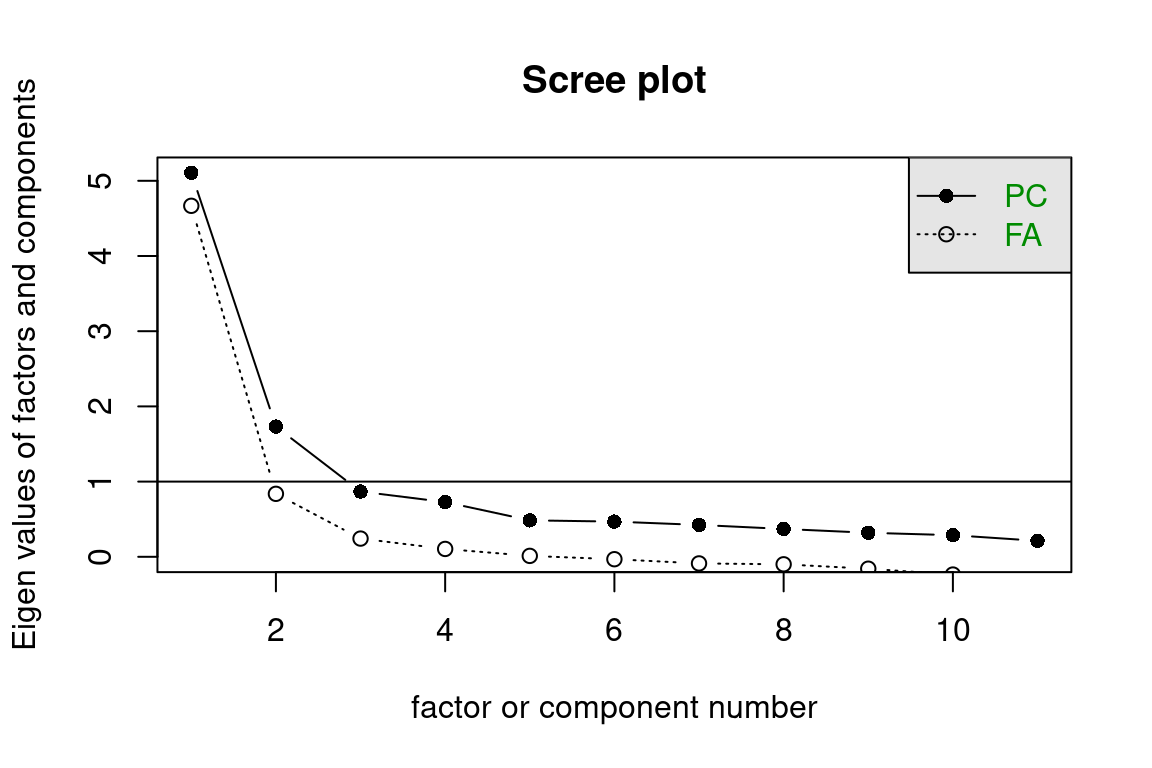
# Determine number of factors using scree plot and parallel analysisscree(df.ZEROSUM)
Show the code
wrapped_fa_parallel <-paste(strwrap(capture.output(fa.parallel(df.ZEROSUM, fa ="fa")), width =80), collapse ="\n")
Show the code
cat(wrapped_fa_parallel, "\n")
Parallel analysis suggests that the number of factors = 2 and the number of
components = NA
Show the code
# Run 2-factor factor analysis (adjust nfactors based on scree plot/parallel analysis)fa_result <-fa(df.ZEROSUM, nfactors =2, # adjust this number based on your analysisrotate ="promax",fm ="ml") # maximum likelihood
Loading required namespace: GPArotation
Show the code
# View resultsprint(fa_result)
Factor Analysis using method =  ml
Call: fa(r = df.ZEROSUM, nfactors = 2, rotate = "promax", fm = "ml")
Standardized loadings (pattern matrix) based upon correlation matrix
             ML2   ML1   h2    u2 com
ZEROSUM_1   0.41  0.39 0.31 0.688 2.0
ZEROSUM_2   0.00  1.00 1.00 0.005 1.0
ZEROSUM_3  -0.18  0.47 0.26 0.742 1.3
ZEROSUM_4   0.67  0.00 0.45 0.546 1.0
ZEROSUM_5   0.81  0.01 0.66 0.337 1.0
ZEROSUM_6   0.81  0.03 0.65 0.348 1.0
ZEROSUM_7   0.64 -0.08 0.42 0.583 1.0
ZEROSUM_8   0.67 -0.15 0.47 0.528 1.1
ZEROSUM_9   0.74  0.10 0.55 0.445 1.0
ZEROSUM_10  0.84 -0.11 0.73 0.271 1.0
ZEROSUM_11  0.77 -0.03 0.59 0.406 1.0

                       ML2  ML1
SS loadings           4.67 1.43
Proportion Var        0.42 0.13
Cumulative Var        0.42 0.55
Proportion Explained  0.77 0.23
Cumulative Proportion 0.77 1.00

 With factor correlations of
      ML2   ML1
ML2  1.00 -0.02
ML1 -0.02  1.00

Mean item complexity =  1.1
Test of the hypothesis that 2 factors are sufficient.

df null model =  55  with the objective function =  5.55 with Chi Square =  613.32
df of  the model are 34  and the objective function was  0.49

The root mean square of the residuals (RMSR) is  0.05
The df corrected root mean square of the residuals is  0.06

The harmonic n.obs is  115 with the empirical chi square  31.85  with prob <  0.57
The total n.obs was  116  with Likelihood Chi Square =  53.46  with prob <  0.018

Tucker Lewis Index of factoring reliability =  0.943
RMSEA index =  0.07  and the 90 % confidence intervals are  0.03 0.105
BIC =  -108.16
Fit based upon off diagonal values = 0.99
Measures of factor score adequacy
                                                   ML2  ML1
Correlation of (regression) scores with factors   0.96 1.00
Multiple R square of scores with factors          0.92 1.00
Minimum correlation of possible factor scores     0.84 0.99
# Get factor scoresfactor_scores <- fa_result$scores
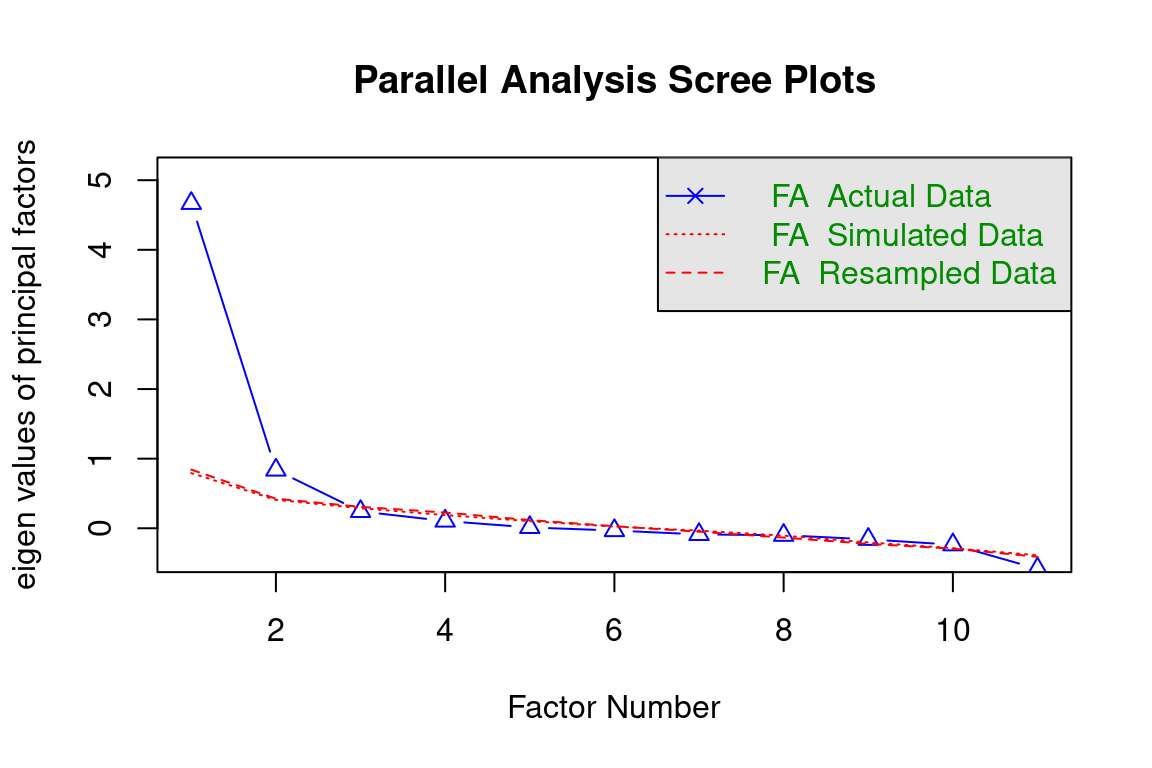
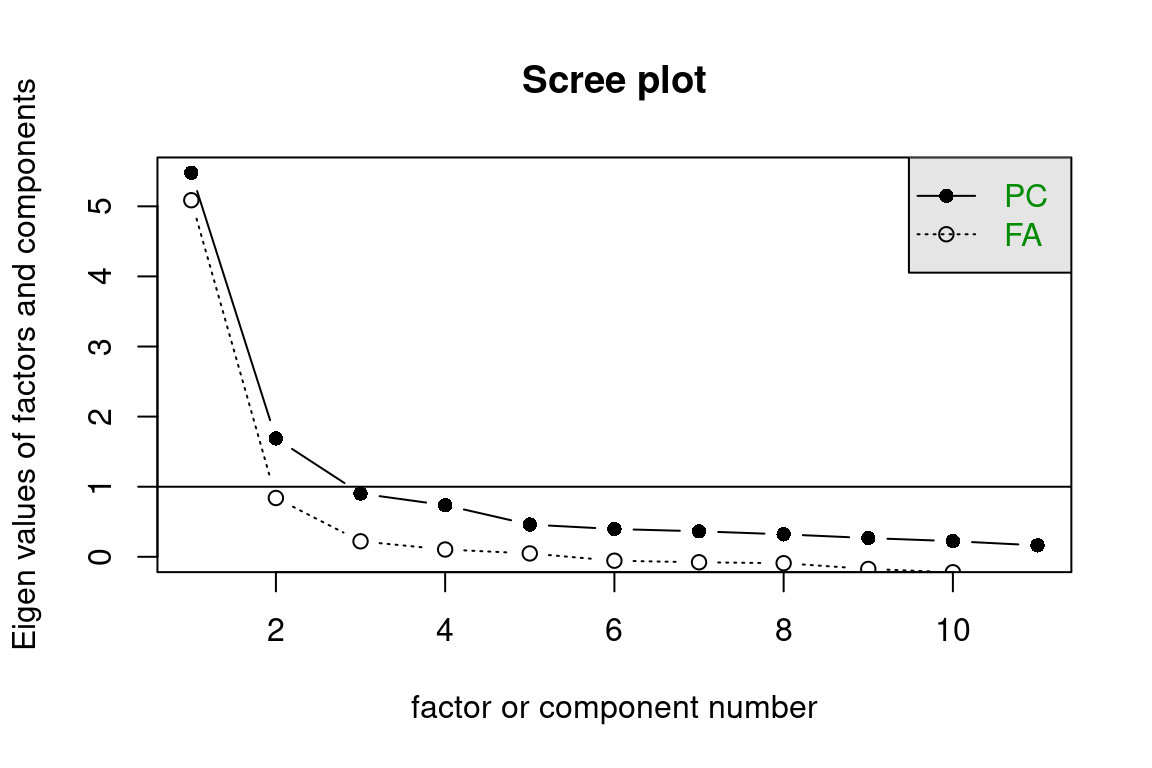
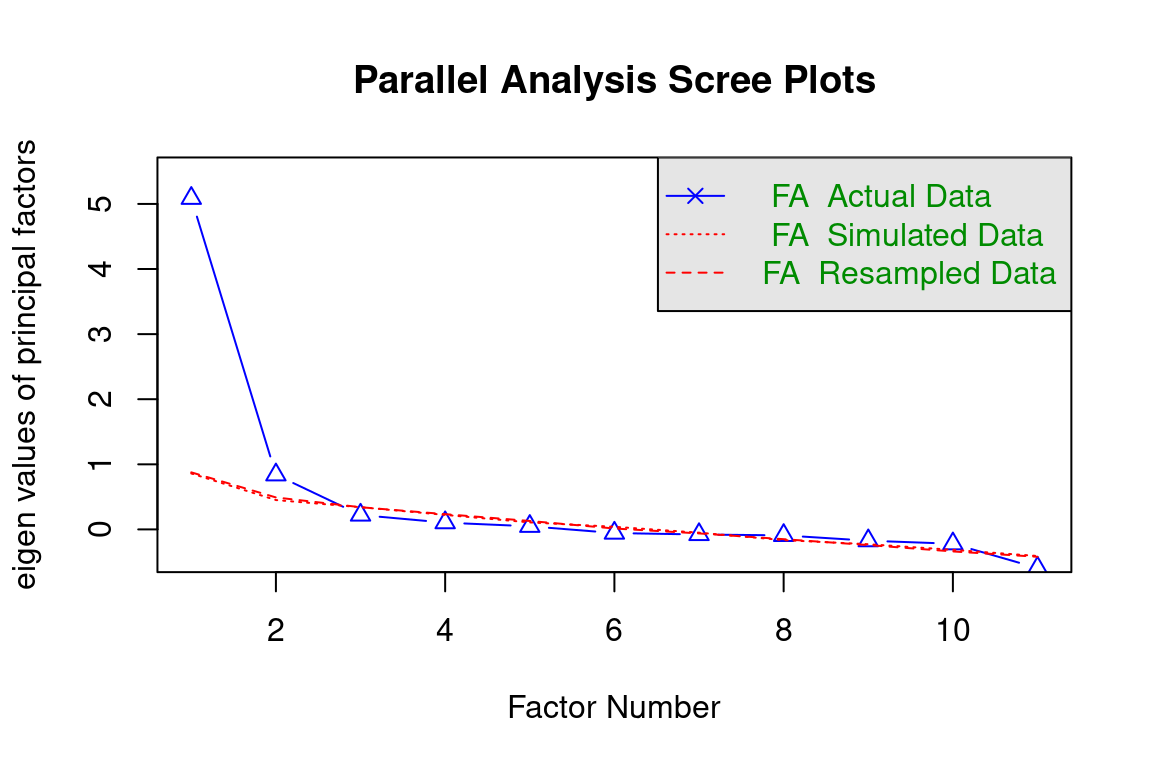
The results of the factor analysis – an unsupervised machine learning technique – support a two factor model with a promax rotation. The first item loads equally on each factor and will not be included in the composite construction. Based on the items, we named the first factor as ZEROSUM_ECONOMIC and the second factor as ZEROSUM_IDENTITY to correspond with the two different referents of economic (e.g., wealth vs. poor) and social identity (e.g., racial minorities vs. white people), respectively. The IDENTITY factor showed high reliability, with a Cronbach’s alpha of 0.91. This means the items in the ZEROSUM_IDENTITY scale consistently measure the same social identity concept.
Table 21. Paired t-Test Comparing ZEROSUM Economic and ZEROSUM Identity
estimate
statistic
p.value
parameter
conf.low
conf.high
method
alternative
1.698465
8.816751
1.65e-14
113
1.316809
2.080121
Paired t-test
two.sided
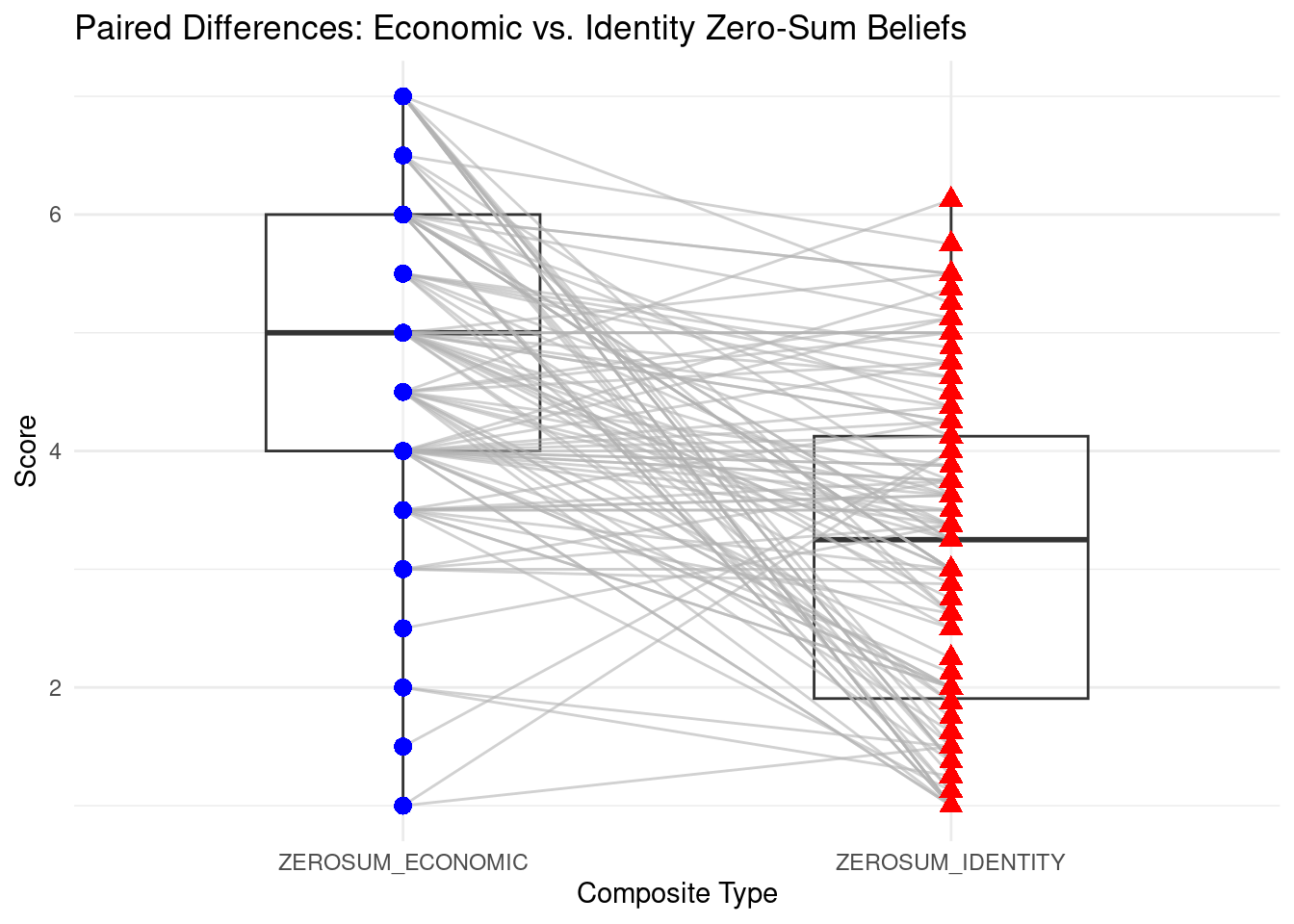
There is a significant difference between participants’ scores on ZEROSUM_ECONOMIC and ZEROSUM_IDENTITY. On average, participants rated economic zero-sum beliefs 1.75 points higher than identity zero-sum beliefs, 95% CI [1.38, 2.12].
In [17]:
Show the code
# Create long data with participant IDpaired_data_long <- select_data %>%select(ZEROSUM_ECONOMIC, ZEROSUM_IDENTITY) %>%filter(!is.na(ZEROSUM_ECONOMIC) &!is.na(ZEROSUM_IDENTITY)) %>%# Remove missing pairsmutate(ID =row_number()) %>%pivot_longer(cols =c(ZEROSUM_ECONOMIC, ZEROSUM_IDENTITY), names_to ="Composite", values_to ="Score")# Plot: boxplot + paired linesggplot(paired_data_long, aes(x = Composite, y = Score, group = ID)) +geom_boxplot(aes(group = Composite), width =0.5, alpha =0.3, fill ="white", outlier.shape =NA) +geom_line(color ="gray70", alpha =0.6) +geom_point(data = paired_data_long %>%filter(Composite =="ZEROSUM_ECONOMIC"), shape =16, size =3, color ="blue") +geom_point(data = paired_data_long %>%filter(Composite =="ZEROSUM_IDENTITY"),shape =17, size =3, color ="red") +labs(title ="Paired Differences: Economic vs. Identity Zero-Sum Beliefs",x ="Composite Type", y ="Score") +theme_minimal()
The final sample reflected racial diversity, with participants identifying as White (n = 48), Black (n = 25), Mixed or Other (n = 25), and Asian (n = 24).
In [18]:
Show the code
table(select_data$ETHNICITY)
      Asian       Black Mixed/Other       White
         23          25          23          45
Show the code
## notice that the groups are unequal which is a problem for the ANOVA.## TO DO: consider whether we should do a non-parametric approach# SOURCE FOR DUMMY CODE## https://stats.oarc.ucla.edu/other/mult-pkg/faq/general/faqwhat-is-dummy-coding/## https://www.nathanwhudson.com/courses/methods/resources/10.%20Dummy%20Coding.pdf## can you find an R specific example?
In [19]:
Show the code
#select_data[, c("RACE", "RACIALIDENTITY.4", "ETHNICITY")]## Race (RACIALIDENTITY.4) was derived from the RACE item. Ethnicity was taken directly from the ETHNICITY item. As expected, these variables were not mutually exclusive, some respondents who identified their race as Mixed/Other reported ethnicity as White. ## So race and ethnicity maybe are not forced to be logically consistent in many people’s minds, I think that's not an error, just like “mixed / biracial” people have multiple identities, and “White” in ethnicity sometimes is interpreted as “White Hispanic” or simply culturally white.
# Run t-tests using the dummy variablezerosum_1_gender <-t.test(ZEROSUM_1 ~ GENDER_MALE, data = select_data)kable(data.frame(t = zerosum_1_gender$statistic,df = zerosum_1_gender$parameter,p_value = zerosum_1_gender$p.value,mean_group_0 = zerosum_1_gender$estimate[1],mean_group_1 = zerosum_1_gender$estimate[2],mean_difference = zerosum_1_gender$estimate[1] - zerosum_1_gender$estimate[2],CI_lower = zerosum_1_gender$conf.int[1],CI_upper = zerosum_1_gender$conf.int[2] ),caption ="Table 22. Independent Samples t-Test: ZEROSUM_1 by Gender",digits =3,booktabs =TRUE)
Table 22. Independent Samples t-Test: ZEROSUM_1 by Gender
t
df
p_value
mean_group_0
mean_group_1
mean_difference
CI_lower
CI_upper
t
0.964
111.94
0.337
4.086
3.776
0.31
-0.328
0.948
There is no significant difference in ZEROSUM_1 scores between men and women (p = .63). The difference in means is small and not statistically meaningful. The 95% CI (-0.48, 0.80) also includes zero, supporting the lack of difference.
Table 23. Independent Samples t-Test: ZEROSUM_ECONOMIC by Gender
t
df
p_value
mean_group_0
mean_group_1
mean_difference
CI_lower
CI_upper
t
1.172
110.757
0.244
4.956
4.664
0.292
-0.202
0.787
There is no significant difference in ZEROSUM_ECONOMIC beliefs between men and women (p = .27). Although women’s mean score appears slightly higher, this difference is not statistically significant. The 95% CI (-0.21, 0.75) includes zero.
Table 24. Independent Samples t-Test: ZEROSUM_IDENTITY by Gender
t
df
p_value
mean_group_0
mean_group_1
mean_difference
CI_lower
CI_upper
t
-0.093
111.232
0.926
3.105
3.129
-0.024
-0.541
0.492
There is no significant difference in ZEROSUM_IDENTITY beliefs between men and women (p = .92). The near-zero difference and very wide p-value indicate no group difference at all.
In [25]:
Show the code
# Reshape the data to long format for easier plottinglong_data <- select_data %>%select(GENDER_MALE, ZEROSUM_1, ZEROSUM_ECONOMIC, ZEROSUM_IDENTITY) %>%mutate(GENDER =ifelse(GENDER_MALE ==1, "Man", "Woman")) %>%pivot_longer(cols =c(ZEROSUM_1, ZEROSUM_ECONOMIC, ZEROSUM_IDENTITY),names_to ="Variable",values_to ="Score")# Create boxplotsggplot(long_data, aes(x = GENDER, y = Score, fill = GENDER)) +geom_boxplot(width =0.5, alpha =0.7) +facet_wrap(~ Variable, scales ="free_y") +labs(title ="Gender Differences in Zero-Sum Beliefs",x ="Gender",y ="Score") +scale_y_continuous(limits =c(1, 7), breaks =1:7) +theme_minimal() +theme(legend.position ="none")
Warning: Removed 3 rows containing non-finite outside the scale range
(`stat_boxplot()`).
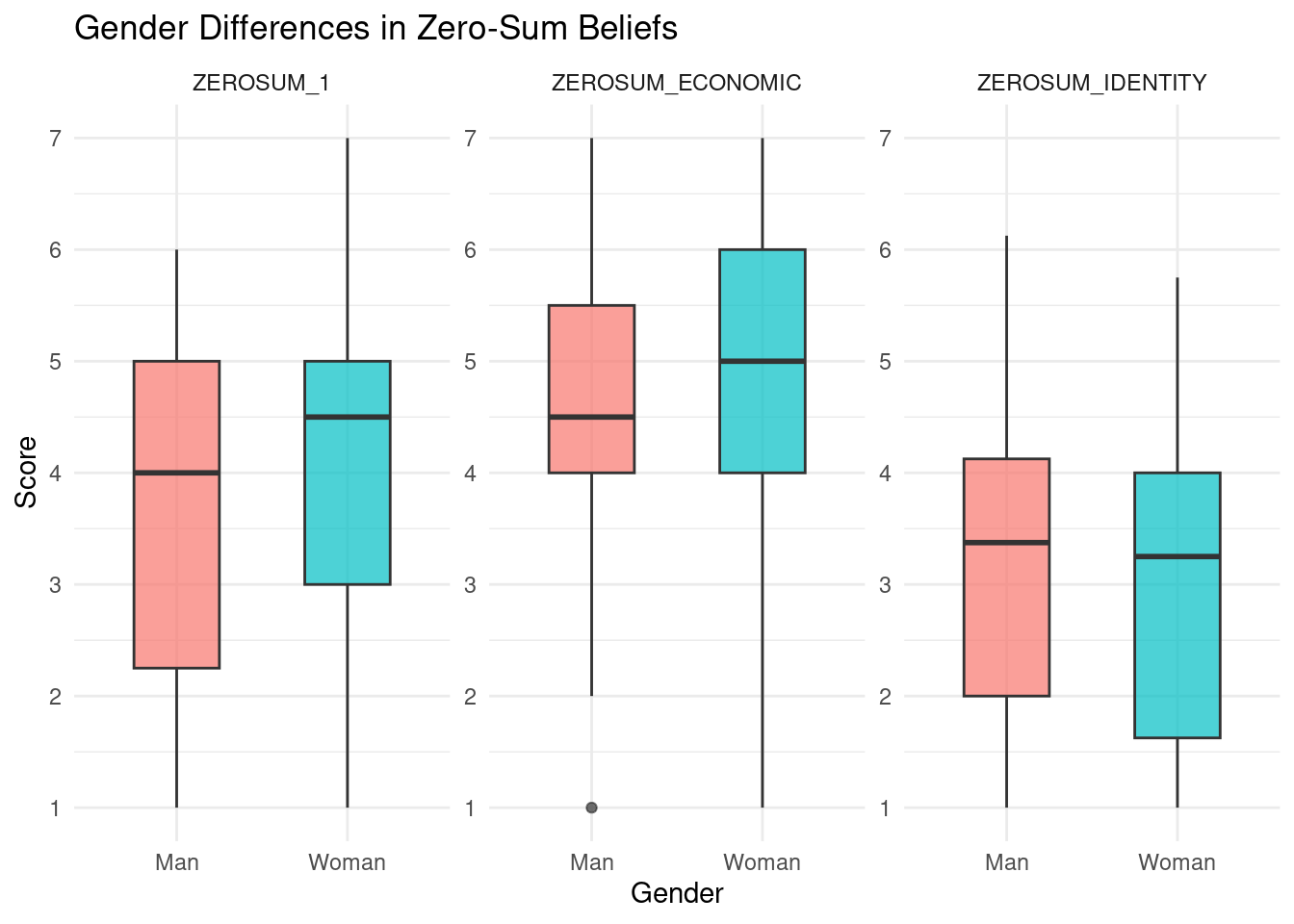
Across all three variables (ZEROSUM_1, ZEROSUM_ECONOMIC, ZEROSUM_IDENTITY), gender is not associated with significant differences in zero-sum beliefs in our sample. As shown in the box plots, the median scores are nearly identical across genders, and the range from the median to the 3rd quartile (i.e., the upper half of the middle 50%) is also highly similar. The overall range of scores tends to span from approximately 1 to 7 for both female and male participants, further indicating that the distribution of zero-sum beliefs is comparable across gender groups.
Zero-Sum Beliefs by Political Party Affiliation
Gain vs. Loss
Do zero-sum beliefs regarding gains and losses differ by racial/ethnic identity and political party affiliation?
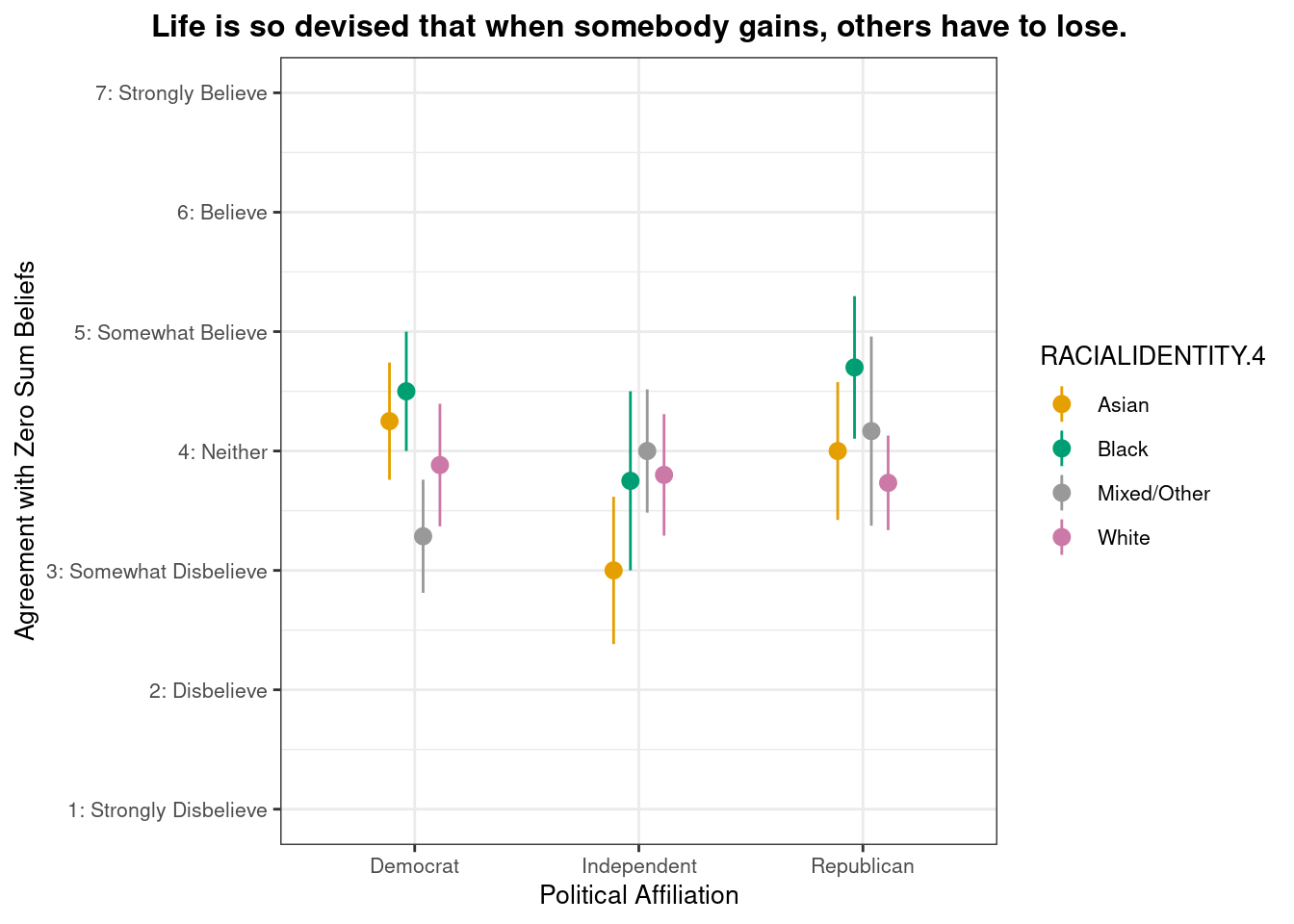
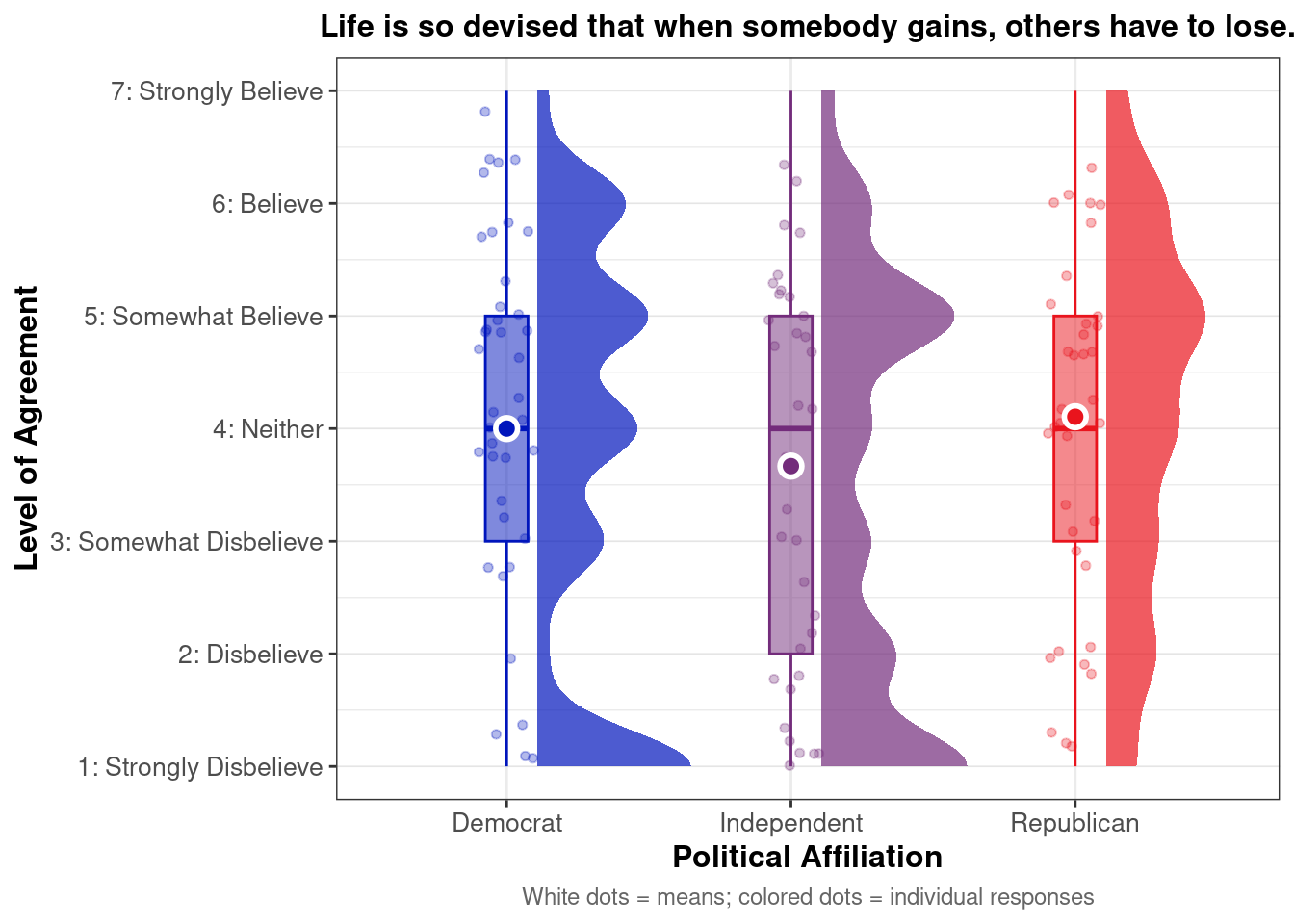
Below we present descriptive statistics and visualizations for ZEROSUM_1 (“Life is so devised that when somebody gains, others have to lose”), examining how responses vary across racial identity and political affiliation.
# A tibble: 6 × 4
  POLITICALPARTY RACIALIDENTITY.4 mean_ZEROSUM_1    se
  <chr>          <chr>                     <dbl> <dbl>
1 Democrat       Asian                      4.25 0.491
2 Democrat       Black                      4.5  0.5
3 Democrat       Mixed/Other                3.29 0.474
4 Democrat       White                      3.88 0.514
5 Independent    Asian                      3    0.617
6 Independent    Black                      3.75 0.75
In [28]:
Show the code
# Define the zesty_four palettezesty_four <-c("#E69F00", "#009E73", "#999999", "#CC79A7") # Create the plot with pointrangeplot.zerosum1 <-ggplot(group_stats_1, aes(POLITICALPARTY, mean_ZEROSUM_1)) +geom_pointrange(aes(color = RACIALIDENTITY.4, ymin = mean_ZEROSUM_1 - se, # Use standard error instead of sdymax = mean_ZEROSUM_1 + se), # Use standard error instead of sdposition =position_dodge(0.3)) +theme_bw() +labs(title ="Life is so devised that when somebody gains, others have to lose.",x ="Political Affiliation",y ="Agreement with Zero Sum Beliefs",color ="RACIALIDENTITY.4") +theme(plot.title =element_text(size =12, face ="bold", hjust =0.5),axis.title =element_text(size =10),axis.text =element_text(size =8),legend.title =element_text(size =10),legend.text =element_text(size =8) ) +scale_y_continuous(breaks =1:7,labels =c("1: Strongly Disbelieve", "2: Disbelieve", "3: Somewhat Disbelieve", "4: Neither", "5: Somewhat Believe", "6: Believe", "7: Strongly Believe"),limits =c(1, 7) # Set the y-axis limits to match the scale )+scale_color_manual(values = zesty_four)# Print and save the plotsprint(plot.zerosum1)
Mean agreement with the belief that “life is so devised that when somebody gains, others have to lose,” by political party and racial/ethnic identity.
This pointrange plot shows that Black respondents exhibit higher agreement with the belief that “life is so devised that when somebody gains, others have to lose” among Republicans and Democrats, highlighting group-based differences in zero-sum beliefs.
In [29]:
Show the code
# ZEROSUM_1 average score with 95% CIgroup_stats_1_avg <- select_data %>%group_by(POLITICALPARTY) %>%summarise(mean_ZEROSUM_1 =mean(ZEROSUM_1, na.rm =TRUE),se =sd(ZEROSUM_1, na.rm =TRUE) /sqrt(n()),n =n(),.groups ='drop' ) %>%mutate(# Calculate 95% confidence interval using t-distributiont_value =qt(0.975, df = n -1), # 95% CI, two-tailedci_lower = mean_ZEROSUM_1 - t_value * se,ci_upper = mean_ZEROSUM_1 + t_value * se )
Do zero-sum beliefs regarding gains and losses differ by political party affiliation?
Warning: Removed 6 rows containing missing values or values outside the scale range
(`geom_point()`).
Distribution of agreement with ‘life is so devised that when somebody gains, others have to lose’ by political affiliation. White dots represent means; colored dots are individual responses.
This raincloud plot shows that mean agreement with the zero-sum belief (indicated by white dots) varies by political affiliation. Among the three groups, Republicans exhibit higher average agreement with the statement “Life is so devised that when somebody gains, others have to lose.” The distribution (via density and individual dots) suggests greater clustering of high agreement scores among partisans, reflecting perceived competition between social groups. The relatively narrow IQRs and tight clustering around high values also indicate consistent endorsement of this belief within parties.
In [31]:
Show the code
shapiro_zerosum1 <- select_data %>%group_by(RACIALIDENTITY.4) %>%summarise(p =shapiro.test(ZEROSUM_1)$p.value)kable( shapiro_zerosum1,caption ="Table 25. Shapiro–Wilk Normality Test for ZEROSUM_1 by Racial Identity",digits =4,booktabs =TRUE)
Table 25. Shapiro–Wilk Normality Test for ZEROSUM_1 by Racial Identity
RACIALIDENTITY.4
p
Asian
0.0758
Black
0.0143
Mixed/Other
0.1651
White
0.0002
Show the code
## White, Mixed/Other (p<0.05) fail the normality assumption for ANOVA, maybe use a non-parametric test (Kruskal-Wallis)
Table 26. Kruskal-Wallis Test Results for ZEROSUM_1
Predictor
df
Chi-squared
p
POLITICALPARTY
2
1.04
0.594
There was no significant difference in ZEROSUM_1 scores across political party groups, Kruskal-Wallis χ²(2) = 1.04, p = 0.594.
Poor vs. Rich
Do zero-sum beliefs regarding poor and rich differ by racial/ethnic identity and political party affiliation?
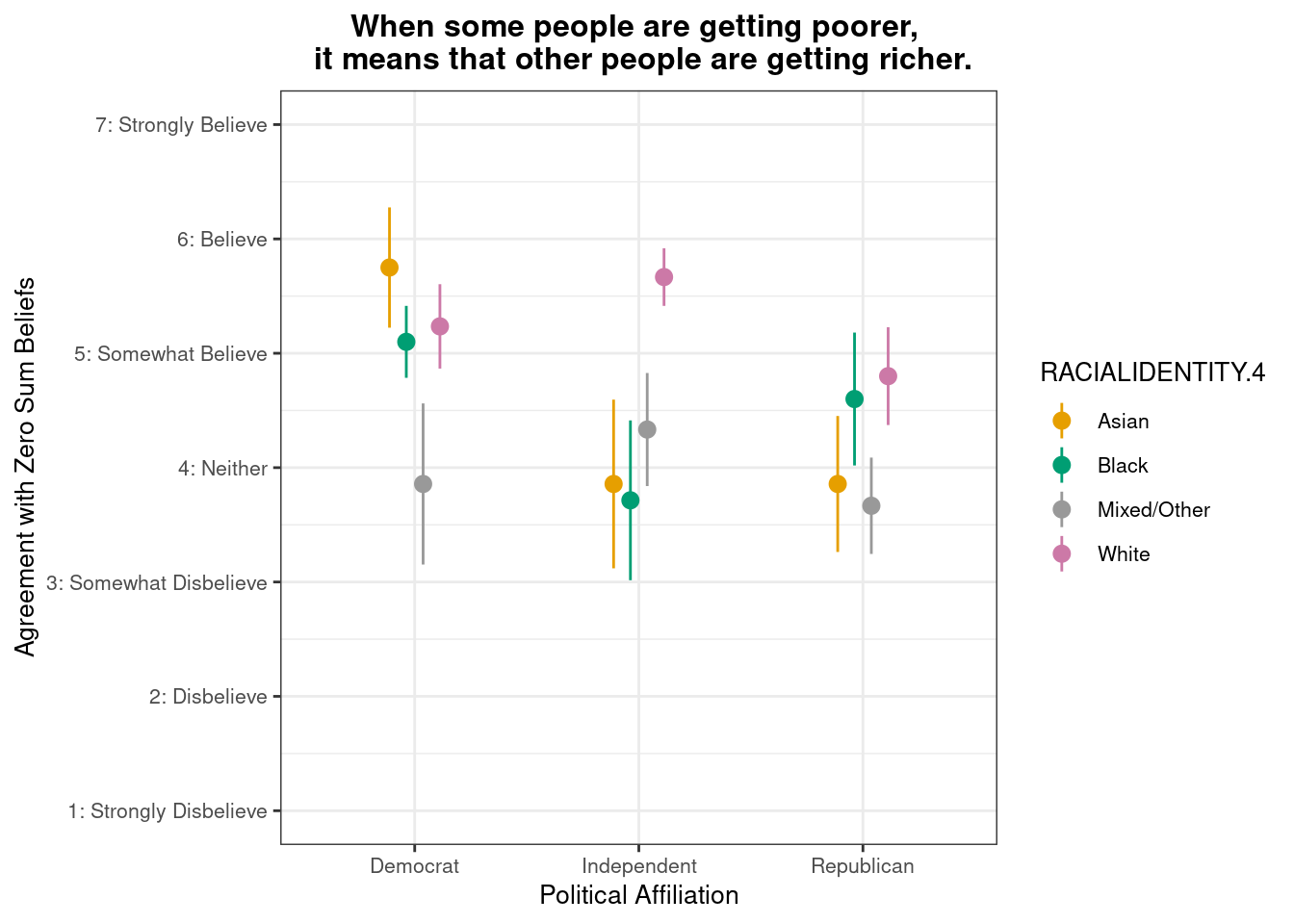
Below we present descriptive statistics and visualizations for ZEROSUM_2 (“When some people are getting poorer, it means that other people are getting richer.”), examining how responses vary across racial identity and political affiliation.
# A tibble: 6 × 4
  POLITICALPARTY RACIALIDENTITY.4 mean_ZEROSUM_2    se
  <chr>          <chr>                     <dbl> <dbl>
1 Democrat       Asian                      5.75 0.526
2 Democrat       Black                      5.1  0.314
3 Democrat       Mixed/Other                3.86 0.705
4 Democrat       White                      5.24 0.369
5 Independent    Asian                      3.86 0.738
6 Independent    Black                      3.71 0.699
In [35]:
Show the code
# Define the zesty_four palettezesty_four <-c("#E69F00", "#009E73", "#999999", "#CC79A7") # Create the plot with pointrangeplot.zerosum2 <-ggplot(group_stats_2, aes(POLITICALPARTY, mean_ZEROSUM_2)) +geom_pointrange(aes(color = RACIALIDENTITY.4,ymin = mean_ZEROSUM_2 - se,# Use standard error instead of sdymax = mean_ZEROSUM_2 + se),# Use standard error instead of sdposition =position_dodge(0.3)) +theme_bw() +labs(title ="When some people are getting poorer, \n it means that other people are getting richer.",x ="Political Affiliation",y ="Agreement with Zero Sum Beliefs",color ="RACIALIDENTITY.4") +theme(plot.title =element_text(size =12, face ="bold", hjust =0.5),axis.title =element_text(size =10),axis.text =element_text(size =8),legend.title =element_text(size =10),legend.text =element_text(size =8) ) +scale_y_continuous(breaks =1:7,labels =c("1: Strongly Disbelieve", "2: Disbelieve", "3: Somewhat Disbelieve", "4: Neither", "5: Somewhat Believe", "6: Believe", "7: Strongly Believe"),limits =c(1, 7) # Set the y-axis limits to match the scale )+scale_color_manual(values = zesty_four)# Print and save the plotsprint(plot.zerosum2)
This pointrange plot shows that White respondents exhibit higher agreement with the belief that “when some people are getting poorer, it means that other people are getting richer” among Republicans and Independents, highlighting group-based differences in zero-sum beliefs.
In [36]:
Show the code
# ZEROSUM_1 average score with 95% CIgroup_stats_2_avg <- select_data %>%group_by(POLITICALPARTY) %>%summarise(mean_ZEROSUM_2 =mean(ZEROSUM_2, na.rm =TRUE),se =sd(ZEROSUM_2, na.rm =TRUE) /sqrt(n()),n =n(),.groups ='drop' ) %>%mutate(# Calculate 95% confidence interval using t-distributiont_value =qt(0.975, df = n -1), # 95% CI, two-tailedci_lower = mean_ZEROSUM_2 - t_value * se,ci_upper = mean_ZEROSUM_2 + t_value * se )
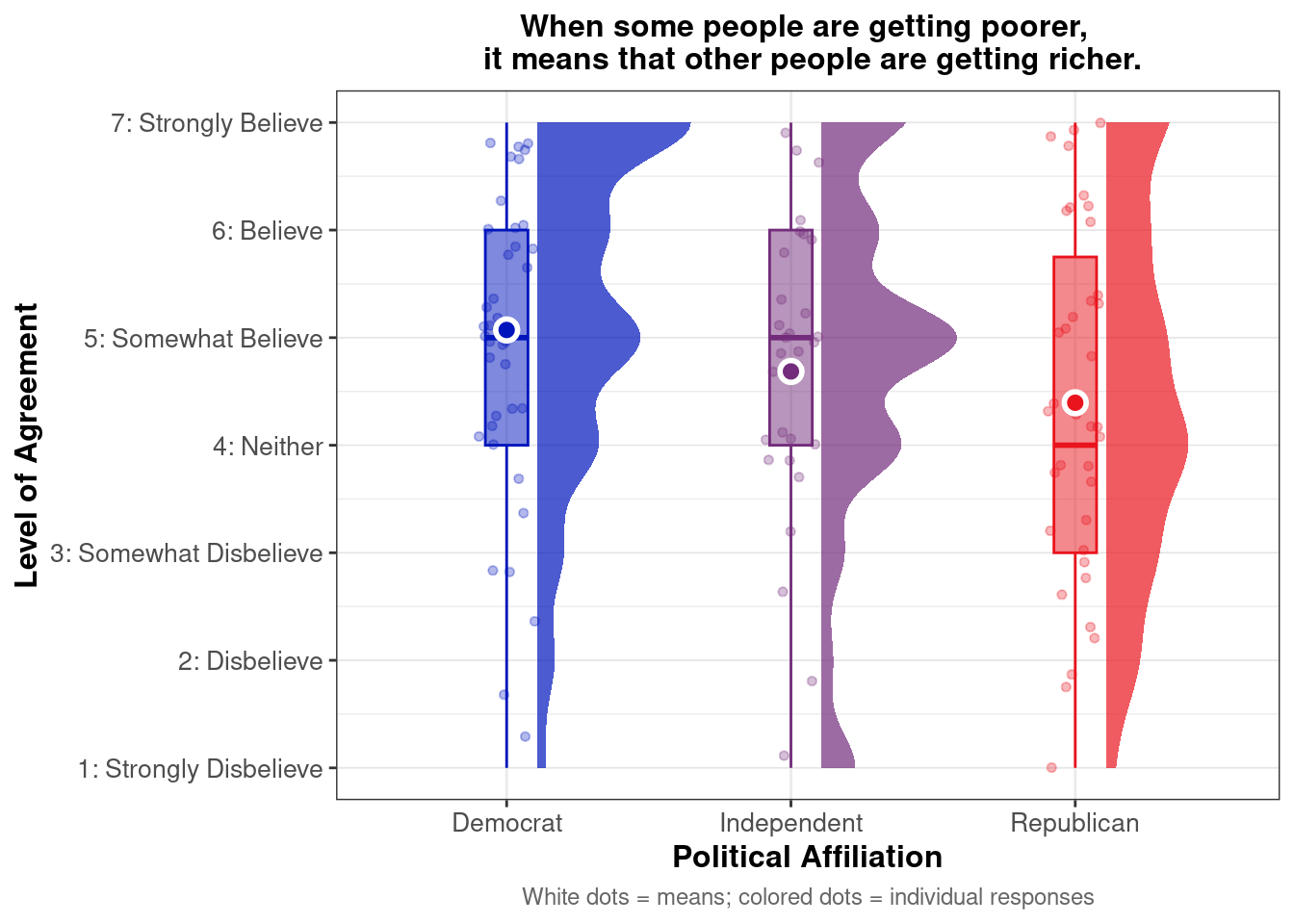
Do zero-sum beliefs regarding poor and rich differ by political party affiliation?
In [37]:
Show the code
library(ggdist)library(patchwork)plot.zerosum2_raincloud <- select_data %>%filter(!is.na(ZEROSUM_2), !is.na(POLITICALPARTY)) %>%ggplot(aes(x = POLITICALPARTY, y = ZEROSUM_2, fill = POLITICALPARTY, color = POLITICALPARTY)) +stat_halfeye(adjust =0.5,width =0.6,.width =0,justification =-0.2,point_colour =NA,alpha =0.7 ) +geom_boxplot(width =0.15,outlier.shape =NA,alpha =0.5 ) +geom_point(size =1.3,alpha =0.3,position =position_jitter(seed =1, width =0.1 ) ) +stat_summary(fun = mean,geom ="point",size =3,color ="white",stroke =1.5,shape =21 ) +scale_fill_manual(values = party_colors) +scale_color_manual(values = party_colors) +theme_bw() +labs(title ="When some people are getting poorer, \n it means that other people are getting richer.",x ="Political Affiliation",y ="Level of Agreement",caption ="White dots = means; colored dots = individual responses" ) +theme(plot.title =element_text(size =12, face ="bold", hjust =0.5),plot.caption =element_text(size =9, color ="gray40", hjust =0.5),axis.title =element_text(size =12, face ="bold"),axis.text =element_text(size =10),legend.position ="none",panel.grid.major.y =element_line(color ="gray90", linewidth =0.3) # Fixed ) +scale_y_continuous(breaks =1:7,labels =c("1: Strongly Disbelieve", "2: Disbelieve", "3: Somewhat Disbelieve", "4: Neither", "5: Somewhat Believe", "6: Believe", "7: Strongly Believe"),limits =c(1, 7) )plot.zerosum2_raincloud
Warning: Removed 8 rows containing missing values or values outside the scale range
(`geom_point()`).
This raincloud plot shows that mean agreement with the zero-sum belief (indicated by white dots) varies by political affiliation. Among the three groups, Democrat exhibit higher average agreement with the statement “When some people are getting poorer, it means that other people are getting richer.” ßThe distribution (via density and individual dots) reveals different patterns across groups. Democrats show greater clustering of high agreement scores (concentrated in the 5-7 range). Republicans show the most dispersed distribution with responses spread across nearly the full scale. Independents are more concentrated in the middle-to-lower range.
In [38]:
Show the code
shapiro_zerosum2 <- select_data %>%group_by(RACIALIDENTITY.4) %>%summarise(p =shapiro.test(ZEROSUM_2)$p.value)kable( shapiro_zerosum2,caption ="Table 27. Shapiro–Wilk Normality Test for ZEROSUM_2 by Racial Identity",digits =4,booktabs =TRUE)
Table 27. Shapiro–Wilk Normality Test for ZEROSUM_2 by Racial Identity
RACIALIDENTITY.4
p
Asian
0.0203
Black
0.0410
Mixed/Other
0.1886
White
0.0005
Show the code
## Asian, Black, White (p<0.05) fail the normality assumption for ANOVA, maybe use a non-parametric test (Kruskal-Wallis)
Table 28. Kruskal-Wallis Test Results for ZEROSUM_2
Predictor
df
Chi-squared
p
POLITICALPARTY
2
4.09
0.129
There was no significant difference in ZEROSUM_2 scores across political party groups, Kruskal-Wallis χ²(2) = 4.09, p = 0.129.
Wealth few vs. many
Do zero-sum beliefs regarding wealth concentration differ by racial/ethnic identity and political party affiliation?
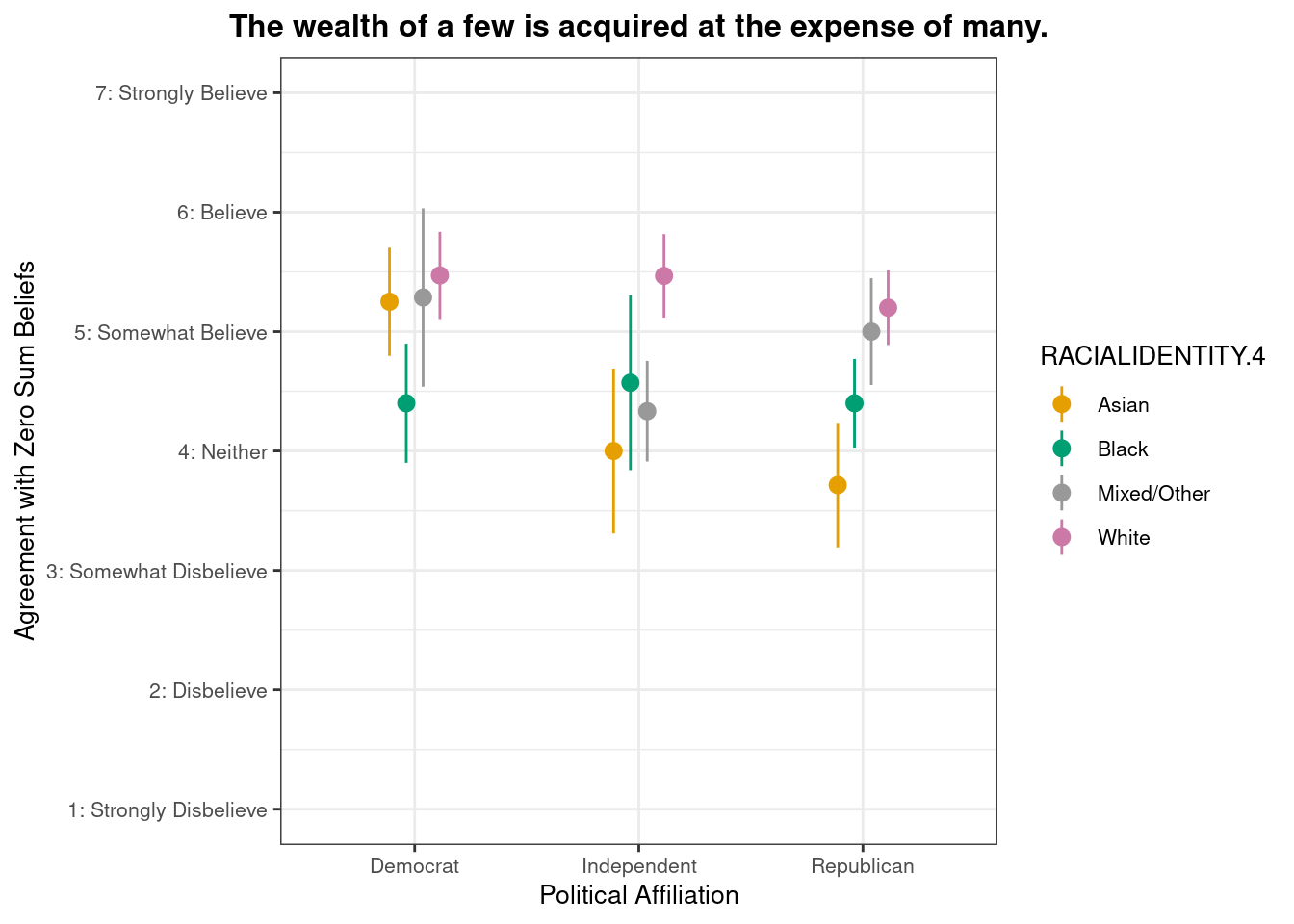
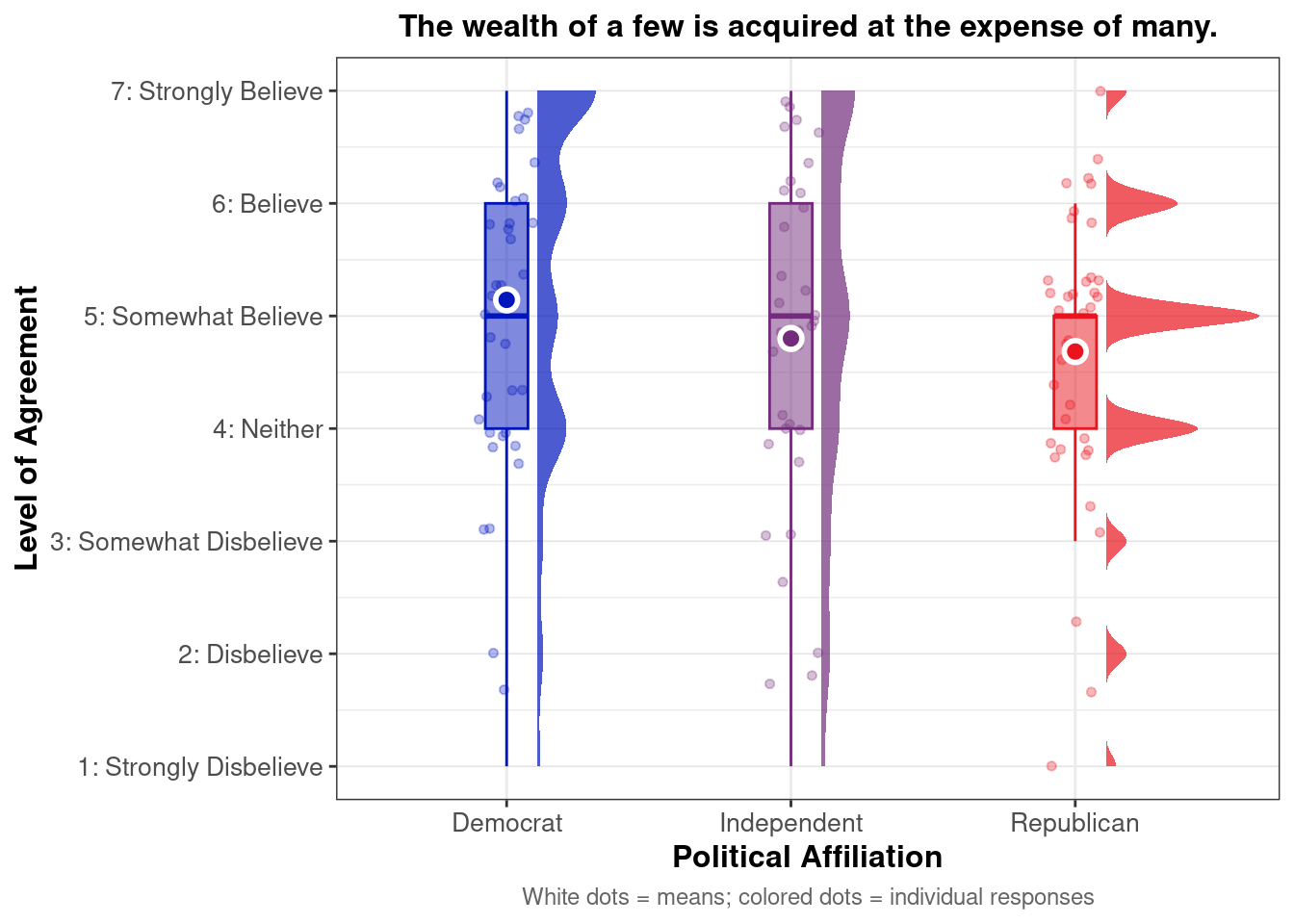
Below we present descriptive statistics and visualizations for ZEROSUM_3 (“The wealth of a few is acquired at the expense of many.”), examining how responses vary across racial identity and political affiliation.
# A tibble: 6 × 4
  POLITICALPARTY RACIALIDENTITY.4 mean_ZEROSUM_3    se
  <chr>          <chr>                     <dbl> <dbl>
1 Democrat       Asian                      5.25 0.453
2 Democrat       Black                      4.4  0.499
3 Democrat       Mixed/Other                5.29 0.747
4 Democrat       White                      5.47 0.365
5 Independent    Asian                      4    0.690
6 Independent    Black                      4.57 0.732
In [42]:
Show the code
# Define the zesty_four palettezesty_four <-c("#E69F00", "#009E73", "#999999", "#CC79A7") # Create the plot with pointrangeplot.zerosum3 <-ggplot(group_stats_3,aes(POLITICALPARTY, mean_ZEROSUM_3)) +geom_pointrange(aes(color = RACIALIDENTITY.4,ymin = mean_ZEROSUM_3 - se,# Use standard error instead of sdymax = mean_ZEROSUM_3 + se),# Use standard error instead of sdposition =position_dodge(0.3)) +theme_bw() +labs(title ="The wealth of a few is acquired at the expense of many.",x ="Political Affiliation",y ="Agreement with Zero Sum Beliefs",color ="RACIALIDENTITY.4") +theme(plot.title =element_text(size =12, face ="bold", hjust =0.5),axis.title =element_text(size =10),axis.text =element_text(size =8),legend.title =element_text(size =10),legend.text =element_text(size =8) ) +scale_y_continuous(breaks =1:7,labels =c("1: Strongly Disbelieve", "2: Disbelieve", "3: Somewhat Disbelieve", "4: Neither", "5: Somewhat Believe", "6: Believe", "7: Strongly Believe"),limits =c(1, 7) # Set the y-axis limits to match the scale )+scale_color_manual(values = zesty_four)# Print and save the plotsprint(plot.zerosum3)
This pointrange plot shows that White respondents exhibit higher agreement with the belief that “the wealth of a few is acquired at the expense of many” among all three political groups, highlighting group-based differences in zero-sum beliefs.
In [43]:
Show the code
# ZEROSUM_3 average score with 95% CIgroup_stats_3_avg <- select_data %>%group_by(POLITICALPARTY) %>%summarise(mean_ZEROSUM_3 =mean(ZEROSUM_3, na.rm =TRUE),se =sd(ZEROSUM_3, na.rm =TRUE) /sqrt(n()),n =n(),.groups ='drop' ) %>%mutate(# Calculate 95% confidence interval using t-distributiont_value =qt(0.975, df = n -1), # 95% CI, two-tailedci_lower = mean_ZEROSUM_3 - t_value * se,ci_upper = mean_ZEROSUM_3 + t_value * se )
Do zero-sum beliefs regarding wealth concentration differ by political party affiliation?
In [44]:
Show the code
plot.zerosum3_raincloud <- select_data %>%filter(!is.na(ZEROSUM_3), !is.na(POLITICALPARTY)) %>%ggplot(aes(x = POLITICALPARTY, y = ZEROSUM_3, fill = POLITICALPARTY, color = POLITICALPARTY)) +stat_halfeye(adjust =0.5,width =0.6,.width =0,justification =-0.2,point_colour =NA,alpha =0.7 ) +geom_boxplot(width =0.15,outlier.shape =NA,alpha =0.5 ) +geom_point(size =1.3,alpha =0.3,position =position_jitter(seed =1, width =0.1 ) ) +stat_summary(fun = mean,geom ="point",size =3,color ="white",stroke =1.5,shape =21 ) +scale_fill_manual(values = party_colors) +scale_color_manual(values = party_colors) +theme_bw() +labs(title ="The wealth of a few is acquired at the expense of many.",x ="Political Affiliation",y ="Level of Agreement",caption ="White dots = means; colored dots = individual responses" ) +theme(plot.title =element_text(size =12, face ="bold", hjust =0.5),plot.caption =element_text(size =9, color ="gray40", hjust =0.5),axis.title =element_text(size =12, face ="bold"),axis.text =element_text(size =10),legend.position ="none",panel.grid.major.y =element_line(color ="gray90", linewidth =0.3) # Fixed ) +scale_y_continuous(breaks =1:7,labels =c("1: Strongly Disbelieve", "2: Disbelieve", "3: Somewhat Disbelieve", "4: Neither", "5: Somewhat Believe", "6: Believe", "7: Strongly Believe"),limits =c(1, 7) )plot.zerosum3_raincloud
Warning: Removed 10 rows containing missing values or values outside the scale range
(`geom_point()`).
This raincloud plot shows that mean agreement with the zero-sum belief (indicated by white dots) varies by political affiliation. Among the three groups, Democrat exhibit higher average agreement with the statement “the wealth of a few is acquired at the expense of many.” The distribution (via density and individual dots) reveals different patterns across groups. Democrats show strong clustering around high agreement scores (concentrated in the 5-7 range) with a clear rightward skew toward stronger belief. Republicans display a more spread distribution with notable presence across moderate to high agreement levels, though still centered around the middle range. Independents show a relatively concentrated distribution around the moderate-to-high range (4-6), with their mean falling between the other two groups.
In [45]:
Show the code
shapiro_zerosum3 <- select_data %>%group_by(RACIALIDENTITY.4) %>%summarise(p =shapiro.test(ZEROSUM_3)$p.value)kable( shapiro_zerosum3,caption ="Table 29. Shapiro–Wilk Normality Test for ZEROSUM_3 by Racial Identity",digits =6,booktabs =TRUE)
Table 29. Shapiro–Wilk Normality Test for ZEROSUM_3 by Racial Identity
RACIALIDENTITY.4
p
Asian
0.176619
Black
0.031488
Mixed/Other
0.031972
White
0.000089
Show the code
## Black, White, Mixed/Other (p<0.05) fail the normality assumption for ANOVA, maybe use a non-parametric test (Kruskal-Wallis)
Table 30. Kruskal-Wallis Test Results for ZEROSUM_3
Predictor
df
Chi-squared
p
POLITICALPARTY
2
2.34
0.311
There was no significant difference in ZEROSUM_3 scores across political party groups, Kruskal-Wallis χ²(2) = 2.34, p = 0.311.
Women vs. Men
Do zero-sum beliefs regarding gender discrimination differ by racial/ethnic identity and political party affiliation?
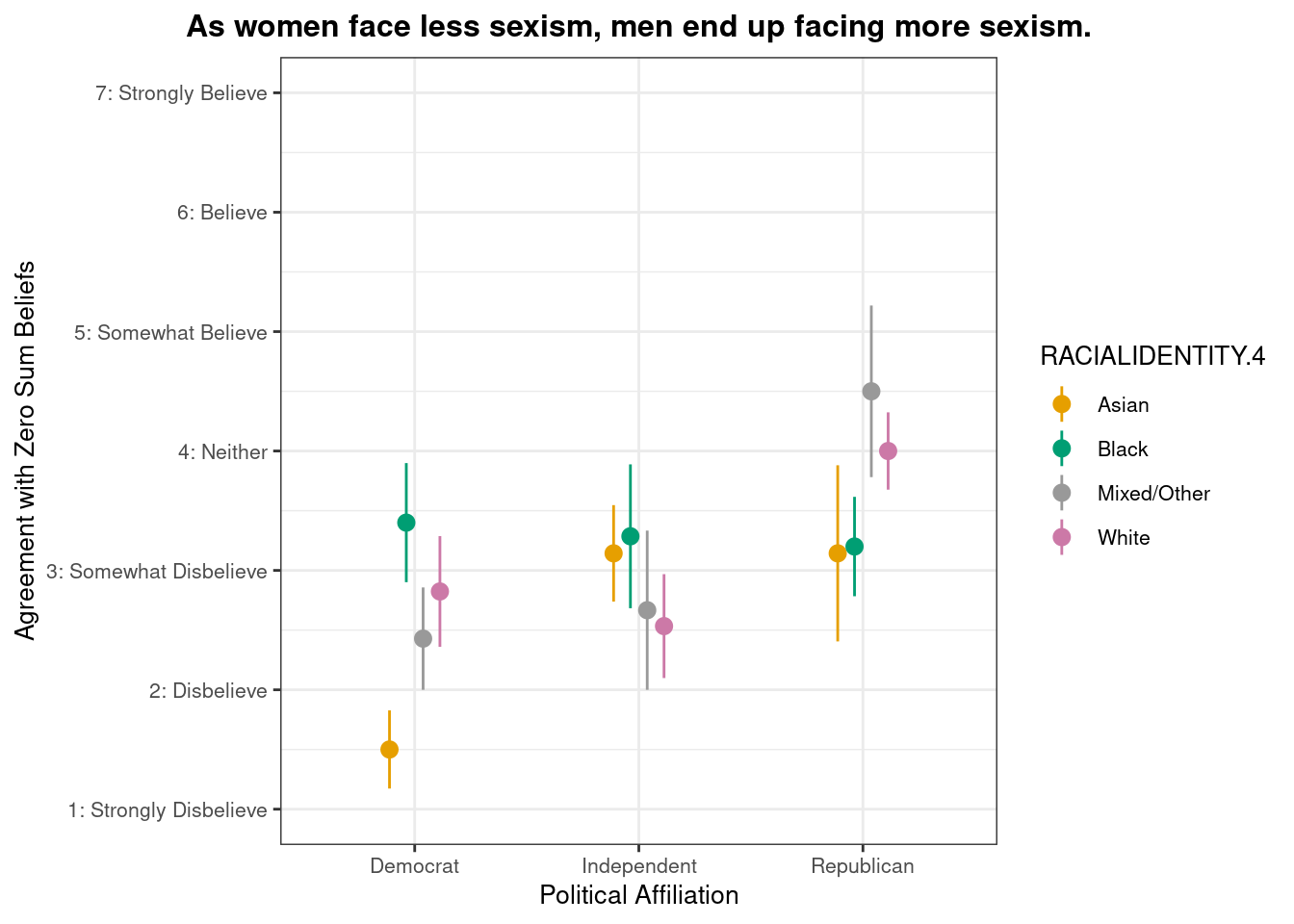
Below we present descriptive statistics and visualizations for ZEROSUM_4 (“As women face less sexism, men end up facing more sexism.”), examining how responses vary across racial identity and political affiliation.
# A tibble: 6 × 4
  POLITICALPARTY RACIALIDENTITY.4 mean_ZEROSUM_4    se
  <chr>          <chr>                     <dbl> <dbl>
1 Democrat       Asian                      1.5  0.327
2 Democrat       Black                      3.4  0.499
3 Democrat       Mixed/Other                2.43 0.429
4 Democrat       White                      2.82 0.464
5 Independent    Asian                      3.14 0.404
6 Independent    Black                      3.29 0.603
In [49]:
Show the code
# Define the zesty_four palettezesty_four <-c("#E69F00", "#009E73", "#999999", "#CC79A7") # Create the plot with pointrangeplot.zerosum4 <-ggplot(group_stats_4, aes(POLITICALPARTY, mean_ZEROSUM_4)) +geom_pointrange(aes(color = RACIALIDENTITY.4, ymin = mean_ZEROSUM_4 - se,# Use standard error instead of sdymax = mean_ZEROSUM_4 + se),# Use standard error instead of sdposition =position_dodge(0.3)) +theme_bw() +labs(title ="As women face less sexism, men end up facing more sexism.",x ="Political Affiliation",y ="Agreement with Zero Sum Beliefs",color ="RACIALIDENTITY.4") +theme(plot.title =element_text(size =12, face ="bold", hjust =0.5),axis.title =element_text(size =10),axis.text =element_text(size =8),legend.title =element_text(size =10),legend.text =element_text(size =8) ) +scale_y_continuous(breaks =1:7,labels =c("1: Strongly Disbelieve", "2: Disbelieve", "3: Somewhat Disbelieve", "4: Neither", "5: Somewhat Believe", "6: Believe", "7: Strongly Believe"),limits =c(1, 7) # Set the y-axis limits to match the scale )+scale_color_manual(values = zesty_four)# Print and save the plotsprint(plot.zerosum4)
This pointrange plot shows that Mixed/Other respondents exhibit higher agreement with the belief that “As women face less sexism, men end up facing more sexism.” among Republicans. Among political groups, Republicans show the highest overall agreement, while Democrats (particularly Asian and Mixed/Other respondents) show the lowest agreement. The pattern highlights how both political affiliation and racial identity intersect to shape zero-sum beliefs about gender discrimination.
In [50]:
Show the code
# ZEROSUM_4 average score with 95% CIgroup_stats_4_avg <- select_data %>%group_by(POLITICALPARTY) %>%summarise(mean_ZEROSUM_4 =mean(ZEROSUM_4, na.rm =TRUE),se =sd(ZEROSUM_4, na.rm =TRUE) /sqrt(n()),n =n(),.groups ='drop' ) %>%mutate(# Calculate 95% confidence interval using t-distributiont_value =qt(0.975, df = n -1), # 95% CI, two-tailedci_lower = mean_ZEROSUM_4 - t_value * se,ci_upper = mean_ZEROSUM_4 + t_value * se )
Do zero-sum beliefs regarding gender discrimination differ by political party affiliation?
In [51]:
Show the code
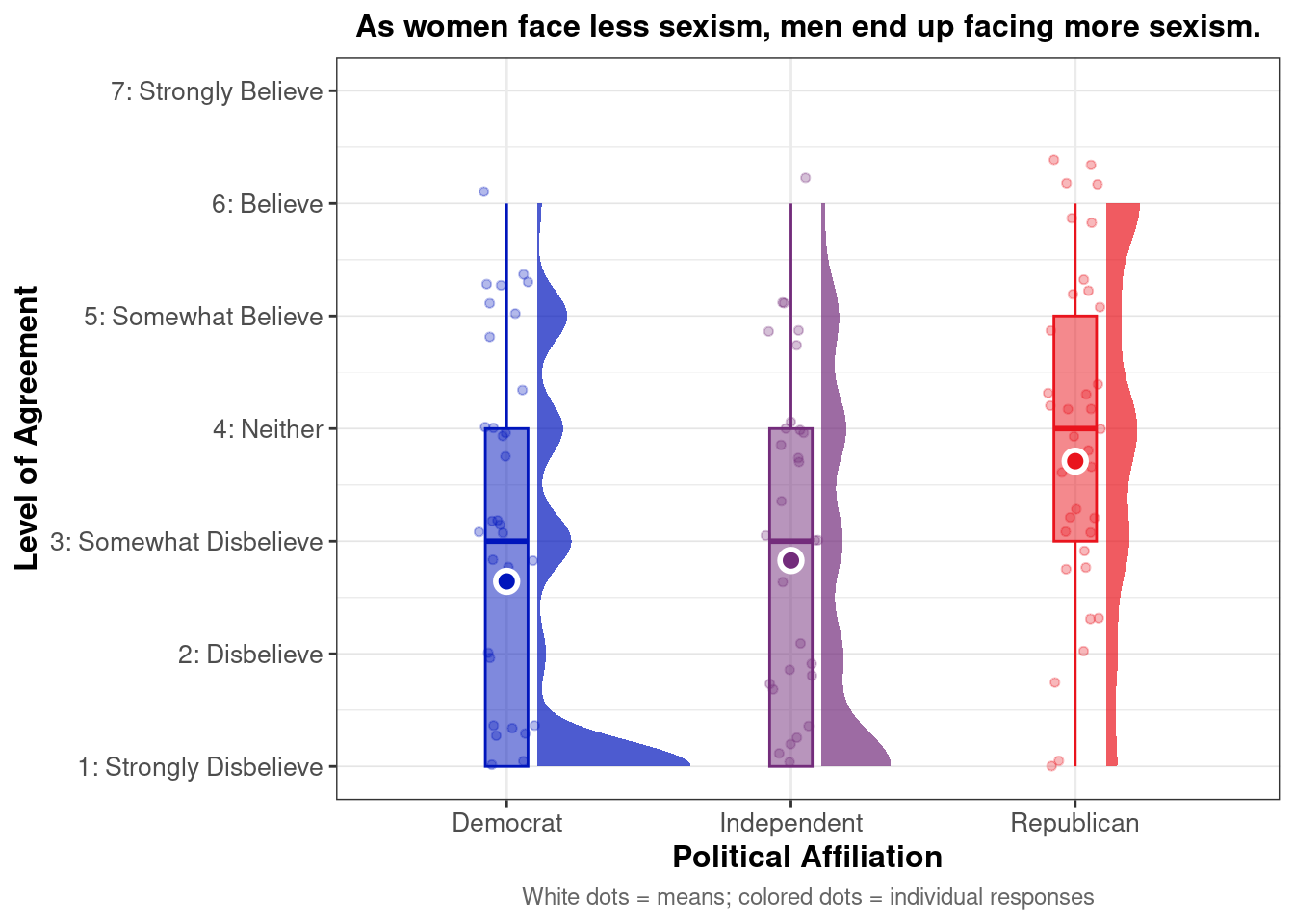
plot.zerosum4_raincloud <- select_data %>%filter(!is.na(ZEROSUM_4), !is.na(POLITICALPARTY)) %>%ggplot(aes(x = POLITICALPARTY, y = ZEROSUM_4, fill = POLITICALPARTY, color = POLITICALPARTY)) +stat_halfeye(adjust =0.5,width =0.6,.width =0,justification =-0.2,point_colour =NA,alpha =0.7 ) +geom_boxplot(width =0.15,outlier.shape =NA,alpha =0.5 ) +geom_point(size =1.3,alpha =0.3,position =position_jitter(seed =1, width =0.1 ) ) +stat_summary(fun = mean,geom ="point",size =3,color ="white",stroke =1.5,shape =21 ) +scale_fill_manual(values = party_colors) +scale_color_manual(values = party_colors) +theme_bw() +labs(title ="As women face less sexism, men end up facing more sexism.",x ="Political Affiliation",y ="Level of Agreement",caption ="White dots = means; colored dots = individual responses" ) +theme(plot.title =element_text(size =12, face ="bold", hjust =0.5),plot.caption =element_text(size =9, color ="gray40", hjust =0.5),axis.title =element_text(size =12, face ="bold"),axis.text =element_text(size =10),legend.position ="none",panel.grid.major.y =element_line(color ="gray90", linewidth =0.3) # Fixed ) +scale_y_continuous(breaks =1:7,labels =c("1: Strongly Disbelieve", "2: Disbelieve", "3: Somewhat Disbelieve", "4: Neither", "5: Somewhat Believe", "6: Believe", "7: Strongly Believe"),limits =c(1, 7) )plot.zerosum4_raincloud
Warning: Removed 18 rows containing missing values or values outside the scale range
(`geom_point()`).
This raincloud plot shows that mean agreement with the zero-sum belief (indicated by white dots) varies by political affiliation. Among the three groups, Republican exhibit higher average agreement with the statement “As women face less sexism, men end up facing more sexism.”
The distribution (via density and individual dots) reveals different patterns across groups. Republicans show a relatively spread distribution with responses concentrated in the moderate-to-high range (3-6) and some clustering around the mean. Independents display a more concentrated distribution around the lower-moderate range with their density peaked around 2-4. Democrats show the most pronounced leftward skew with strong clustering in the low agreement range (1-3) and a long tail extending toward higher values, indicating most Democrats disagree with this zero-sum perspective on gender discrimination.
In [52]:
Show the code
shapiro_zerosum4 <- select_data %>%group_by(RACIALIDENTITY.4) %>%summarise(p =shapiro.test(ZEROSUM_4)$p.value)kable( shapiro_zerosum4,caption ="Table 31. Shapiro–Wilk Normality Test for ZEROSUM_4 by Racial Identity",digits =4,booktabs =TRUE)
Table 31. Shapiro–Wilk Normality Test for ZEROSUM_4 by Racial Identity
Table 32. Kruskal-Wallis Test Results for ZEROSUM_4
Predictor
df
Chi-squared
p
POLITICALPARTY
2
9.06
0.011
There was significant difference in ZEROSUM_4 scores across political party groups, Kruskal-Wallis χ²(2) = 9.06, p = 0.0108.
Minorities vs. Whites
Do zero-sum beliefs regarding racial discrimination (minorities and whites) differ by racial/ethnic identity and political party affiliation?
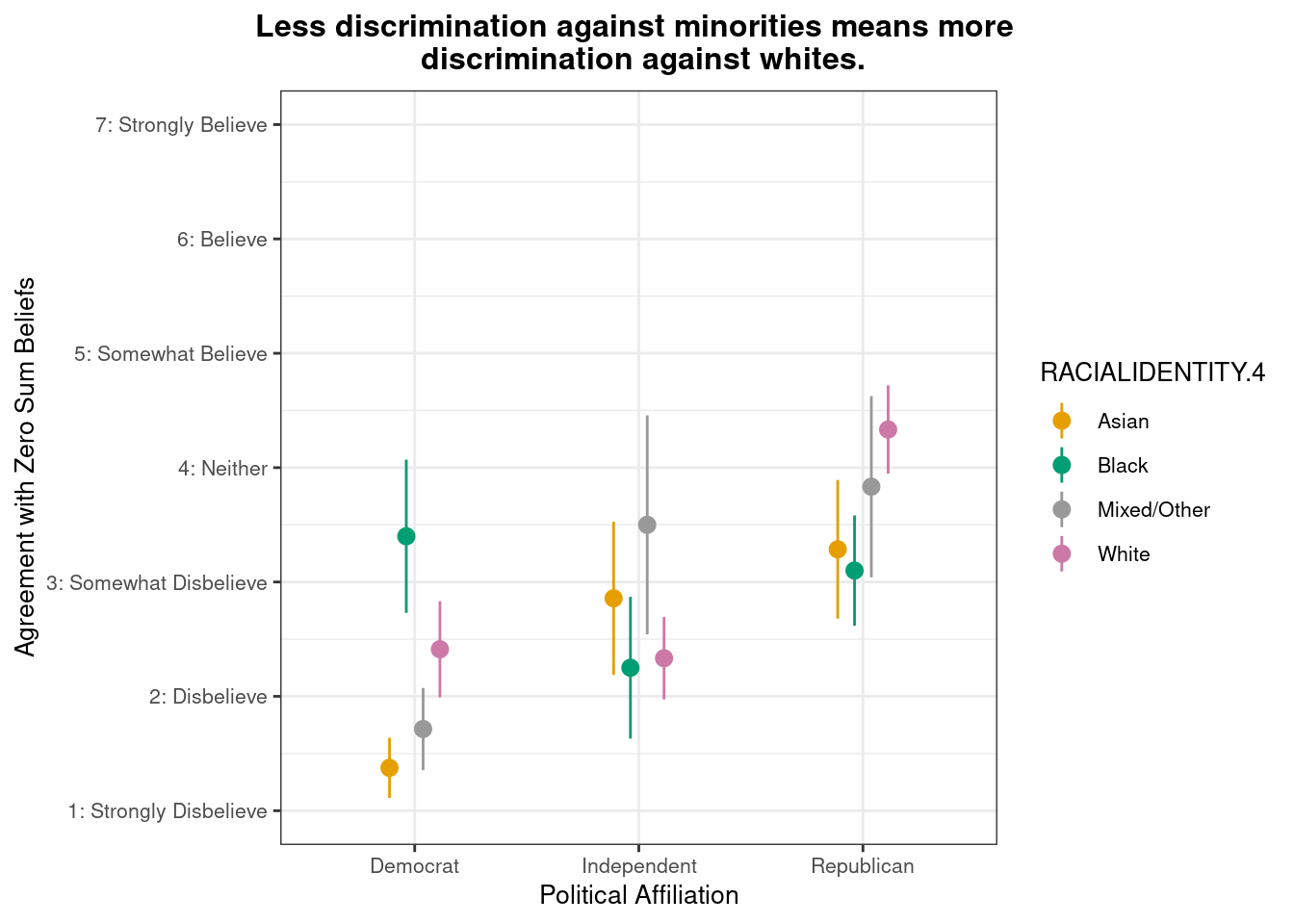
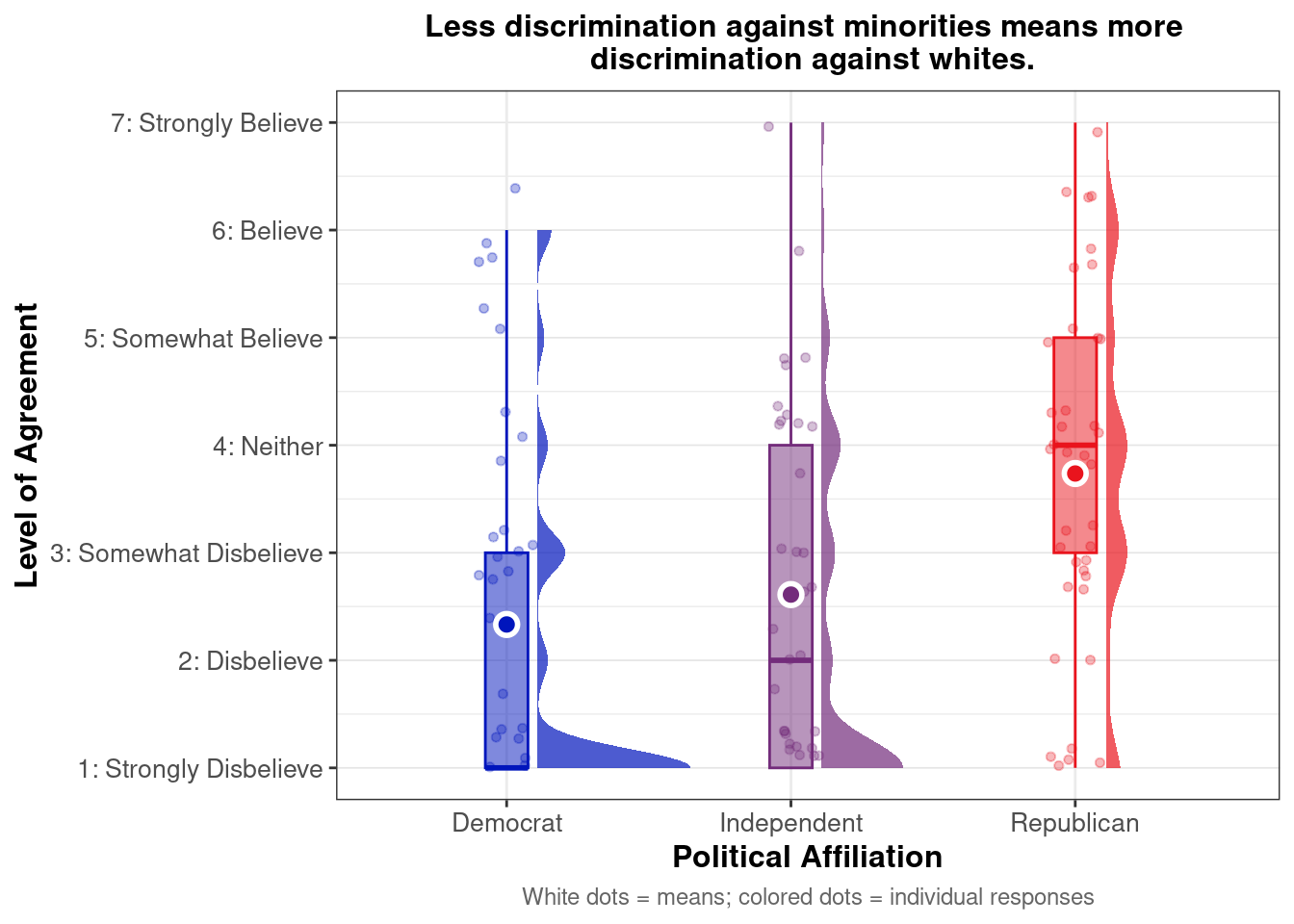
Below we present descriptive statistics and visualizations for ZEROSUM_5 (“Less discrimination against minorities means more discrimination against whites.”), examining how responses vary across racial identity and political affiliation.
# A tibble: 6 × 4
  POLITICALPARTY RACIALIDENTITY.4 mean_ZEROSUM_5    se
  <chr>          <chr>                     <dbl> <dbl>
1 Democrat       Asian                      1.38 0.263
2 Democrat       Black                      3.4  0.670
3 Democrat       Mixed/Other                1.71 0.360
4 Democrat       White                      2.41 0.421
5 Independent    Asian                      2.86 0.670
6 Independent    Black                      2.25 0.620
In [56]:
Show the code
# Define the zesty_four palettezesty_four <-c("#E69F00", "#009E73", "#999999", "#CC79A7") # Create the plot with pointrangeplot.zerosum5 <-ggplot(group_stats_5, aes(POLITICALPARTY, mean_ZEROSUM_5)) +geom_pointrange(aes(color = RACIALIDENTITY.4, ymin = mean_ZEROSUM_5 - se, # Use standard error instead of sdymax = mean_ZEROSUM_5 + se), # Use standard error instead of sdposition =position_dodge(0.3)) +theme_bw() +labs(title ="Less discrimination against minorities means more \n discrimination against whites.",x ="Political Affiliation",y ="Agreement with Zero Sum Beliefs",color ="RACIALIDENTITY.4") +theme(plot.title =element_text(size =12, face ="bold", hjust =0.5),axis.title =element_text(size =10),axis.text =element_text(size =8),legend.title =element_text(size =10),legend.text =element_text(size =8) ) +scale_y_continuous(breaks =1:7,labels =c("1: Strongly Disbelieve", "2: Disbelieve", "3: Somewhat Disbelieve", "4: Neither", "5: Somewhat Believe", "6: Believe", "7: Strongly Believe"),limits =c(1, 7) # Set the y-axis limits to match the scale )+scale_color_manual(values = zesty_four)# Print and save the plotsprint(plot.zerosum5)
This pointrange plot shows that White respondents exhibit higher agreement with the belief that “Less discrimination against minorities means more discrimination against whites.” among Republicans. Among political groups, Republicans show the highest overall agreement, while Democrats (particularly Asian and Mixed/Other respondents) show the lowest agreement. The pattern highlights how both political affiliation and racial identity intersect to shape zero-sum beliefs about racial discrimination.
In [57]:
Show the code
# ZEROSUM_5 average score with 95% CIgroup_stats_5_avg <- select_data %>%group_by(POLITICALPARTY) %>%summarise(mean_ZEROSUM_5 =mean(ZEROSUM_5, na.rm =TRUE),se =sd(ZEROSUM_5, na.rm =TRUE) /sqrt(n()),n =n(),.groups ='drop' ) %>%mutate(# Calculate 95% confidence interval using t-distributiont_value =qt(0.975, df = n -1), # 95% CI, two-tailedci_lower = mean_ZEROSUM_5 - t_value * se,ci_upper = mean_ZEROSUM_5 + t_value * se )
Do zero-sum beliefs regarding racial discrimination (minorities and whites) differ by political party affiliation?
Warning: Removed 19 rows containing missing values or values outside the scale range
(`geom_point()`).
This raincloud plot shows that mean agreement with the zero-sum belief (indicated by white dots) varies by political affiliation. Among the three groups, Republican exhibit higher average agreement with the statement “Less discrimination against minorities means more discrimination against whites.” The distribution (via density and individual dots) reveals different patterns across groups. Republicans show a broader distribution with notable density across moderate-to-high agreement levels (3-6), indicating more varied responses within the party. Independents display a relatively concentrated distribution around the lower-moderate range with their density peaked around 1-4. Democrats show strong leftward skew with pronounced clustering in the low agreement range (1-3) and a steep drop-off at higher values, indicating most Democrats reject this zero-sum perspective on racial discrimination.
In [59]:
Show the code
shapiro_zerosum5 <- select_data %>%group_by(RACIALIDENTITY.4) %>%summarise(p =shapiro.test(ZEROSUM_5)$p.value)kable( shapiro_zerosum5,caption ="Table 33. Shapiro–Wilk Normality Test for ZEROSUM_5 by Racial Identity",digits =4,booktabs =TRUE)
Table 33. Shapiro–Wilk Normality Test for ZEROSUM_5 by Racial Identity
Table 34. Kruskal-Wallis Test Results for ZEROSUM_5
Predictor
df
Chi-squared
p
POLITICALPARTY
2
14.82
0.00061
There was significant difference in ZEROSUM_5 scores across political party groups, Kruskal-Wallis χ²(2) = 14.82, p = 6.06^{-4}.
Transgender vs. Cisgender
Do zero-sum beliefs regarding gender identity (transgender and cisgender) differ by racial/ethnic identity and political party affiliation?
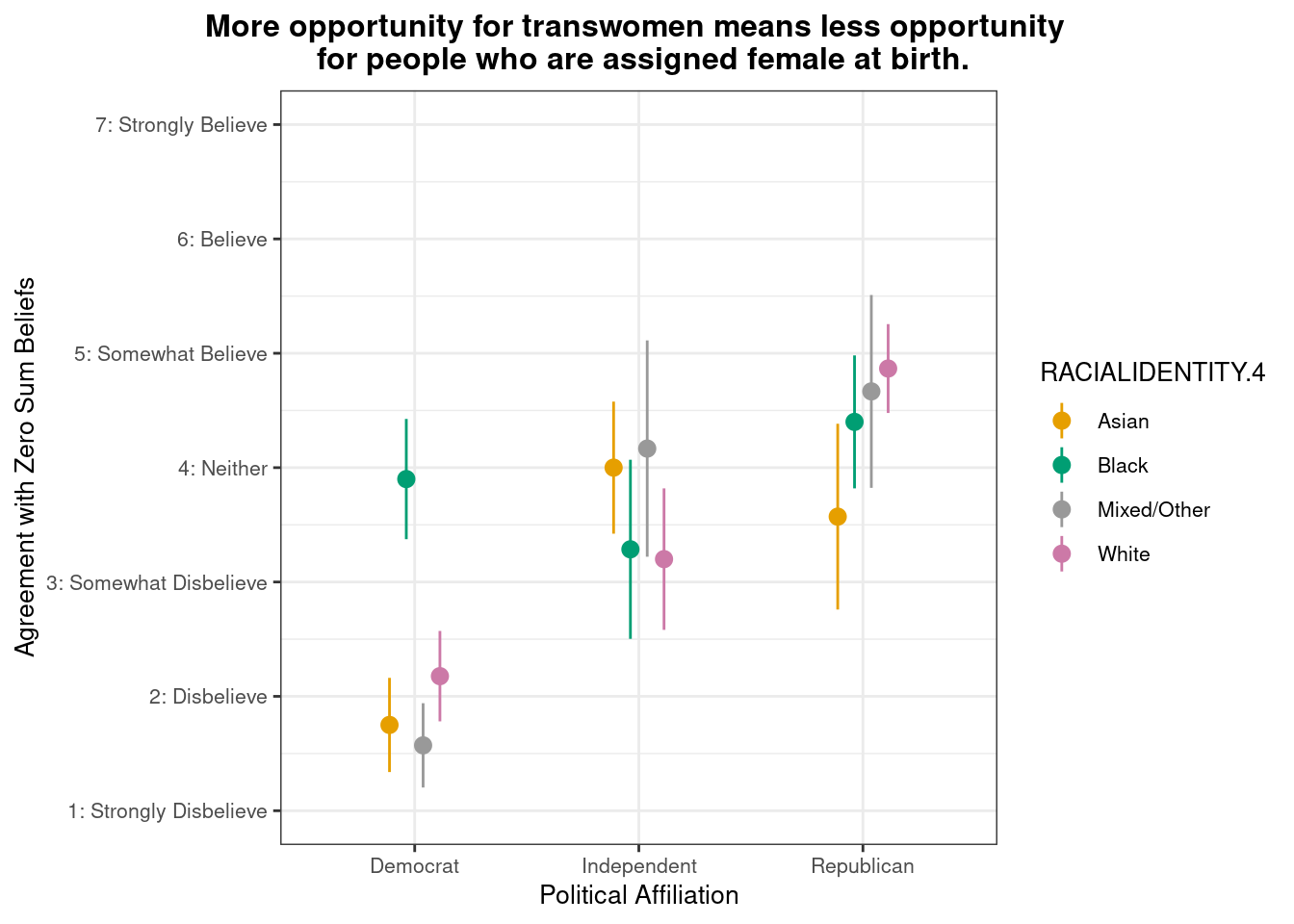
Below we present descriptive statistics and visualizations for ZEROSUM_6 (“More opportunity for transwomen means less opportunity for people who are assigned female at birth.”), examining how responses vary across racial identity and political affiliation.
# A tibble: 6 × 4
  POLITICALPARTY RACIALIDENTITY.4 mean_ZEROSUM_6    se
  <chr>          <chr>                     <dbl> <dbl>
1 Democrat       Asian                      1.75 0.412
2 Democrat       Black                      3.9  0.526
3 Democrat       Mixed/Other                1.57 0.369
4 Democrat       White                      2.18 0.395
5 Independent    Asian                      4    0.577
6 Independent    Black                      3.29 0.783
In [63]:
Show the code
# Define the zesty_four palettezesty_four <-c("#E69F00", "#009E73", "#999999", "#CC79A7") # Create the plot with pointrangeplot.zerosum6 <-ggplot(group_stats_6, aes(POLITICALPARTY, mean_ZEROSUM_6)) +geom_pointrange(aes(color = RACIALIDENTITY.4, ymin = mean_ZEROSUM_6 - se, # Use standard error instead of sdymax = mean_ZEROSUM_6 + se), # Use standard error instead of sdposition =position_dodge(0.3)) +theme_bw() +labs(title ="More opportunity for transwomen means less opportunity \n for people who are assigned female at birth.",x ="Political Affiliation",y ="Agreement with Zero Sum Beliefs",color ="RACIALIDENTITY.4") +theme(plot.title =element_text(size =12, face ="bold", hjust =0.5),axis.title =element_text(size =10),axis.text =element_text(size =8),legend.title =element_text(size =10),legend.text =element_text(size =8) ) +scale_y_continuous(breaks =1:7,labels =c("1: Strongly Disbelieve", "2: Disbelieve", "3: Somewhat Disbelieve", "4: Neither", "5: Somewhat Believe", "6: Believe", "7: Strongly Believe"),limits =c(1, 7) # Set the y-axis limits to match the scale )+scale_color_manual(values = zesty_four)# Print and save the plotsprint(plot.zerosum6)
This pointrange plot shows that White respondents exhibit higher agreement with the belief that “More opportunity for transwomen means less opportunity for people who are assigned female at birth.” among Republicans. Among political groups, Republicans show the highest overall agreement, while Democrats (particularly Asian and Mixed/Other respondents) show the lowest agreement. The pattern highlights how both political affiliation and racial identity intersect to shape zero-sum beliefs about transgender rights and opportunities.
In [64]:
Show the code
# ZEROSUM_6 average score with 95% CIgroup_stats_6_avg <- select_data %>%group_by(POLITICALPARTY) %>%summarise(mean_ZEROSUM_6 =mean(ZEROSUM_6, na.rm =TRUE),se =sd(ZEROSUM_6, na.rm =TRUE) /sqrt(n()),n =n(),.groups ='drop' ) %>%mutate(# Calculate 95% confidence interval using t-distributiont_value =qt(0.975, df = n -1), # 95% CI, two-tailedci_lower = mean_ZEROSUM_6 - t_value * se,ci_upper = mean_ZEROSUM_6 + t_value * se )
Do zero-sum beliefs regarding gender identity (transgender and cisgender) differ by political party affiliation?
In [65]:
Show the code
plot.zerosum6_raincloud <- select_data %>%filter(!is.na(ZEROSUM_6), !is.na(POLITICALPARTY)) %>%ggplot(aes(x = POLITICALPARTY, y = ZEROSUM_6, fill = POLITICALPARTY, color = POLITICALPARTY)) +stat_halfeye(adjust =0.5,width =0.6,.width =0,justification =-0.2,point_colour =NA,alpha =0.7 ) +geom_boxplot(width =0.15,outlier.shape =NA,alpha =0.5 ) +geom_point(size =1.3,alpha =0.3,position =position_jitter(seed =1, width =0.1 ) ) +stat_summary(fun = mean,geom ="point",size =3,color ="white",stroke =1.5,shape =21 ) +scale_fill_manual(values = party_colors) +scale_color_manual(values = party_colors) +theme_bw() +labs(title ="More opportunity for transwomen means less opportunity \n for people who are assigned female at birth.",x ="Political Affiliation",y ="Level of Agreement",caption ="White dots = means; colored dots = individual responses" ) +theme(plot.title =element_text(size =12, face ="bold", hjust =0.5),plot.caption =element_text(size =9, color ="gray40", hjust =0.5),axis.title =element_text(size =12, face ="bold"),axis.text =element_text(size =10),legend.position ="none",panel.grid.major.y =element_line(color ="gray90", linewidth =0.3) # Fixed ) +scale_y_continuous(breaks =1:7,labels =c("1: Strongly Disbelieve", "2: Disbelieve", "3: Somewhat Disbelieve", "4: Neither", "5: Somewhat Believe", "6: Believe", "7: Strongly Believe"),limits =c(1, 7) )plot.zerosum6_raincloud
Warning: Removed 22 rows containing missing values or values outside the scale range
(`geom_point()`).
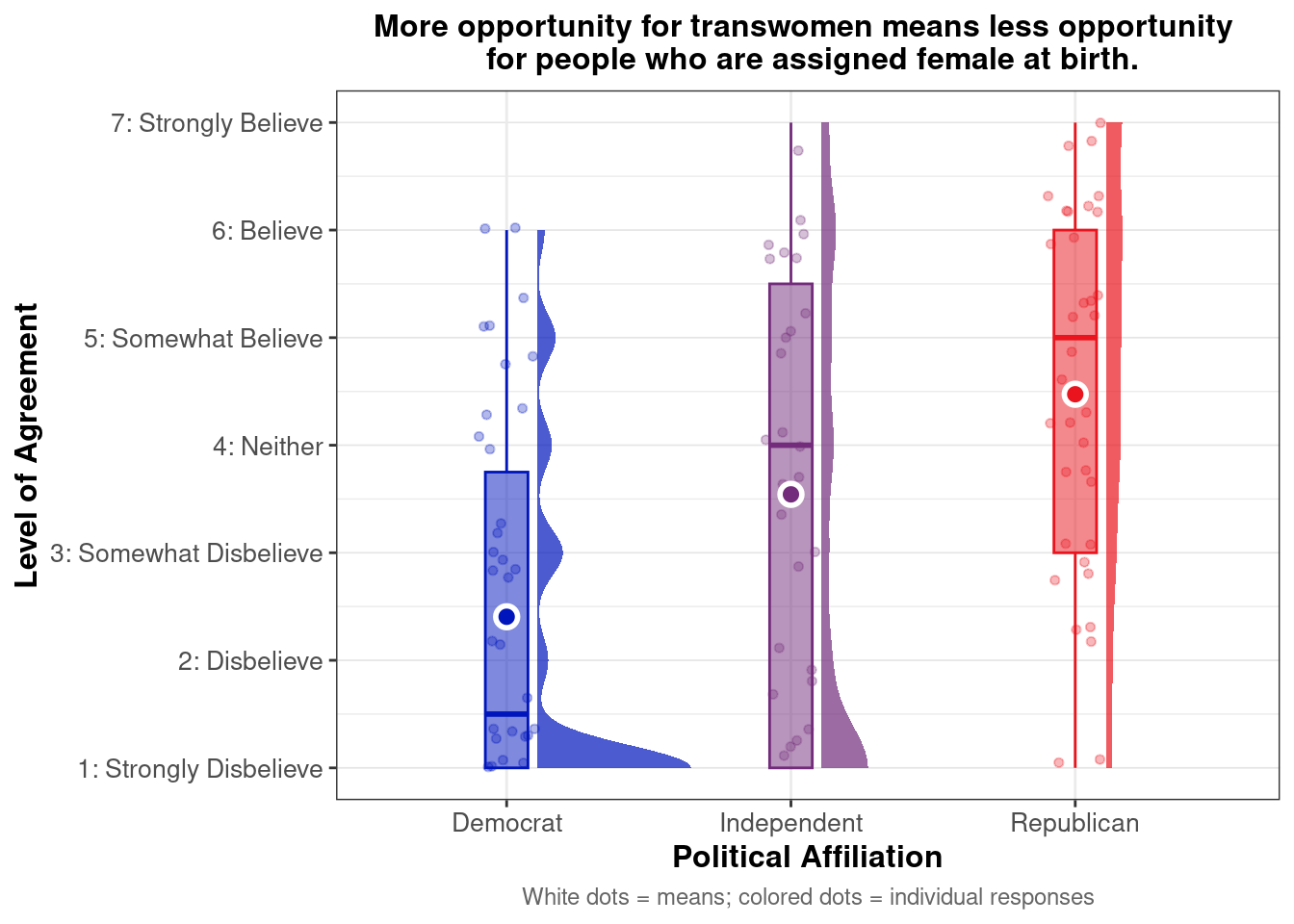
This raincloud plot shows that mean agreement with the zero-sum belief (indicated by white dots) varies by political affiliation. Among the three groups, Republican exhibit higher average agreement with the statement “More opportunity for transwomen means less opportunity for people who are assigned female at birth.”
The distribution (via density and individual dots) reveals different patterns across groups. Republicans show a relatively concentrated distribution around moderate-to-high agreement levels (3-6) with some spread toward the extremes. Independents display a broad distribution with responses spanning from low to high agreement but concentrated in the moderate range (2-6). Democrats show strong leftward skew with pronounced clustering in the low agreement range (1-3) and a steep drop-off at higher values, indicating most Democrats reject this zero-sum perspective on transgender rights and opportunities.
In [66]:
Show the code
shapiro_zerosum6 <- select_data %>%group_by(RACIALIDENTITY.4) %>%summarise(p =shapiro.test(ZEROSUM_6)$p.value)kable( shapiro_zerosum6,caption ="Table 35. Shapiro–Wilk Normality Test for ZEROSUM_6 by Racial Identity",digits =5,booktabs =TRUE)
Table 35. Shapiro–Wilk Normality Test for ZEROSUM_6 by Racial Identity
Table 36. Kruskal-Wallis Test Results for ZEROSUM_6
Predictor
df
Chi-squared
p
POLITICALPARTY
2
20.98
3e-05
There was significant difference in ZEROSUM_6 scores across political party groups, Kruskal-Wallis χ²(2) = 20.98, p = 2.79^{-5}.
Undocumented vs. Citizens
Do zero-sum beliefs about healthcare access—specifically, that undocumented immigration reduces access for U.S. citizens—differ by racial/ethnic identity and political affiliation?
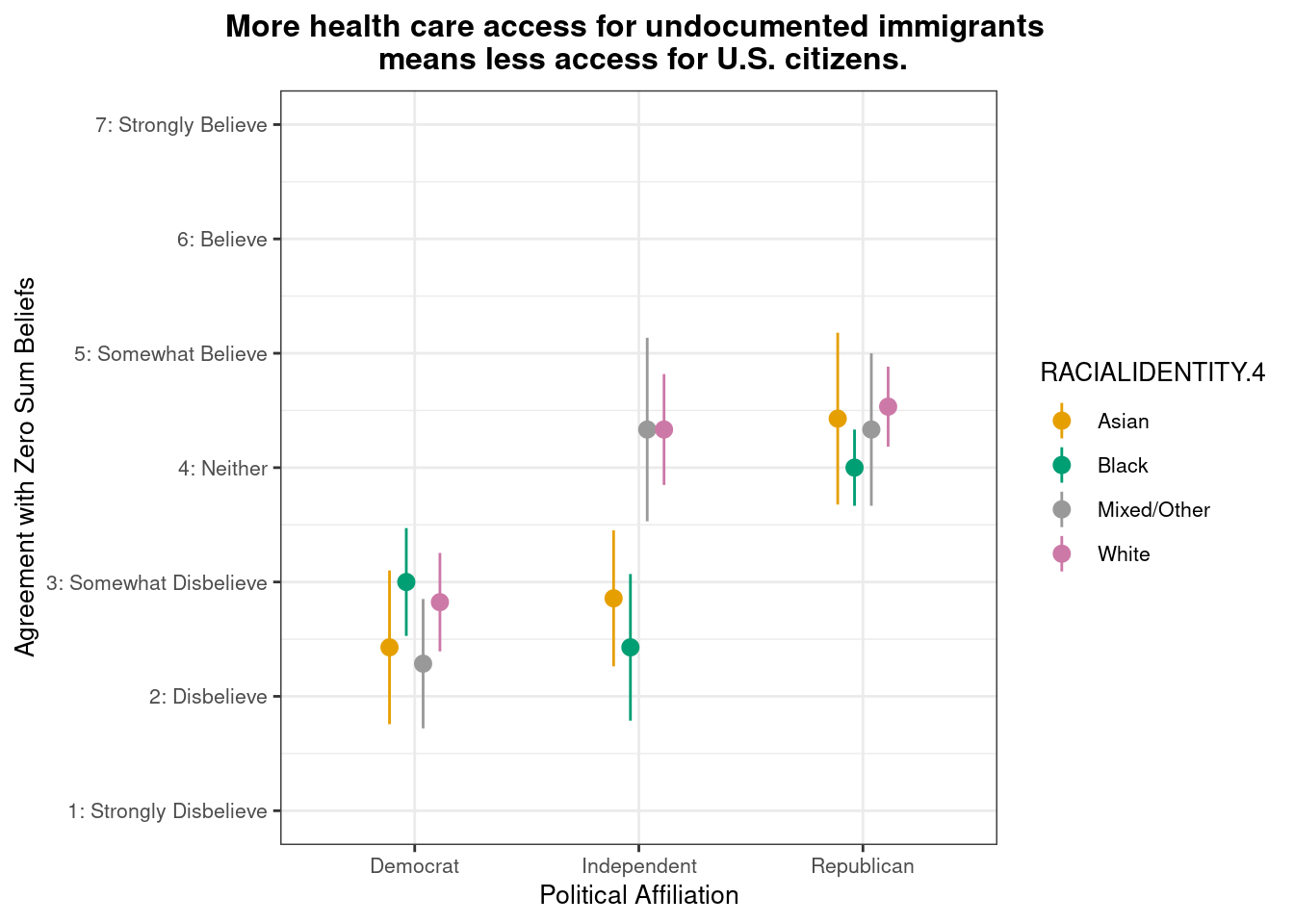
Below we present descriptive statistics and visualizations for ZEROSUM_7 (“More health care access for undocumented immigrants means less access for U.S. citizens.”), examining how responses vary across racial identity and political affiliation.
# A tibble: 6 × 4
  POLITICALPARTY RACIALIDENTITY.4 mean_ZEROSUM_7    se
  <chr>          <chr>                     <dbl> <dbl>
1 Democrat       Asian                      2.43 0.673
2 Democrat       Black                      3    0.471
3 Democrat       Mixed/Other                2.29 0.565
4 Democrat       White                      2.82 0.431
5 Independent    Asian                      2.86 0.595
6 Independent    Black                      2.43 0.641
In [70]:
Show the code
# Define the zesty_four palettezesty_four <-c("#E69F00", "#009E73", "#999999", "#CC79A7") # Create the plot with pointrangeplot.zerosum7 <-ggplot(group_stats_7, aes(POLITICALPARTY, mean_ZEROSUM_7)) +geom_pointrange(aes(color = RACIALIDENTITY.4, ymin = mean_ZEROSUM_7 - se, # Use standard error instead of sdymax = mean_ZEROSUM_7 + se), # Use standard error instead of sdposition =position_dodge(0.3)) +theme_bw() +labs(title ="More health care access for undocumented immigrants \n means less access for U.S. citizens.",x ="Political Affiliation",y ="Agreement with Zero Sum Beliefs",color ="RACIALIDENTITY.4") +theme(plot.title =element_text(size =12, face ="bold", hjust =0.5),axis.title =element_text(size =10),axis.text =element_text(size =8),legend.title =element_text(size =10),legend.text =element_text(size =8) ) +scale_y_continuous(breaks =1:7,labels =c("1: Strongly Disbelieve", "2: Disbelieve", "3: Somewhat Disbelieve", "4: Neither", "5: Somewhat Believe", "6: Believe", "7: Strongly Believe"),limits =c(1, 7) # Set the y-axis limits to match the scale )+scale_color_manual(values = zesty_four)# Print and save the plotsprint(plot.zerosum7)
This pointrange plot shows that Asian respondents exhibit higher agreement with the belief that “More health care access for undocumented immigrants means less access for U.S. citizens.” among Republicans. Among political groups, Republicans show the highest overall agreement, while Democrats (particularly Asian and Mixed/Other respondents) show the lowest agreement. This pattern highlights that political affiliation creates a greater divide in zero-sum beliefs about health care resources within each political group than does racial identity.
In [71]:
Show the code
# ZEROSUM_7 average score with 95% CIgroup_stats_7_avg <- select_data %>%group_by(POLITICALPARTY) %>%summarise(mean_ZEROSUM_7 =mean(ZEROSUM_7, na.rm =TRUE),se =sd(ZEROSUM_7, na.rm =TRUE) /sqrt(n()),n =n(),.groups ='drop' ) %>%mutate(# Calculate 95% confidence interval using t-distributiont_value =qt(0.975, df = n -1), # 95% CI, two-tailedci_lower = mean_ZEROSUM_7 - t_value * se,ci_upper = mean_ZEROSUM_7 + t_value * se )
Do zero-sum beliefs about healthcare access—specifically, that undocumented immigration reduces access for U.S. citizens—differ by political affiliation?
In [72]:
Show the code
plot.zerosum7_raincloud <- select_data %>%filter(!is.na(ZEROSUM_7), !is.na(POLITICALPARTY)) %>%ggplot(aes(x = POLITICALPARTY, y = ZEROSUM_7, fill = POLITICALPARTY, color = POLITICALPARTY)) +stat_halfeye(adjust =0.5,width =0.6,.width =0,justification =-0.2,point_colour =NA,alpha =0.7 ) +geom_boxplot(width =0.15,outlier.shape =NA,alpha =0.5 ) +geom_point(size =1.3,alpha =0.3,position =position_jitter(seed =1, width =0.1 ) ) +stat_summary(fun = mean,geom ="point",size =3,color ="white",stroke =1.5,shape =21 ) +scale_fill_manual(values = party_colors) +scale_color_manual(values = party_colors) +theme_bw() +labs(title ="More health care access for undocumented immigrants \n means less access for U.S. citizens.",x ="Political Affiliation",y ="Level of Agreement",caption ="White dots = means; colored dots = individual responses" ) +theme(plot.title =element_text(size =12, face ="bold", hjust =0.5),plot.caption =element_text(size =9, color ="gray40", hjust =0.5),axis.title =element_text(size =12, face ="bold"),axis.text =element_text(size =10),legend.position ="none",panel.grid.major.y =element_line(color ="gray90", linewidth =0.3) # Fixed ) +scale_y_continuous(breaks =1:7,labels =c("1: Strongly Disbelieve", "2: Disbelieve", "3: Somewhat Disbelieve", "4: Neither", "5: Somewhat Believe", "6: Believe", "7: Strongly Believe"),limits =c(1, 7) )plot.zerosum7_raincloud
Warning: Removed 11 rows containing missing values or values outside the scale range
(`geom_point()`).
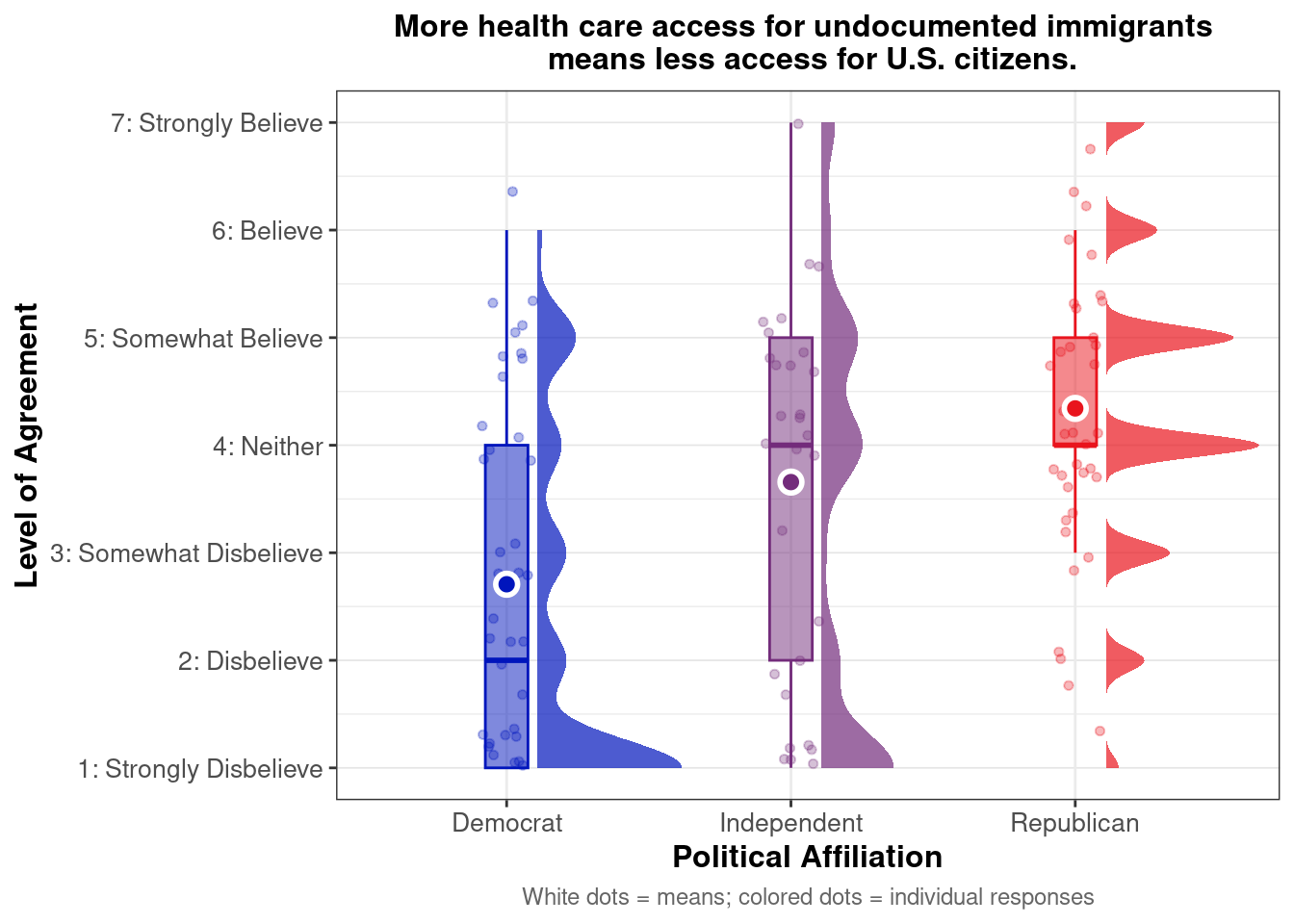
This raincloud plot shows that mean agreement with the zero-sum belief (indicated by white dots) varies by political affiliation. Among the three groups, Republican exhibit higher average agreement with the statement “More health care access for undocumented immigrants means less access for U.S. citizens.” The distribution (via density and individual dots) reveals different patterns across groups. Republicans show a relatively concentrated distribution around moderate-to-high agreement levels (4-6) with their density peaked around the mean. Independents display a broader, more spread distribution across the full range with notable presence from low to high agreement levels. Democrats show strong leftward skew with pronounced clustering in the low agreement range (1-3) and a steep drop-off at higher values, indicating most Democrats reject this zero-sum perspective on healthcare access.
In [73]:
Show the code
shapiro_zerosum7 <- select_data %>%group_by(RACIALIDENTITY.4) %>%summarise(p =shapiro.test(ZEROSUM_7)$p.value)kable( shapiro_zerosum7,caption ="Table 37. Shapiro–Wilk Normality Test for ZEROSUM_7 by Racial Identity",digits =5,booktabs =TRUE)
Table 37. Shapiro–Wilk Normality Test for ZEROSUM_7 by Racial Identity
Table 38. Kruskal-Wallis Test Results for ZEROSUM_7
Predictor
df
Chi-squared
p
POLITICALPARTY
2
15.35
0.00046
There was significant difference in ZEROSUM_7 scores across political party groups, Kruskal-Wallis χ²(2) = 15.35, p = 4.63^{-4}.
Paywomen vs. men
Do zero-sum beliefs regarding gender pay equity differ by racial/ethnic identity and political party affiliation?
Below we present descriptive statistics and visualizations for ZEROSUM_8 (“If there is equal pay for women, men will get lower wages.”), examining how responses vary across racial identity and political affiliation.
# A tibble: 6 × 4
  POLITICALPARTY RACIALIDENTITY.4 mean_ZEROSUM_8    se
  <chr>          <chr>                     <dbl> <dbl>
1 Democrat       Asian                      2.38 0.460
2 Democrat       Black                      3.3  0.517
3 Democrat       Mixed/Other                2.71 0.644
4 Democrat       White                      2.06 0.326
5 Independent    Asian                      3.14 0.670
6 Independent    Black                      3.86 0.476
In [77]:
Show the code
# Define the zesty_four palettezesty_four <-c("#E69F00", "#009E73", "#999999", "#CC79A7") # Create the plot with pointrangeplot.zerosum8 <-ggplot(group_stats_8, aes(POLITICALPARTY, mean_ZEROSUM_8)) +geom_pointrange(aes(color = RACIALIDENTITY.4, ymin = mean_ZEROSUM_8 - se, # Use standard error instead of sdymax = mean_ZEROSUM_8 + se), # Use standard error instead of sdposition =position_dodge(0.3)) +theme_bw() +labs(title ="If there is equal pay for women, men will get lower wages.",x ="Political Affiliation",y ="Agreement with Zero Sum Beliefs",color ="RACIALIDENTITY.4") +theme(plot.title =element_text(size =12, face ="bold", hjust =0.5),axis.title =element_text(size =10),axis.text =element_text(size =8),legend.title =element_text(size =10),legend.text =element_text(size =8) ) +scale_y_continuous(breaks =1:7,labels =c("1: Strongly Disbelieve", "2: Disbelieve", "3: Somewhat Disbelieve", "4: Neither", "5: Somewhat Believe", "6: Believe", "7: Strongly Believe"),limits =c(1, 7) # Set the y-axis limits to match the scale )+scale_color_manual(values = zesty_four)# Print and save the plotsprint(plot.zerosum8)
This pointrange plot shows that White respondents exhibit higher agreement with the belief that “If there is equal pay for women, men will get lower wages.” among Republicans. Among political groups, Republicans show the highest overall agreement, while Democrats across all racial groups showed lower levels of agreement (2-3 range), with white respondents showing the lowest agreement. This pattern highlights how political affiliation creates major divisions in zero-sum beliefs about gender pay equality, with racial differences more pronounced among Republicans than other political groups.
In [78]:
Show the code
# ZEROSUM_8 average score with 95% CIgroup_stats_8_avg <- select_data %>%group_by(POLITICALPARTY) %>%summarise(mean_ZEROSUM_8 =mean(ZEROSUM_8, na.rm =TRUE),se =sd(ZEROSUM_8, na.rm =TRUE) /sqrt(n()),n =n(),.groups ='drop' ) %>%mutate(# Calculate 95% confidence interval using t-distributiont_value =qt(0.975, df = n -1), # 95% CI, two-tailedci_lower = mean_ZEROSUM_8 - t_value * se,ci_upper = mean_ZEROSUM_8 + t_value * se )
Do zero-sum beliefs regarding gender pay equity differ by political party affiliation?
Warning: Removed 21 rows containing missing values or values outside the scale range
(`geom_point()`).
This raincloud plot shows that mean agreement with the zero-sum belief (indicated by white dots) varies by political affiliation. Among the three groups, Republican exhibit higher average agreement with the statement “If there is equal pay for women, men will get lower wages.” Independents and Democrats show similar mean agreement levels at lower values. The distribution (via density and individual dots) reveals different patterns across groups. Republicans show a relatively concentrated distribution around moderate agreement levels (3-5) with their density peaked around the mean. Both independents and Democrats show very similar distributions, ranging widely across low to moderate levels of agreement (1-5). This suggests that both groups have similar overall skepticism about this zero-sum view of gender pay equality.
In [80]:
Show the code
shapiro_zerosum8 <- select_data %>%group_by(RACIALIDENTITY.4) %>%summarise(p =shapiro.test(ZEROSUM_8)$p.value)kable( shapiro_zerosum8,caption ="Table 39. Shapiro–Wilk Normality Test for ZEROSUM_8 by Racial Identity",digits =5,booktabs =TRUE)
Table 39. Shapiro–Wilk Normality Test for ZEROSUM_8 by Racial Identity
Table 40. Kruskal-Wallis Test Results for ZEROSUM_8
Predictor
df
Chi-squared
p
POLITICALPARTY
2
13.51
0.00117
There was significant difference in ZEROSUM_8 scores across political party groups, Kruskal-Wallis χ²(2) = 13.51, p = 0.00117.
LGBTQ vs. Religious
Do zero-sum beliefs regarding LGBTQ+ rights and religious freedom differ by racial/ethnic identity and political party affiliation?
Below we present descriptive statistics and visualizations for ZEROSUM_9 (“LGBTQ+ rights mean less freedom for religious groups.”), examining how responses vary across racial identity and political affiliation.
# A tibble: 6 × 4
  POLITICALPARTY RACIALIDENTITY.4 mean_ZEROSUM_9    se
  <chr>          <chr>                     <dbl> <dbl>
1 Democrat       Asian                      1.38 0.263
2 Democrat       Black                      3.1  0.567
3 Democrat       Mixed/Other                1.29 0.286
4 Democrat       White                      2.06 0.337
5 Independent    Asian                      2.57 0.369
6 Independent    Black                      2.29 0.567
In [84]:
Show the code
# Define the zesty_four palettezesty_four <-c("#E69F00", "#009E73", "#999999", "#CC79A7") # Create the plot with pointrangeplot.zerosum9 <-ggplot(group_stats_9, aes(POLITICALPARTY, mean_ZEROSUM_9)) +geom_pointrange(aes(color = RACIALIDENTITY.4, ymin = mean_ZEROSUM_9 - se, # Use standard error instead of sdymax = mean_ZEROSUM_9 + se), # Use standard error instead of sdposition =position_dodge(0.3)) +theme_bw() +labs(title ="LGBTQ+ rights mean less freedom for religious groups.",x ="Political Affiliation",y ="Agreement with Zero Sum Beliefs",color ="RACIALIDENTITY.4") +theme(plot.title =element_text(size =12, face ="bold", hjust =0.5),axis.title =element_text(size =10),axis.text =element_text(size =8),legend.title =element_text(size =10),legend.text =element_text(size =8) ) +scale_y_continuous(breaks =1:7,labels =c("1: Strongly Disbelieve", "2: Disbelieve", "3: Somewhat Disbelieve", "4: Neither", "5: Somewhat Believe", "6: Believe", "7: Strongly Believe"),limits =c(1, 7) # Set the y-axis limits to match the scale )+scale_color_manual(values = zesty_four)# Print and save the plotsprint(plot.zerosum9)
This pointrange plot shows that Black respondents exhibit higher agreement with the belief that “LGBTQ+ rights mean less freedom for religious groups.” among Republicans. Among political groups, Republicans show the highest overall agreement, while Democrats across all racial groups showed lower levels of agreement (1-2 range), with Mixed/Other and Asian respondents showing the lowest agreement. This pattern captures how political affiliation creates major divisions in zero-sum beliefs about LGBTQ+ and religious rights, with significant racial differences occurring primarily among Republicans.
In [85]:
Show the code
# ZEROSUM_9 average score with 95% CIgroup_stats_9_avg <- select_data %>%group_by(POLITICALPARTY) %>%summarise(mean_ZEROSUM_9 =mean(ZEROSUM_9, na.rm =TRUE),se =sd(ZEROSUM_9, na.rm =TRUE) /sqrt(n()),n =n(),.groups ='drop' ) %>%mutate(# Calculate 95% confidence interval using t-distributiont_value =qt(0.975, df = n -1), # 95% CI, two-tailedci_lower = mean_ZEROSUM_9 - t_value * se,ci_upper = mean_ZEROSUM_9 + t_value * se )
Do zero-sum beliefs regarding LGBTQ+ rights and religious freedom differ by political party affiliation?
Warning: Removed 27 rows containing missing values or values outside the scale range
(`geom_point()`).
This raincloud plot shows that mean agreement with the zero-sum belief (indicated by white dots) varies by political affiliation. Among the three groups, Republican exhibit higher average agreement with the statement “LGBTQ+ rights mean less freedom for religious groups.” The distribution (via density and individual dots) reveals different patterns across groups. Republicans show a broad distribution with responses spanning from low to high agreement (2-7) and notable density across moderate-to-high agreement levels. Independents display leftward skew with clustering in the low agreement range (1-3) and a tail extending toward higher values. Democrats show even stronger leftward skew with pronounced clustering in the very low agreement range (1-3) and a steep drop-off at higher values. This suggests that most Democrats and independents reject this zero-sum view of LGBTQ+ and religious rights, with Democrats showing more extreme opposition.
In [87]:
Show the code
shapiro_zerosum9 <- select_data %>%group_by(RACIALIDENTITY.4) %>%summarise(p =shapiro.test(ZEROSUM_9)$p.value)kable( shapiro_zerosum9,caption ="Table 41. Shapiro–Wilk Normality Test for ZEROSUM_9 by Racial Identity",digits =6,booktabs =TRUE)
Table 41. Shapiro–Wilk Normality Test for ZEROSUM_9 by Racial Identity
Table 42. Kruskal-Wallis Test Results for ZEROSUM_9
Predictor
df
Chi-squared
p
POLITICALPARTY
2
18.62
9e-05
There was significant difference in ZEROSUM_9 scores across political party groups, Kruskal-Wallis χ²(2) = 18.62, p = 9.07^{-5}.
Disabilities vs. Non-disabilities
Do zero-sum beliefs regarding disability and non-disability healthcare time differ by racial/ethnic identity and political party affiliation?
Below we present descriptive statistics and visualizations for ZEROSUM_10 (“Accessible healthcare for people with disabilities means longer wait times for non-disabled patients.”), examining how responses vary across racial identity and political affiliation.
# A tibble: 6 × 4
  POLITICALPARTY RACIALIDENTITY.4 mean_ZEROSUM_10    se
  <chr>          <chr>                      <dbl> <dbl>
1 Democrat       Asian                       2.38 0.532
2 Democrat       Black                       3.1  0.526
3 Democrat       Mixed/Other                 2.14 0.459
4 Democrat       White                       2.24 0.369
5 Independent    Asian                       3.14 0.595
6 Independent    Black                       2.12 0.581
In [91]:
Show the code
# Define the zesty_four palettezesty_four <-c("#E69F00", "#009E73", "#999999", "#CC79A7") # Create the plot with pointrangeplot.zerosum10 <-ggplot(group_stats_10, aes(POLITICALPARTY, mean_ZEROSUM_10)) +geom_pointrange(aes(color = RACIALIDENTITY.4, ymin = mean_ZEROSUM_10 - se, # Use standard error instead of sdymax = mean_ZEROSUM_10 + se), # Use standard error instead of sdposition =position_dodge(0.3)) +theme_bw() +labs(title ="Accessible healthcare for people with disabilities means \n longer wait times for non-disabled patients.",x ="Political Affiliation",y ="Agreement with Zero Sum Beliefs",color ="RACIALIDENTITY.4") +theme(plot.title =element_text(size =12, face ="bold", hjust =0.5),axis.title =element_text(size =10),axis.text =element_text(size =8),legend.title =element_text(size =10),legend.text =element_text(size =8) ) +scale_y_continuous(breaks =1:7,labels =c("1: Strongly Disbelieve", "2: Disbelieve", "3: Somewhat Disbelieve", "4: Neither", "5: Somewhat Believe", "6: Believe", "7: Strongly Believe"),limits =c(1, 7) # Set the y-axis limits to match the scale )+scale_color_manual(values = zesty_four)# Print and save the plotsprint(plot.zerosum10)
This pointrange plot shows that Black respondents exhibit higher agreement with the belief that “Accessible healthcare for people with disabilities means longer wait times for non-disabled patients.” among Republicans. Among political groups, Republicans show the highest overall agreement, while Democrats across all racial groups showed lower levels of agreement (2-3 range), with relatively small differences between groups. This pattern captures how political affiliation creates major divisions in zero-sum beliefs about disability healthcare access, with racial differences being most pronounced among Republicans.
In [92]:
Show the code
# ZEROSUM_10 average score with 95% CIgroup_stats_10_avg <- select_data %>%group_by(POLITICALPARTY) %>%summarise(mean_ZEROSUM_10 =mean(ZEROSUM_10, na.rm =TRUE),se =sd(ZEROSUM_10, na.rm =TRUE) /sqrt(n()),n =n(),.groups ='drop' ) %>%mutate(# Calculate 95% confidence interval using t-distributiont_value =qt(0.975, df = n -1), # 95% CI, two-tailedci_lower = mean_ZEROSUM_10 - t_value * se,ci_upper = mean_ZEROSUM_10 + t_value * se )
Do zero-sum beliefs regarding disability and non-disability healthcare time differ by political party affiliation?
Warning: Removed 16 rows containing missing values or values outside the scale range
(`geom_point()`).
This raincloud plot shows that mean agreement with the zero-sum belief (indicated by white dots) varies by political affiliation. Among the three groups, Republican exhibit higher average agreement with the statement “Accessible healthcare for people with disabilities means longer wait times for non-disabled patients.” The distribution (via density and individual dots) reveals different patterns across groups. Republicans show a broad distribution with responses spanning from low to high agreement (1-7) and notable density across moderate-to-high agreement levels. Independents display leftward skew with clustering in the low-to-moderate agreement range (1-4) and their density peaked in the lower range. Democrats show strong leftward skew with pronounced clustering in the low agreement range (1-3) and a steep drop-off at higher values. This suggests that most Democrats reject this zero-sum perspective on disability healthcare access.
In [94]:
Show the code
shapiro_zerosum10 <- select_data %>%group_by(RACIALIDENTITY.4) %>%summarise(p =shapiro.test(ZEROSUM_10)$p.value)kable( shapiro_zerosum10,caption ="Table 43. Shapiro–Wilk Normality Test for ZEROSUM_10 by Racial Identity",digits =5,booktabs =TRUE)
Table 43. Shapiro–Wilk Normality Test for ZEROSUM_10 by Racial Identity
Table 44. Kruskal-Wallis Test Results for ZEROSUM_10
Predictor
df
Chi-squared
p
POLITICALPARTY
2
26.92
0
There was significant difference in ZEROSUM_10 scores across political party groups, Kruskal-Wallis χ²(2) = 26.92, p = 1.43^{-6}.
Healthcare vs. Private
Do zero-sum beliefs about universal healthcare differ by racial/ethnic identity and political party affiliation?
Below we present descriptive statistics and visualizations for ZEROSUM_11 (“Universal healthcare means worse healthcare for those who can afford private insurance.”), examining how responses vary across racial identity and political affiliation.
# A tibble: 6 × 4
  POLITICALPARTY RACIALIDENTITY.4 mean_ZEROSUM_11    se
  <chr>          <chr>                      <dbl> <dbl>
1 Democrat       Asian                       2.12 0.441
2 Democrat       Black                       3.1  0.547
3 Democrat       Mixed/Other                 2    0.436
4 Democrat       White                       2.53 0.385
5 Independent    Asian                       3.29 0.606
6 Independent    Black                       2.57 0.607
In [98]:
Show the code
# Define the zesty_four palettezesty_four <-c("#E69F00", "#009E73", "#999999", "#CC79A7") # Create the plot with pointrangeplot.zerosum11 <-ggplot(group_stats_11, aes(POLITICALPARTY, mean_ZEROSUM_11)) +geom_pointrange(aes(color = RACIALIDENTITY.4, ymin = mean_ZEROSUM_11 - se, # Use standard error instead of sdymax = mean_ZEROSUM_11 + se), # Use standard error instead of sdposition =position_dodge(0.3)) +theme_bw() +labs(title ="Universal healthcare means worse healthcare for those who can afford private insurance.",x ="Political Affiliation",y ="Agreement with Zero Sum Beliefs",color ="RACIALIDENTITY.4") +theme(plot.title =element_text(size =12, face ="bold", hjust =0.5),axis.title =element_text(size =10),axis.text =element_text(size =8),legend.title =element_text(size =10),legend.text =element_text(size =8) ) +scale_y_continuous(breaks =1:7,labels =c("1: Strongly Disbelieve", "2: Disbelieve", "3: Somewhat Disbelieve", "4: Neither", "5: Somewhat Believe", "6: Believe", "7: Strongly Believe"),limits =c(1, 7) # Set the y-axis limits to match the scale )+scale_color_manual(values = zesty_four)# Print and save the plotsprint(plot.zerosum11)
This pointrange plot shows that White respondents exhibit higher agreement with the belief that “Universal healthcare means worse healthcare for those who can afford private insurance.” among Republicans. Among political groups, Republicans show the highest overall agreement, while Democrats (particularly Asian and Mixed/Other respondents) show the lowest agreement. This pattern captures how political affiliation creates major divisions in zero-sum beliefs about universal healthcare, with racial differences being most pronounced among Republicans.
In [99]:
Show the code
# ZEROSUM_11 average score with 95% CIgroup_stats_11_avg <- select_data %>%group_by(POLITICALPARTY) %>%summarise(mean_ZEROSUM_11 =mean(ZEROSUM_11, na.rm =TRUE),se =sd(ZEROSUM_11, na.rm =TRUE) /sqrt(n()),n =n(),.groups ='drop' ) %>%mutate(# Calculate 95% confidence interval using t-distributiont_value =qt(0.975, df = n -1), # 95% CI, two-tailedci_lower = mean_ZEROSUM_11 - t_value * se,ci_upper = mean_ZEROSUM_11 + t_value * se )
Do zero-sum beliefs about universal healthcare differ by political party affiliation?
Warning: Removed 18 rows containing missing values or values outside the scale range
(`geom_point()`).
This raincloud plot shows that mean agreement with the zero-sum belief (indicated by white dots) varies by political affiliation. Among the three groups, Republican exhibit higher average agreement with the statement “Universal healthcare means worse healthcare for those who can afford private insurance.” The distribution (via density and individual dots) reveals different patterns across groups. Republicans show a broad distribution with responses spanning from low to high agreement (2-7) and notable density across moderate-to-high agreement levels. Independents display leftward skew with clustering in the low-to-moderate agreement range (1-5) and their density peaked in the lower-moderate range. Democrats show strong leftward skew with pronounced clustering in the low-to-moderate agreement range (1-4) and a steep drop-off at higher values. This suggest that most Democrats reject this zero-sum perspective on universal healthcare policy.
In [101]:
Show the code
shapiro_zerosum11 <- select_data %>%group_by(RACIALIDENTITY.4) %>%summarise(p =shapiro.test(ZEROSUM_11)$p.value)kable( shapiro_zerosum11,caption ="Table 45. Shapiro–Wilk Normality Test for ZEROSUM_11 by Racial Identity",digits =5,booktabs =TRUE)
Table 45. Shapiro–Wilk Normality Test for ZEROSUM_11 by Racial Identity
Asian participants reported significantly lower levels of economic zero-sum beliefs compared to White participants (β = -0.90, p = .006), indicating a negative association between identifying as Asian and the belief that economic resources are fixed and must be competed for. This suggests that Asian individuals may be less likely to perceive economic outcomes as a zero-sum competition between groups.
As social status increased, participants reported lower levels of economic zero-sum beliefs (β = -0.15, p = .043), indicating a negative association between perceived social standing and belief in fixed economic resources. Individuals with higher perceived social status may be less likely to view the economy as a zero-sum system.
Explaining Zero-Sum Identity Beliefs (multiple linear regression)
What sociodemographic factors explain zero-sum identity beliefs?
As social status increased, participants reported higher levels of identity zero-sum beliefs (β = 0.23, p = .003), indicating a positive association between perceived social standing and belief in fixed identity resources. This suggests that individuals who perceive themselves as having higher social status may be more likely to endorse the view that one group’s gain comes at another’s expense.
Predicting Voting Behavior for 2024 Presidential Candidate
This figure shows the relationship between self-reported political ideology (ranging from “far left/leftist” to “very conservative”) and the predicted probability of voting for Trump in the 2024 election. The purple curve exhibits a strong S-shaped relationship with a 95% confidence interval. This indicates a sharp increase in the probability of voting for Trump, from near zero among far left voters to almost certainty among very conservative voters, with the largest increase among liberal and moderate voters. The statistical model shows a highly significant positive correlation coefficient (β = 2.39, p < .001, 95% CI: [1.29, 4.06]), confirming that political beliefs are the strongest predictor.
In [111]:
Show the code
# Create prediction data for ZEROSUM_IDENTITY (holding others at mean)pred_data_identity <-with(select_data, data.frame(ZEROSUM_IDENTITY =seq(min(ZEROSUM_IDENTITY, na.rm =TRUE), max(ZEROSUM_IDENTITY, na.rm =TRUE), length =100),POLITICALBELIEFS =mean(POLITICALBELIEFS, na.rm =TRUE),SOCIALSTATUS =mean(SOCIALSTATUS, na.rm =TRUE),ZEROSUM_ECONOMIC =mean(ZEROSUM_ECONOMIC, na.rm =TRUE),ZEROSUM_1 =mean(ZEROSUM_1, na.rm =TRUE),GENDER_MALE =mean(GENDER_MALE, na.rm =TRUE),RELIGIOUS_YES =mean(RELIGIOUS_YES, na.rm =TRUE),RACE_BLACK =mean(RACE_BLACK, na.rm =TRUE),RACE_ASIAN =mean(RACE_ASIAN, na.rm =TRUE),RACE_OTHER =mean(RACE_OTHER, na.rm =TRUE),EDUCATION_HIGH =mean(EDUCATION_HIGH, na.rm =TRUE),COMPETITION_SCORE =mean(COMPETITION_SCORE, na.rm =TRUE) ))# Get predictions with standard errorspredictions_identity <-predict(logregmodel.v1, pred_data_identity, type ="link", se.fit =TRUE)# Convert to probabilities and calculate confidence intervalspred_data_identity$predicted_prob <-plogis(predictions_identity$fit)pred_data_identity$lower_ci <-plogis(predictions_identity$fit -1.96* predictions_identity$se.fit)pred_data_identity$upper_ci <-plogis(predictions_identity$fit +1.96* predictions_identity$se.fit)# Plot with confidence intervals and proper labelsplot.TRUMPVOTE.ZEROSUM_IDENTITY <-ggplot(pred_data_identity, aes(x = ZEROSUM_IDENTITY, y = predicted_prob)) +geom_ribbon(aes(ymin = lower_ci, ymax = upper_ci), alpha =0.3, fill ="red") +geom_line(color ="red", size =1) +scale_x_continuous(breaks =1:7,labels =c("Strongly\nDisbelieve", "Disbelieve", "Somewhat\nDisbelieve", "Neither\nDisbelieve\nnor Believe", "Somewhat\nBelieve", "Believe", "Strongly\nBelieve") ) +labs(title ="Predicted Probability of Trump Vote by Zero-Sum IDENTITY Beliefs",subtitle ="With 95% Confidence Intervals",x ="Zero-Sum IDENTITY Beliefs", y ="Predicted Probability") +theme_minimal() +theme(axis.text.x =element_text(angle =45, hjust =1, size =9))# Print and save the plotsprint(plot.TRUMPVOTE.ZEROSUM_IDENTITY)
Predicted Probability of Trump Vote by Zero-Sum Identity Beliefs.
This figure shows the relationship between zero-sum thinking about identity issues (ranging from “strongly disbelieve” to “believe”) and the predicted probability of voting for Trump in the 2024 election. The red curve exhibits a steady upward trend with a 95% confidence interval. This indicates a consistent increase in the probability of voting for Trump, from approximately 5% among those who strongly disbelieve zero-sum identity concepts to around 95% among those who believe in them. The statistical model shows a significant positive correlation coefficient (β = 1.43, p = .002, 95% CI: [0.63, 2.51]), confirming that zero-sum identity beliefs are a meaningful predictor of Trump support beyond traditional political ideology.
In [112]:
Show the code
# Create prediction data for ZEROSUM_ECONOMIC (holding others at mean)pred_data_econ <-with(select_data, data.frame(ZEROSUM_ECONOMIC =seq(min(ZEROSUM_ECONOMIC, na.rm =TRUE), max(ZEROSUM_ECONOMIC, na.rm =TRUE), length =100),POLITICALBELIEFS =mean(POLITICALBELIEFS, na.rm =TRUE),SOCIALSTATUS =mean(SOCIALSTATUS, na.rm =TRUE),ZEROSUM_IDENTITY =mean(ZEROSUM_IDENTITY, na.rm =TRUE),ZEROSUM_1 =mean(ZEROSUM_1, na.rm =TRUE),GENDER_MALE =mean(GENDER_MALE, na.rm =TRUE),RELIGIOUS_YES =mean(RELIGIOUS_YES, na.rm =TRUE),RACE_BLACK =mean(RACE_BLACK, na.rm =TRUE),RACE_ASIAN =mean(RACE_ASIAN, na.rm =TRUE),RACE_OTHER =mean(RACE_OTHER, na.rm =TRUE),EDUCATION_HIGH =mean(EDUCATION_HIGH, na.rm =TRUE),COMPETITION_SCORE =mean(COMPETITION_SCORE, na.rm =TRUE) ))# Get predictions with standard errorspredictions_econ <-predict(logregmodel.v1, pred_data_econ, type ="link", se.fit =TRUE)# Convert to probabilities and calculate confidence intervalspred_data_econ$predicted_prob <-plogis(predictions_econ$fit)pred_data_econ$lower_ci <-plogis(predictions_econ$fit -1.96* predictions_econ$se.fit)pred_data_econ$upper_ci <-plogis(predictions_econ$fit +1.96* predictions_econ$se.fit)# Plot with confidence intervals and proper labelsplot.TRUMPVOTE.ZEROSUM_ECONOMIC <-ggplot(pred_data_econ, aes(x = ZEROSUM_ECONOMIC, y = predicted_prob)) +geom_ribbon(aes(ymin = lower_ci, ymax = upper_ci), alpha =0.3, fill ="blue") +geom_line(color ="blue", size =1) +scale_x_continuous(breaks =1:7,labels =c("Strongly\nDisbelieve", "Disbelieve", "Somewhat\nDisbelieve", "Neither\nDisbelieve\nnor Believe", "Somewhat\nBelieve", "Believe", "Strongly\nBelieve") ) +labs(title ="Predicted Probability of Trump Vote by Zero-Sum Economic Beliefs",subtitle ="With 95% Confidence Intervals",x ="Zero-Sum Economic Beliefs", y ="Predicted Probability") +theme_minimal() +theme(axis.text.x =element_text(angle =45, hjust =1, size =9))# Print and save the plotsprint(plot.TRUMPVOTE.ZEROSUM_ECONOMIC)
Predicted Probability of Trump Vote by Zero-Sum Economic Beliefs.
This figure shows the relationship between zero-sum thinking about economic issues (ranging from “strongly disbelieve” to “strongly believe”) and the predicted probability of voting for Trump in the 2024 election. The blue curve exhibits an interesting U-shaped pattern with a 95% confidence interval. This indicates higher Trump support at both extremes: around 70-75% among those who strongly disbelieve or strongly believe in zero-sum economic thinking, while those with neutral positions show the lowest support at around 40-45%. However, the statistical model shows this relationship is not significant (`β` = -0.24, p = .582, 95% CI: [-1.12, 0.63]), indicating that zero-sum economic beliefs do not reliably predict Trump’s voting outcome when accounting for statistical uncertainty.
# Alternative visualization with different stylecorrplot(cor_matrix, method ="circle",type ="full",order ="original",tl.cex =0.8,tl.col ="black",tl.srt =45,col =colorRampPalette(c("blue", "white", "red"))(100))
Correlation Matrix of All Variables.
This heat map illustrates the correlation structure between voting for Trump, zero-sum beliefs (including economic and identity beliefs), individual zero-sum items (ZEROSUM_1 through ZEROSUM_11), and overall political beliefs. Red circles indicate positive correlations, blue circles indicate negative correlations, and the size of the circles represents the strength of the correlation. The matrix shows that voting for Trump is strongly positively correlated with both zero-sum identity beliefs and political beliefs.
Decision Tree and Random Forest Analysis
To further validate these findings and examine the predictive power of our variables using a different analytical approach, we employed a series of machine learning techniques. Our analysis proceeded in three stages:
Stage 1: Initial Decision Tree: We first constructed a simple decision tree to identify the primary predictors and their splitting thresholds for Trump voting behavior. This provided an interpretable baseline model showing how the algorithm naturally segments voters.
Stage 2: Extended Decision Tree with Cross-Validation: We then built a more complex decision tree incorporating additional demographic variables and used cross-validation to determine the optimal model complexity. Through this process, we found that the best performing tree is the 2-split model, which achieved a cross-validation error of 0.24. This suggests that despite having access to multiple demographic and ideological variables, the most predictive model requires only two key splits to effectively classify voters.
Stage 3: Random Forest Analysis: Finally, we employed a Random Forest ensemble method to capture potential non-linear relationships and interactions while providing robust variable importance measures. This approach confirmed our regression findings by identifying ZEROSUM_IDENTITY and POLITICALBELIEFS as the most important predictors, with substantially higher importance scores than all other variables.
This machine learning approach serves as an independent validation of our regression based findings, using fundamentally different algorithms to examine the same relationships and providing additional confidence in our substantive conclusions about voting behavior predictors.
The only variable the tree uses is zero-sum social identity beliefs (ZEROSUM_IDENTITY), suggesting it is the most important predictor in our model. If a respondent scores below 3.3 on ZEROSUM_IDENTITY, they are much more likely to be classified as not voting for Donald Trump in 2024 (84%). Participants who scored 3.3 or higher are much more likely to be classified as voting for Donald Trump (TRUMPVOTE)(87%).
Extended Decision Tree with Demographic Variables.
This expanded decision tree incorporates demographic variables (gender and race) alongside the core predictors. The tree shows how demographic factors interact with ideological variables to refine predictions, with male respondents and those from “other” racial categories showing higher Trump support within similar ideological profiles.
The best tree is the 2-split model with Cross-validation error (0.24)
In [118]:
Show the code
library(randomForest)library(tidyr)# need to drop NA to get accuracyselect_data <- select_data %>%drop_na(TRUMPVOTE, POLITICALBELIEFS, ZEROSUM_ECONOMIC, ZEROSUM_IDENTITY, ZEROSUM_1, GENDER_MALE, RELIGIOUS_YES, RACE_BLACK, RACE_ASIAN, RACE_OTHER, EDUCATION_HIGH, SOCIALSTATUS, COMPETITION_SCORE)# split into training and testing setsset.seed(123)train_idx <-sample(seq_len(nrow(select_data)), size =0.7*nrow(select_data))train <- select_data[train_idx, ]test <- select_data[-train_idx, ]# Fit random forest modelrf_model <-randomForest( TRUMPVOTE ~ POLITICALBELIEFS + ZEROSUM_ECONOMIC + ZEROSUM_IDENTITY + ZEROSUM_1 + GENDER_MALE + RELIGIOUS_YES + RACE_BLACK + RACE_ASIAN + RACE_OTHER + EDUCATION_HIGH + SOCIALSTATUS + COMPETITION_SCORE,data = train,na.action = na.roughfix,ntree =500)# Variable importancevarImpPlot(rf_model)
Variable Importance in Random Forest Model.
Show the code
pred <-predict(rf_model, newdata = test)conf_matrix <-table(Predicted = pred, Actual = test$TRUMPVOTE)# Convert to data frame for kableconf_matrix_df <-as.data.frame.matrix(conf_matrix) %>%rownames_to_column(var ="Predicted")kable( conf_matrix,caption ="Table 51. Random Forest Confusion Matrix",digits =3,booktabs =TRUE)
Table 51. Random Forest Confusion Matrix
0
1
0
10
2
1
0
14
Variable Importance in Random Forest Model.
Show the code
accuracy <-mean(predict(rf_model, newdata = test) == test$TRUMPVOTE)accuracy_df <-data.frame(Metric ="Accuracy", Value =round(accuracy, 3))kable( accuracy_df,caption ="Table 52. Random Forest Model Accuracy",digits =7,booktabs =TRUE)
Table 52. Random Forest Model Accuracy
Metric
Value
Accuracy
0.923
Variable Importance in Random Forest Model.
Zero-sum identity beliefs and political beliefs emerge as the most important predictors, with Mean Decrease Gini values around 9-12, substantially higher than other variables. This ranking confirms our regression results that these two variables are the main drivers of Trump’s voting behavior, while demographic and other ideological variables play a secondary role.
In [119]:
Show the code
library(yardstick)library(ggplot2)library(dplyr)# Create data frame for predictions and actual valuesconf_df <-data.frame(truth = test$TRUMPVOTE,prediction = pred)# Create confusion matrix objectconf_mat_obj <-conf_mat(conf_df, truth = truth, estimate = prediction)# Visualize itautoplot(conf_mat_obj, type ="heatmap") +scale_fill_gradient(low ="white", high ="steelblue") +labs(title ="Confusion Matrix: Random Forest",x ="Predicted",y ="Actual")
Scale for fill is already present.
Adding another scale for fill, which will replace the existing scale.
Random Forest Model Performance.
The confusion matrix shows the random forest model’s prediction accuracy on the test data. The model achieved an overall accuracy of 83.33%, correctly classifying 13 of 16 non-Trump voters and 12 of 14 Trump voters. The model experienced two false negatives (predicting Trump voters as non-Trump voters) and three false positives (predicting non-Trump voters as Trump voters), indicating strong but not perfect prediction performance.
Participant Flowchart showing exclusions for missing data and final analytic samples used in Kruskal-Wallis and Logistic Regression analyses.
Logistic Regression for White vs. Color
Are explanatory variables for voter preference different for White people compared to People of Color?
In [121]:
Show the code
# White onlywhite_data <- select_data %>%filter(RACE_BLACK ==0& RACE_ASIAN ==0& RACE_OTHER ==0) # White = reference group# People of Color (anyone not White)poc_data <- select_data %>%filter(RACE_BLACK ==1| RACE_ASIAN ==1| RACE_OTHER ==1)
In [122]:
Show the code
# Logistic regression for White onlymodel_white <-glm( TRUMPVOTE ~ ZEROSUM_IDENTITY + ZEROSUM_ECONOMIC, data = white_data, family = binomial)# Logistic regression for POC onlymodel_poc <-glm( TRUMPVOTE ~ ZEROSUM_IDENTITY + ZEROSUM_ECONOMIC, data = poc_data, family = binomial)tidy_white <-tidy(model_white, conf.int =TRUE, exponentiate =TRUE)kable_white <- tidy_white %>%kable(digits =3,caption ="Table 53. Logistic Regression for White Participants",booktabs =TRUE ) %>%kable_styling(bootstrap_options =c("striped", "hover", "condensed")) %>%row_spec(which(tidy_white$p.value <0.05), background ="gray")kable_white
Table 53. Logistic Regression for White Participants
Table 54. Logistic Regression for POC Participants
term
estimate
std.error
statistic
p.value
conf.low
conf.high
(Intercept)
0.299
1.867
-0.647
0.518
0.006
11.441
ZEROSUM_IDENTITY
4.156
0.396
3.595
0.000
2.130
10.432
ZEROSUM_ECONOMIC
0.511
0.421
-1.595
0.111
0.202
1.080
ZEROSUM_IDENTITY is positively associated with TRUMPVOTE for both groups. The coefficients are numerically similar (1.3 vs 1.59). ZEROSUM_ECONOMIC is significant only for POC and negative (-0.9002), meaning higher economic zero-sum beliefs reduce the likelihood of voting Trump for POC. For White participants, this effect is near zero (-0.09855).
In [123]:
Show the code
# Prediction data for White vs. ZEROSUM_IDENTITYpred_white <-with(white_data,data.frame(ZEROSUM_IDENTITY =seq(min(ZEROSUM_IDENTITY, na.rm =TRUE),max(ZEROSUM_IDENTITY, na.rm =TRUE), length =100),ZEROSUM_ECONOMIC =mean(ZEROSUM_ECONOMIC, na.rm =TRUE) ))# Predictionspredictions_white <-predict(model_white, pred_white, type ="link", se.fit =TRUE)# Convert to probabilitiespred_white$predicted_prob <-plogis(predictions_white$fit)pred_white$lower_ci <-plogis(predictions_white$fit -1.96* predictions_white$se.fit)pred_white$upper_ci <-plogis(predictions_white$fit +1.96* predictions_white$se.fit)# Plotplot_white <-ggplot(pred_white, aes(x = ZEROSUM_IDENTITY, y = predicted_prob)) +geom_ribbon(aes(ymin = lower_ci, ymax = upper_ci), alpha =0.3, fill ="steelblue") +geom_line(color ="steelblue", size =1) +labs(title ="Predicted Probability of Trump Vote (White Only)",subtitle ="With 95% Confidence Intervals",x ="Zero-Sum Identity Beliefs",y ="Predicted Probability") +theme_minimal(base_size =14)plot_white
In [124]:
Show the code
# Prediction data for POC vs. ZEROSUM_IDENTITYpred_poc <-with(poc_data,data.frame(ZEROSUM_IDENTITY =seq(min(ZEROSUM_IDENTITY, na.rm =TRUE),max(ZEROSUM_IDENTITY, na.rm =TRUE), length =100),ZEROSUM_ECONOMIC =mean(ZEROSUM_ECONOMIC, na.rm =TRUE) ))# Predictionspredictions_poc <-predict(model_poc, pred_poc, type ="link", se.fit =TRUE)# Convert to probabilitiespred_poc$predicted_prob <-plogis(predictions_poc$fit)pred_poc$lower_ci <-plogis(predictions_poc$fit -1.96* predictions_poc$se.fit)pred_poc$upper_ci <-plogis(predictions_poc$fit +1.96* predictions_poc$se.fit)# Plotplot_poc <-ggplot(pred_poc, aes(x = ZEROSUM_IDENTITY, y = predicted_prob)) +geom_ribbon(aes(ymin = lower_ci, ymax = upper_ci), alpha =0.3, fill ="darkred") +geom_line(color ="darkred", size =1) +labs(title ="Predicted Probability of Trump Vote (People of Color)",subtitle ="With 95% Confidence Intervals",x ="Zero-Sum Identity Beliefs",y ="Predicted Probability") +theme_minimal(base_size =14)plot_poc
In [125]:
Show the code
# Prediction data for POC vs. ZEROSUM_ECONOMICpred_poc <-with(poc_data,data.frame(ZEROSUM_ECONOMIC =seq(min(ZEROSUM_ECONOMIC, na.rm =TRUE),max(ZEROSUM_ECONOMIC, na.rm =TRUE), length =100),ZEROSUM_IDENTITY =mean(ZEROSUM_IDENTITY, na.rm =TRUE) ))# Predictionspredictions_poc <-predict(model_poc, pred_poc, type ="link", se.fit =TRUE)# Convert to probabilitiespred_poc$predicted_prob <-plogis(predictions_poc$fit)pred_poc$lower_ci <-plogis(predictions_poc$fit -1.96* predictions_poc$se.fit)pred_poc$upper_ci <-plogis(predictions_poc$fit +1.96* predictions_poc$se.fit)# Plotplot_poc <-ggplot(pred_poc, aes(x = ZEROSUM_ECONOMIC, y = predicted_prob)) +geom_ribbon(aes(ymin = lower_ci, ymax = upper_ci), alpha =0.3, fill ="darkgreen") +geom_line(color ="darkgreen", size =1) +labs(title ="Predicted Probability of Trump Vote (People of Color)",subtitle ="With 95% Confidence Intervals",x ="Zero-Sum Economic Beliefs",y ="Predicted Probability") +theme_minimal(base_size =14)plot_poc
In [126]:
Show the code
# Prediction data for White vs. ZEROSUM_ECONOMICpred_white <-with(white_data,data.frame(ZEROSUM_ECONOMIC =seq(min(ZEROSUM_ECONOMIC, na.rm =TRUE),max(ZEROSUM_ECONOMIC, na.rm =TRUE), length =100),ZEROSUM_IDENTITY =mean(ZEROSUM_IDENTITY, na.rm =TRUE) ))# Predictionspredictions_white <-predict(model_white, pred_white, type ="link", se.fit =TRUE)# Convert to probabilitiespred_white$predicted_prob <-plogis(predictions_white$fit)pred_white$lower_ci <-plogis(predictions_white$fit -1.96* predictions_white$se.fit)pred_white$upper_ci <-plogis(predictions_white$fit +1.96* predictions_white$se.fit)# Plotplot_white <-ggplot(pred_white, aes(x = ZEROSUM_ECONOMIC, y = predicted_prob)) +geom_ribbon(aes(ymin = lower_ci, ymax = upper_ci), alpha =0.3, fill ="purple") +geom_line(color ="purple", size =1) +labs(title ="Predicted Probability of Trump Vote (White Only)",subtitle ="With 95% Confidence Intervals",x ="Zero-Sum Economic Beliefs",y ="Predicted Probability") +theme_minimal(base_size =14)plot_white
Discussion
In the modern era, political scientists and mainstream media have pointed to a racial realignment and class dealignment to explain the shifting political landscape, particularly the significant changes in voter behavior based on racial identity, social class, and educational attainment. The current study extends this literature by emphasizing the importance of social identities in influencing voter preference in the 2024 U.S. Presidential election. However, in contrast to decades of existing research demonstrating that social identities explain voter behavior and preference, our findings suggest that a person’s beliefs about social identity groups—specifically zero-sum social identity beliefs—may matter more than a person’s social identity. Results of a logistic regression classifying self-reported voting behavior in the 2024 U.S. Presidential election indicate that the newly developed measure of zero-sum social identity beliefs (ZEROSUM_IDENTITY) produced the second largest coefficient estimate, trailing only political ideology and exceeding other sociodemographic variables including gender (GENDER_MALE) and racial identity (RI_Else). Decision tree and random forest models also emphasize the importance zero-sum social identity beliefs for classifying voter preference. Also, an item-by-item analysis of all zero sum social identity beliefs showed significantly group differences for political party affiliation (POLITICALPARTY): democrat, republican, and independent.
The current study also advances the domain-specific conceptualization of zero-sum beliefs. An exploratory factor analysis of zero-sum belief items revealed a three-factor solution comprising general, economic, and social identity dimensions. Furthermore, a paired t-test demonstrated that zero-sum economic beliefs (ZEROSUM_ECONOMIC) and zero-sum social identity beliefs (ZEROSUM_IDENTITY) differed significantly from one another and functioned as distinct predictors of voter preference in the 2024 election. While several prior studies have examined gender and racial attitudes in relation to voting behavior, this may be the first study to demonstrate that zero-sum social identity beliefs are significant explanatory variables of Donald Trump preference over Kamala Harris in the 2024 U.S. Presidential election, independent of traditional demographic predictors.
Appendix A: Detailed Factor Analysis Output
Factor Analysis of Zero-Sum Beliefs
In [127]:
Show the code
library(psych)# create data frame of ZEROSUM variables for factor analysisdf.ZEROSUM <- select_data[, c("ZEROSUM_1", "ZEROSUM_2", "ZEROSUM_3", "ZEROSUM_4", "ZEROSUM_5", "ZEROSUM_6", "ZEROSUM_7", "ZEROSUM_8", "ZEROSUM_9", "ZEROSUM_10", "ZEROSUM_11")]# Or using dplyr to select variables# zerosum_vars <- select_data %>% select(ZEROSUM_1:ZEROSUM_11)# Check the correlation matrix firstcor_matrix <-cor(df.ZEROSUM, use ="complete.obs")print(cor_matrix)
# Determine number of factors using scree plot and parallel analysisscree(df.ZEROSUM)
Show the code
wrapped_fa_parallel <-paste(strwrap(capture.output(fa.parallel(df.ZEROSUM, fa ="fa")), width =80), collapse ="\n")
Show the code
cat(wrapped_fa_parallel, "\n")
Parallel analysis suggests that the number of factors = 2 and the number of
components = NA
Show the code
# Run 2-factor factor analysis (adjust nfactors based on scree plot/parallel analysis)fa_result <-fa(df.ZEROSUM, nfactors =2, # adjust this number based on your analysisrotate ="promax",fm ="ml") # maximum likelihood# View resultsprint(fa_result)
Factor Analysis using method = ml
Call: fa(r = df.ZEROSUM, nfactors = 2, rotate = "promax", fm = "ml")
Standardized loadings (pattern matrix) based upon correlation matrix
ML1 ML2 h2 u2 com
ZEROSUM_1 0.48 0.66 0.56 0.44 1.8
ZEROSUM_2 -0.02 0.65 0.43 0.57 1.0
ZEROSUM_3 -0.20 0.30 0.15 0.85 1.7
ZEROSUM_4 0.78 0.16 0.59 0.41 1.1
ZEROSUM_5 0.87 0.04 0.74 0.26 1.0
ZEROSUM_6 0.81 -0.11 0.70 0.30 1.0
ZEROSUM_7 0.61 -0.35 0.58 0.42 1.6
ZEROSUM_8 0.73 0.05 0.53 0.47 1.0
ZEROSUM_9 0.76 0.18 0.57 0.43 1.1
ZEROSUM_10 0.87 -0.15 0.82 0.18 1.1
ZEROSUM_11 0.75 -0.09 0.60 0.40 1.0
ML1 ML2
SS loadings 5.09 1.17
Proportion Var 0.46 0.11
Cumulative Var 0.46 0.57
Proportion Explained 0.81 0.19
Cumulative Proportion 0.81 1.00
With factor correlations of
ML1 ML2
ML1 1.00 -0.17
ML2 -0.17 1.00
Mean item complexity = 1.2
Test of the hypothesis that 2 factors are sufficient.
df null model = 55 with the objective function = 6.67 with Chi Square = 536.67
df of the model are 34 and the objective function was 0.66
The root mean square of the residuals (RMSR) is 0.05
The df corrected root mean square of the residuals is 0.07
The harmonic n.obs is 86 with the empirical chi square 24.8 with prob < 0.88
The total n.obs was 86 with Likelihood Chi Square = 52.34 with prob < 0.023
Tucker Lewis Index of factoring reliability = 0.937
RMSEA index = 0.078 and the 90 % confidence intervals are 0.03 0.121
BIC = -99.11
Fit based upon off diagonal values = 0.99
Measures of factor score adequacy
ML1 ML2
Correlation of (regression) scores with factors 0.97 0.84
Multiple R square of scores with factors 0.94 0.71
Minimum correlation of possible factor scores 0.88 0.43
Paired t-test
data: select_data$ZEROSUM_ECONOMIC and select_data$ZEROSUM_IDENTITY
t = 7.5407, df = 85, p-value = 4.713e-11
alternative hypothesis: true mean difference is not equal to 0
95 percent confidence interval:
1.246834 2.139794
sample estimates:
mean difference
1.693314
Zero-Sum Beliefs by Gender (t-test)
In [132]:
Show the code
# Run t-tests using the dummy variablezerosum_1_gender <-t.test(ZEROSUM_1 ~ GENDER_MALE, data = select_data)# Wrap the printed t-test output before printingwrapped <-paste(strwrap(capture.output(zerosum_1_gender), width =80), collapse ="\n")cat(wrapped, "\n")
Welch Two Sample t-test
data: ZEROSUM_1 by GENDER_MALE
t = 1.0453, df = 82.628, p-value = 0.2989
alternative hypothesis: true difference in means between group 0 and group 1 is
not equal to 0
95 percent confidence interval:
-0.3359495 1.0801356
sample estimates:
mean in group 0 mean in group 1
4.139535 3.767442
Welch Two Sample t-test
data: ZEROSUM_ECONOMIC by GENDER_MALE
t = 0.35888, df = 78.218, p-value = 0.7206
alternative hypothesis: true difference in means between group 0 and group 1 is
not equal to 0
95 percent confidence interval:
-0.4229853 0.6090318
sample estimates:
mean in group 0 mean in group 1
4.860465 4.767442
Welch Two Sample t-test
data: ZEROSUM_IDENTITY by GENDER_MALE
t = -0.19493, df = 83.467, p-value = 0.8459
alternative hypothesis: true difference in means between group 0 and group 1 is
not equal to 0
95 percent confidence interval:
-0.6838724 0.5617794
sample estimates:
mean in group 0 mean in group 1
3.090116 3.151163
Zero-Sum Beliefs by Political Party Affiliation
Gain vs. Loss (shapiro test & kruskal-Wallis test)
library(randomForest)library(tidyr)# need to drop NA to get accuracyselect_data <- select_data %>%drop_na(TRUMPVOTE, POLITICALBELIEFS, ZEROSUM_ECONOMIC, ZEROSUM_IDENTITY, ZEROSUM_1, GENDER_MALE, RELIGIOUS_YES, RACE_BLACK, RACE_ASIAN, RACE_OTHER, EDUCATION_HIGH, SOCIALSTATUS, COMPETITION_SCORE)# split into training and testing setsset.seed(123)train_idx <-sample(seq_len(nrow(select_data)), size =0.7*nrow(select_data))train <- select_data[train_idx, ]test <- select_data[-train_idx, ]# Fit random forest modelrf_model <-randomForest( TRUMPVOTE ~ POLITICALBELIEFS + ZEROSUM_ECONOMIC + ZEROSUM_IDENTITY + ZEROSUM_1 + GENDER_MALE + RELIGIOUS_YES + RACE_BLACK + RACE_ASIAN + RACE_OTHER + EDUCATION_HIGH + SOCIALSTATUS + COMPETITION_SCORE,data = train,na.action = na.roughfix,ntree =500)# Predict on test setpred <-predict(rf_model, newdata = test)# Confusion matrixtable(Predicted = pred, Actual = test$TRUMPVOTE)
Actual
Predicted 0 1
0 10 2
1 0 14
Show the code
# Accuracymean(pred == test$TRUMPVOTE)
[1] 0.9230769
Show the code
# Variable importance#varImpPlot(rf_model)
Logistic Regression for White vs. Color
In [163]:
Show the code
# Logistic regression for White onlymodel_white <-glm( TRUMPVOTE ~ ZEROSUM_IDENTITY + ZEROSUM_ECONOMIC, data = white_data, family = binomial)# Logistic regression for POC onlymodel_poc <-glm( TRUMPVOTE ~ ZEROSUM_IDENTITY + ZEROSUM_ECONOMIC, data = poc_data, family = binomial)summary(model_white)
Call:
glm(formula = TRUMPVOTE ~ ZEROSUM_IDENTITY + ZEROSUM_ECONOMIC,
family = binomial, data = white_data)
Coefficients:
Estimate Std. Error z value Pr(>|z|)
(Intercept) -3.46232 2.84094 -1.219 0.22295
ZEROSUM_IDENTITY 1.18522 0.39844 2.975 0.00293 **
ZEROSUM_ECONOMIC -0.06272 0.43324 -0.145 0.88488
---
Signif. codes: 0 '***' 0.001 '**' 0.01 '*' 0.05 '.' 0.1 ' ' 1
(Dispersion parameter for binomial family taken to be 1)
Null deviance: 48.492 on 34 degrees of freedom
Residual deviance: 30.838 on 32 degrees of freedom
AIC: 36.838
Number of Fisher Scoring iterations: 4
Show the code
summary(model_poc)
Call:
glm(formula = TRUMPVOTE ~ ZEROSUM_IDENTITY + ZEROSUM_ECONOMIC,
family = binomial, data = poc_data)
Coefficients:
Estimate Std. Error z value Pr(>|z|)
(Intercept) -1.2070 1.8668 -0.647 0.517924
ZEROSUM_IDENTITY 1.4247 0.3963 3.595 0.000324 ***
ZEROSUM_ECONOMIC -0.6715 0.4209 -1.595 0.110640
---
Signif. codes: 0 '***' 0.001 '**' 0.01 '*' 0.05 '.' 0.1 ' ' 1
(Dispersion parameter for binomial family taken to be 1)
Null deviance: 70.210 on 50 degrees of freedom
Residual deviance: 42.892 on 48 degrees of freedom
AIC: 48.892
Number of Fisher Scoring iterations: 5
Andrews-Fearon, P., & Davidai, S. (2023). Is status a zero-sum game? Zero-sum beliefs increase people’s preference for dominance but not prestige. Journal of Experimental Psychology: General, 152(2), 389–409. https://doi.org/10.1037/xge0001282
Barber, M., & Pope, J. C. (2024). The Crucial Role of Race in Twenty-First Century US Political Realignment. Public Opinion Quarterly, 88(1), 149–160. https://doi.org/10.1093/poq/nfad063
Boland, F. K., & Davidai, S. (2024). Zero-sum beliefs and the avoidance of political conversations. Communications Psychology, 2(1), 43. https://doi.org/10.1038/s44271-024-00095-4
Brown, N. D., Jacoby-Senghor, D. S., & Raymundo, I. (2022). If you rise, I fall: Equality is prevented by the misperception that it harms advantaged groups. Science Advances, 8(18), eabm2385. https://doi.org/10.1126/sciadv.abm2385
Chinoy, S., Nunn, N., Sequeira, S., & Stantcheva, S. (2023). Zero-sum Thinking and the Roots of US Political Differences (w31688; p. w31688). National Bureau of Economic Research. https://doi.org/10.3386/w31688
Davidai, S., & Ongis, M. (2019). The politics of zero-sum thinking: The relationship between political ideology and the belief that life is a zero-sum game. Science Advances, 5(12), eaay3761. https://doi.org/10.1126/sciadv.aay3761
Esses, V. M., Dovidio, J. F., Jackson, L. M., & Armstrong, T. L. (2001). The Immigration Dilemma: The Role of Perceived Group Competition, Ethnic Prejudice, and National Identity. Journal of Social Issues, 57(3), 389–412. https://doi.org/10.1111/0022-4537.00220
Hornborg, A. (2003). Cornucopia or Zero-Sum Game? The Epistemology of Sustainability. Journal of World-Systems Research, 205–216. https://doi.org/10.5195/jwsr.2003.245
Meyer, N. (2025). The Democrats Embrace Dealignment. Catalyst, 8(4), 8–51.
Norton, M. I., & Sommers, S. R. (2011). Whites See Racism as a Zero-Sum Game That They Are Now Losing. Perspectives on Psychological Science, 6(3), 215–218. https://doi.org/10.1177/1745691611406922
Rasmussen, R., Levari, D. E., Akhtar, M., Crittle, C. S., Gately, M., Pagan, J., Brennen, A., Cashman, D., Wulff, A. N., Norton, M. I., Sommers, S. R., & Urry, H. L. (2022). White (but Not Black) Americans Continue to See Racism as a Zero-Sum Game; White Conservatives (but Not Moderates or Liberals) See Themselves as Losing. Perspectives on Psychological Science, 17(6), 1800–1810. https://doi.org/10.1177/17456916221082111
Różycka-Tran, J., Boski, P., & Wojciszke, B. (2015). Belief in a Zero-Sum Game as a Social Axiom: A 37-Nation Study. Journal of Cross-Cultural Psychology, 46(4), 525–548. https://doi.org/10.1177/0022022115572226
Wilkins, C. L., Wellman, J. D., Babbitt, L. G., Toosi, N. R., & Schad, K. D. (2015). You can win but I can’t lose: Bias against high-status groups increases their zero-sum beliefs about discrimination. Journal of Experimental Social Psychology, 57, 1–14. https://doi.org/10.1016/j.jesp.2014.10.008
Wojciszke, B., Baryła, W., & Różycka, J. (2009). Wiara w życie jako grę o sumie zerowej [Zero-Sum Game Belief]. In Między przeszłością a przyszłością. Szkice z psychologii politycznej [Between the past and the future. Essays from political psychology] (pp. 179–188). Warsaw: Polish Academy of Sciences Press.
Wong, Y. J., Klann, E. M., Bijelić, N., & Aguayo, F. (2017). The link between men’s zero-sum gender beliefs and mental health: Findings from Chile and Croatia. Psychology of Men & Masculinity, 18(1), 12–19. https://doi.org/10.1037/men0000035