Projects
FRI Stream Projects
Cohort 12
#1 Examining Factors Associated with Health Information: What factors influence people to avoid health information about sleep, nutrition, and mental health?
#2 Risk and Protective Factors of Alcohol Use and Mental Health: What risk and protective factors are associated with mental health outcomes and alcohol use among Binghamton University undergraduate students?
#3 Un-Screen Your Time: Eliminating Social Media Misuse: What experimental group reports less social media use and an increase in real-life social activities?
#4 Views on Sentencing Length: How do structural determinants such as racial/ethnic identity, socioeconomic status, and political beliefs influence public perceptions of incarceration and, in turn, shape sentencing length outcomes?
#5 Let’s Talk Food Insecurity: A Workshop on Awareness, Barriers, and Stigma for Binghamton University Students: What are Binghamton University students’ perceptions of and experiences with food insecurity, and how can an informative health intervention improve food awareness and health behaviors?
Cohort 11
#1 Community Safety & Gun Violence Prevention: Are individuals’ growth (vs. fixed) mindsets associated with their preference for care-based (vs. fear-based) violence prevention and intervention approaches? Click to view Team 1’s brief research report.
#2 Lifestyle Approaches for Mental Health: Which restorative state (sleep, physical activity) is most associated with less mental distress and more mental wellbeing?
#3 Politically Polarizing Social Media on Mental Health: Does politically leaning and politically polarizing content on social media facilitate mental distress among college students? Click to view Team 3’s research manuscript.
#4 Cooking Demonstration Program for Food Security: Does a 60-minute cooking intervention effectively enhance cooking knowledge and cooking self-efficacy? Click to view Team 4’s research manuscript.
#5 Ultra-Processed Foods and Nutrition on Campus: Is food classification knowledge (measured by qualitative responses and two different knowledge tests) or a traditional nutrition knowledge test more influential in explaining average fruit and vegetable consumption among Binghamton University students and Broome County residents? Click to view Team 5’s research manuscript.
Lab Projects
At Binghamton
Mental Health Narratives Project
Youth mental health is a pressing problem on college campuses. With the Division of Student Affairs, FRI students in our lab are leading an effort to change the mental health narrative at Binghamton University by studying student lay beliefs regarding mental health and designing mental health workshops. Ultimately, we aim to evaluate whether workshop participants are able to improve mental health for themselves, their friends, and a group (their club or residence hall). Campus groups can request a workshop through the narratives project.
Teaching Structural Thinking in Public Health
Attributing health problems to causes beyond the individual has been called ecological thinking, structural thinking, and in health care, structural competency. In the Public Health stream, first-year students explain the causes of mortality in two case studies before and after the course and complete measures of free will and individualism, the antithesis of structural competency. We code their causal beliefs for biological, lifestyle, social, and sociostructural attributions to see whether structural thinking changes.
Beyond Binghamton
Prosocial Regulatory Focus Theory
Regulatory focus theory explains how promotion and prevention motivation lead to different goals and strategies. We extend it to prosocial regulatory focus by adding prosocial promotion motivation, a focus on promoting care for others, and prosocial prevention motivation, a focus on preventing harm to them. In a multi-study, mixed-methods design, we are developing and validating a prosocial regulatory focus scale, testing its factor structure and its relationships with the original promotion and prevention subscales. We then test whether these prosocial mindsets predict health conceptions and goal preferences, such as promoting peace versus preventing violence. A content analysis of open-ended responses shows how participants think about care and harm.
Zero-Sum Beliefs and Health Care
Zero-sum beliefs, the view that one group’s gain is another group’s loss, can undermine population health and support for universal health care coverage. We extended a single gender item (as women face less sexism, men face more) into a broader zero-sum social identity scale, with items on health care access for undocumented immigrants, people with disabilities, and universal coverage. In a pilot with 125 U.S. adults balanced across party affiliation, Republican affiliation and higher subjective social status predicted stronger zero-sum beliefs (Khan, Hei, John & McCarty, 2025). We are now examining whether zero-sum beliefs inhibit support for universal health coverage.
Commercial Determinants of Mental Health
In 2014, the mental health field began a shift from treatment-focused, individual-level mental health interventions toward promotion/prevention approaches to address social determinants of mental health (SDoMH: see WHO, 2014) that facilitate community mental health (Nelson, Kloos & Ornelas, 2014) and population mental health (Dodge et al., 2024). Recent reviews of mental health interventions targeting social factors demonstrate the effectiveness of housing, cash transfer programs, and psychosocial interventions (e.g., Oswald et al., 2023). However, these reviews do not critically assess the extent to which neoliberal influences may be undermining efforts to realize SDMH goals of structural change. Specifically, Chater and Loewenstein (2022) argue that a historical over-emphasis on ‘i-frame’ (individual-level) interventions, often driven by corporate interests, diverts from ‘s-frame’ (systems-level) interventions which could more effectively address population mental health. Numerous leaders in the field of community psychology have distinguished between first-order change and second-order change (Bond et al., 2017) along with ameliorative and transformational change (Prilleltensky, 2008). Despite this important dynamic, it is unknown whether the new paradigm brought about by the social determinants of mental health movement has resulted in interventions that have shifted away from the dominant individual-level to a systems-level. For a poster at the SCRA2025 conference, we identify interventions targeting the social determinants of mental health/ill health and categorize them using two independent reviewers into i-frame or s-frame interventions. In a more recent paper, we identify commercial-friendly narratives that undermine community mental health (Cosgrove et al., 2026).
R Shiny Apps
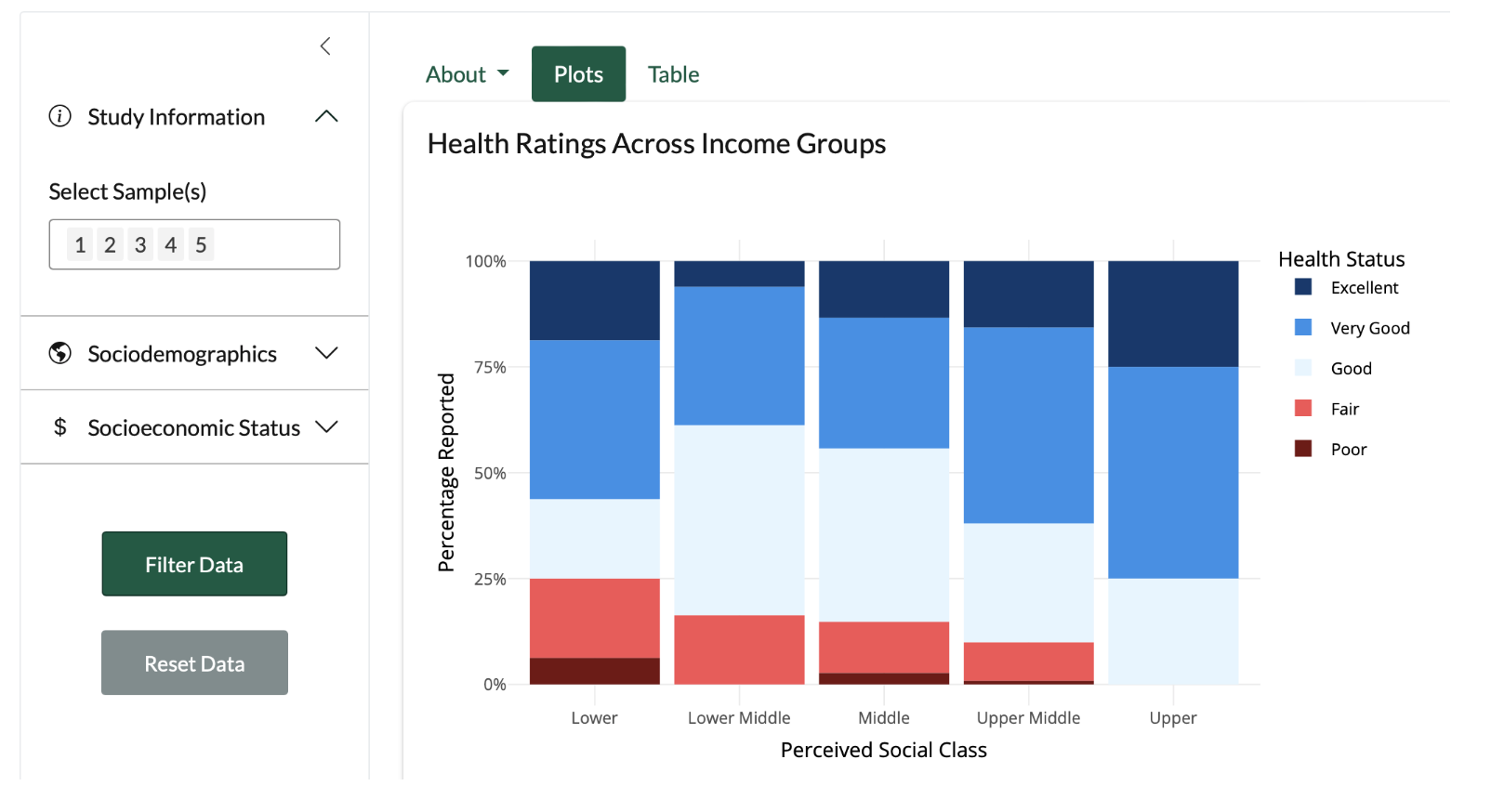
In an independent study, Andrew Silhavy and Zach Spiegel developed shiny web-based applications to visualize health data and inequality.
Health Status Explorer : Examine the health status of 300+ people
U.S. Inequality Quiz : Take a quiz and view results of U.S. wealth inequality